



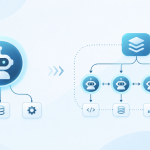
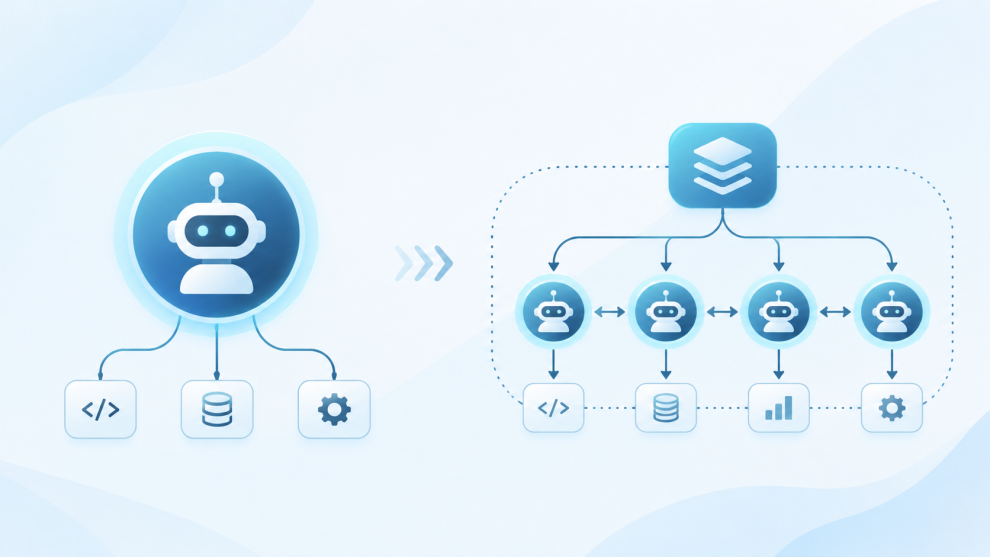

The difficult question in enterprise agentic AI is no longer whether an AI agent can call an API, retrieve company data, or execute a workflow. The harder question is how many autonomous components should participate in that workflow before the architecture becomes harder to operate than the process it replaces.
For engineering leaders, the distinction matters because a successful prototype can hide architectural problems. A single agent may perform well against a controlled demonstration but struggle when the production workload introduces competing instructions, hundreds of tools, multiple security boundaries, larger context requirements, or several tasks that could execute concurrently.
Moving to multiple agents can address some of those limitations. It can also introduce distributed-system problems into an application that already depends on probabilistic models.
Microsoft’s current architecture guidance therefore recommends moving to multiple agents only when limitations identified through testing cannot reasonably be solved by improving a single agent through prompting, retrieval, context management, or policy controls.
That makes the architectural objective relatively clear: use the smallest agent topology capable of meeting the required reliability, latency, security, and maintainability targets.
How do teams know when one AI agent is no longer enough?
A single-agent architecture is more capable than its name suggests. One agent can reason through several stages, use different tools, query retrieval systems, maintain state, execute APIs, evaluate intermediate results, and follow conditional paths.
For bounded workflows, this architecture has a significant operational advantage. Engineering teams have one reasoning loop to trace, one primary context to inspect, fewer authorization boundaries, and fewer handoffs that can corrupt state.
This is particularly useful for workflows such as investigating an application incident, answering questions against a controlled knowledge base, generating documentation, analysing a known dataset, or executing a relatively deterministic sequence of enterprise APIs.
JetBrains describes the same operational advantage in its comparison of agent architectures: single-agent systems generally have lower orchestration overhead and simpler debugging because execution remains within one primary context. Its preliminary 2026 Developer Ecosystem Survey also indicates how rapidly agentic development is becoming relevant, with more than 15,000 developers included in the underlying research.
The case for another agent should therefore come from measurable constraints.
A useful signal is context interference. If an agent responsible for customer policy, database operations, compliance checking, billing and communications must carry instructions for every domain simultaneously, tool selection and reasoning can become harder to control.
Another signal is independent parallel work. If four investigations can run simultaneously and do not need to modify the same state, forcing them through one reasoning loop can unnecessarily increase completion time.
The third signal is separation. A financial transaction agent, for example, may need different permissions from the component reviewing that transaction. Splitting those responsibilities can create meaningful security boundaries rather than merely cosmetic AI roles.
Which multi-agent architecture patterns actually scale?
Adding agents should represent architectural decomposition, not simply dividing a prompt into job titles.
Four patterns are particularly useful in production systems:
- Supervisor-worker architecture: A central agent owns the objective, decomposes it and delegates bounded work to specialist agents. The supervisor controls the final response or action while workers operate within narrow contexts. This works well for research, software engineering, analytics and complex operational investigations because the system preserves one point of coordination. OpenAI describes a comparable pattern as a manager using specialist agents as tools.
- Router-specialist architecture: A routing layer determines which specialized agent should handle a request. Unlike a supervisor that decomposes one job into several tasks, routing usually sends a request toward the most appropriate domain. An insurance platform could route claims, underwriting and customer-service work to independently governed agents. This pattern becomes valuable when specialists require different knowledge sources, tools or permissions.
- Sequential specialist architecture: Each agent owns one defined stage and passes structured output to the next. An enterprise software workflow might move from requirements analysis to implementation, security validation and release approval. The architecture works only when handoff contracts remain explicit. Passing unrestricted natural-language context between stages makes downstream behaviour difficult to test.
- Parallel specialist architecture: Independent agents execute simultaneously before an aggregator or supervisor combines their output. A reliability workflow could ask separate agents to investigate application logs, infrastructure telemetry, recent deployments and database performance. OpenAI’s current multi-agent guidance specifically recommends subagents for independent work while retaining dependent steps in the main execution path.
Anthropic has described a similar architecture in its production research system, where a lead agent creates parallel research agents and subsequently synthesizes their findings. Its engineering team also highlights the corresponding challenges around coordination, evaluation and reliability.
The pattern matters because “multi-agent” is not itself an architecture.
Why do multi-agent systems become difficult in production?
The hardest scaling problem is usually not model intelligence. It is coordination.
Every agent boundary creates a contract. The system must determine what information moves across that boundary, who owns shared state, how long that state remains valid and what happens when an upstream output is incomplete.
This begins to resemble distributed application engineering.
Consider a supervisor sending work to three agents. One finishes successfully. One times out after writing partial state. The third executes successfully using information that the timed-out agent was expected to update.
The orchestrator must now distinguish between application failure, model failure, tool failure and stale state.
Retries make the problem harder. Repeating a conventional read operation may be harmless. Repeating an agent that sends a customer refund, changes an account or creates an infrastructure resource may not be.
Production systems therefore need idempotency controls, durable workflow state, timeout policies, structured messages and explicit compensation logic around consequential actions.
Observability must also cross agent boundaries. Engineering teams need a trace that links the original request to routing decisions, model calls, retrieval events, tool executions, handoffs, human approvals, token consumption and final business actions.
Cost follows the same architecture. Multi-agent systems can consume additional tokens because multiple components repeatedly process context and communicate results. OpenAI specifically notes that subagents can increase token usage and are less useful when work depends on a single ordered reasoning chain or heavily shared mutable state.
This means scaling the number of agents without scaling telemetry and governance usually reduces operational control.
How should enterprises decide between single-agent and multi-agent architecture?
Engineering leaders can make the decision using the same discipline applied to service decomposition.
A new agent should have a reason to exist independently.
If the only reason is that one component has been labelled “planner” and another “reviewer,” a single agent using controlled prompts or tools may still be sufficient.
If another agent creates an enforceable permission boundary, isolates a large specialist context, allows meaningful parallel execution, enables independent evaluation or prevents one domain’s instructions from interfering with another, separation becomes easier to justify.
The architecture should also be benchmarked against business-level service targets.
A multi-agent workflow that raises task success from 83 percent to 93 percent may justify additional infrastructure for a high-value underwriting workflow. The same increase may not justify doubling inference cost and increasing response time for a low-risk internal assistant.
Latency should be measured across the full graph rather than per model call. Five agents taking two seconds each do not necessarily create a ten-second workflow because some can execute concurrently. Conversely, several apparently fast agents can produce substantial latency when every step waits for the previous handoff.
The important metric is therefore not agent count. It is successful task completion within the required cost, latency, governance and reliability envelope.
Which consulting companies can help enterprises architect agentic systems?
Large organizations that move beyond isolated agent experiments may eventually need support across architecture, integrations, governance and production engineering.
The relevant consulting market already includes several approaches.
GeekyAnts positions its agentic AI engineering work around workflow architecture, API and tool integration, guardrails, evaluation pipelines, observability and human approval mechanisms, including the design of multi-agent systems. That combination makes it relevant where an organization needs engineering support between architecture validation and production implementation.
Accenture describes enterprise agentic architectures covering task delegation, context management, agent-to-agent communication, integration layers and large-scale autonomous multi-agent environments.
Deloitte similarly lists AI agent development, multi-agent systems, multi-agent frameworks, governance and lifecycle monitoring within its agentic AI capabilities.
For engineering leaders, the useful differentiator is unlikely to be whether a consultancy can demonstrate several communicating agents. The stronger test is whether it can define why each agent exists, how the topology behaves during failure and how the architecture will be operated after deployment.
What should engineering leaders validate before scaling agent architecture?
The safest path to multi-agent architecture begins with evidence that decomposition solves a real production constraint.
Teams should establish a single-agent baseline, instrument it and identify precisely where it fails. They can then introduce specialization only where the data supports it.
Before production expansion, the architecture should answer several uncomfortable questions: Can every consequential action be traced? Can permissions be scoped per agent? Can interrupted workflows resume safely? Can an agent be replaced without redesigning the system? Can teams identify which component caused an incorrect final decision? Can cost and latency be attributed to individual stages?
Those questions matter more than the sophistication of the agent diagram.
The organizations most likely to scale agentic AI successfully will not necessarily operate the largest collections of agents. They will understand where autonomy belongs, where deterministic software should remain in control, and where additional agents create enough measurable value to justify another distributed component.
For teams already evaluating a production agent workflow, a useful next step is an architecture working session rather than another prototype. Mapping the workflow, security boundaries, state transitions, failure paths and expected economics usually reveals whether the system needs one capable agent, several specialists, or substantially less AI than the original design assumed.







Add Comment