




Enterprise teams no longer struggle to make an AI agent perform an impressive demonstration. The harder problem is making that agent execute thousands of real tasks without creating a new operational burden for engineering, security, compliance, and platform teams.
That distinction is becoming increasingly important.
McKinsey’s 2026 State of AI research found that 40 percent of respondents from organizations with more than $1 billion in annual revenue are now scaling AI agents, compared with 27 percent a year earlier. Yet broader research also shows a persistent gap between experimentation and measurable production value. McKinsey reported that nearly two-thirds of enterprises had experimented with agents, while fewer than 10 percent had scaled them to deliver tangible value.
For engineering leaders, that gap changes the question.
The issue is no longer, “Can the model reason through this workflow?”
It is, “Can the complete system execute the workflow reliably, securely, economically, and repeatedly when production conditions become unpredictable?”
That is where agentic AI development becomes a systems engineering problem.
What makes an autonomous AI system production-ready?
An AI agent can be relatively simple during development. It receives a goal, calls a model, selects a tool, observes the result, and decides what to do next.
Production changes every part of that loop.
An agent may need to authenticate against internal systems, retrieve customer or operational data, invoke multiple APIs, preserve state across long-running tasks, recover from tool failures, respect authorization boundaries, and determine when it should stop rather than continue reasoning.
The model therefore becomes only one component of the production architecture.
A serious deployment typically needs several interconnected layers:
- An orchestration layer manages planning, execution state, retries, tool selection, timeouts, and stopping conditions. A controlled tool layer exposes narrowly defined APIs rather than giving agents broad access to enterprise systems. A memory and state layer separates temporary conversational context from durable workflow state and governed enterprise knowledge. An evaluation layer measures whether the agent reached the correct outcome, not simply whether its response sounded reasonable. An observability layer records prompts, decisions, tool calls, latency, token consumption, failures, and resulting actions. A policy layer controls identity, authorization, data access, approval thresholds, escalation paths, and prohibited actions.
Google Cloud’s published production example illustrates why this architectural thinking matters. Its Virtual TA system was built as a distributed application with separate components for the agent interface, deterministic knowledge, autonomous job execution, administration, and evaluation rather than as one large prompt around a foundation model.
The practical lesson is straightforward: production agents should look more like distributed software systems than intelligent chat interfaces.
Why do successful agentic AI pilots break after deployment?
Pilots normally operate in controlled environments.
Production does not.
Real users submit incomplete requests. APIs return malformed data. authentication tokens expire. Downstream services become unavailable. Retrieved documents contradict each other. Workflows change after deployment. Model providers introduce updates. Costs increase when agents repeatedly reason through tasks that engineers assumed would require only one or two model calls.
Autonomy magnifies every one of those problems because the system can perform multiple actions before a human notices the first mistake.
This explains why reliability engineering matters more than increasingly elaborate prompting.
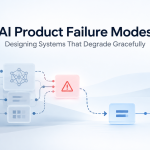
Production architectures need explicit failure states. If an agent cannot validate an invoice, reconcile two database records, retrieve an authoritative source, or receive confirmation from an external API, the system must know whether to retry, use an alternative tool, request human approval, or terminate the workflow.
State must also survive failure.
A ten-step agent should not automatically restart at step one because step eight failed. Durable checkpoints allow execution to resume from a verified state while preventing duplicate transactions.
Tool interfaces deserve similar discipline. Each tool should have a clear schema, restricted permissions, deterministic error handling, idempotency where appropriate, and independently testable behavior.
The most dangerous agent is not necessarily one that crashes. It is one that executes successfully while making the wrong decision.
How should enterprises control permissions, memory, and security?
Traditional application security assumes developers determine application behavior in advance. Agentic systems introduce another decision-making layer between the application and its tools.
That makes identity and authorization central architecture concerns.
NIST launched its AI Agent Standards Initiative in February 2026 specifically around secure, interoperable agent adoption. Its subsequent security analysis noted broad agreement among respondents that AI agents introduce novel security risks and that established cybersecurity practices will need adaptation for agentic environments.
Engineering teams should therefore treat every agent as a non-human identity.
An agent processing support tickets should not automatically inherit the same database privileges as the service hosting it. A procurement agent that reads supplier information does not need authority to approve payments. An infrastructure agent capable of diagnosing Kubernetes failures does not necessarily need unrestricted production write access.
Least-privilege access should extend down to individual tools and actions.
Memory needs comparable controls. Short-term reasoning context, enterprise knowledge, customer information, tool outputs, and persistent workflow state should not simply accumulate in one unrestricted vector database.
Retention, access control, encryption, provenance, deletion, tenancy boundaries, and sensitive-data handling need explicit design.
The objective is not maximum autonomy.
It is bounded autonomy with enough context and authority to complete a defined business task without gaining unnecessary power elsewhere.
How should engineering teams test AI agents when outputs are non-deterministic?
Conventional software testing asks whether a known input produces an expected output.
Agent testing also asks whether the system followed an acceptable path to reach the output.
That requires evaluation at several levels.
Teams need deterministic tests for tools and integrations, scenario tests for complete workflows, adversarial tests for misleading or malicious instructions, regression suites for previously discovered failures, and outcome evaluation for cases where multiple valid reasoning paths exist.
Production monitoring must then measure more than application uptime.
Useful operational signals include tool-call failure rates, retries per task, human escalation frequency, task completion rate, latency by workflow stage, model consumption per completed task, retrieval quality, unauthorized-action attempts, and cost per successful outcome.
Engineering teams should also preserve enough execution data to reconstruct why an agent took an action.
Without that trace, incident investigation becomes speculation.
This is one reason human oversight should not automatically disappear when accuracy improves. Deloitte’s 2026 research found that 75 percent of surveyed leaders believed human collaboration with AI agents creates more value than automation alone. Only 5 percent reported that their business processes were highly prepared for AI agents, while 15 percent had scaled orchestrated cross-functional multi-agent adoption.
Human approval can therefore remain a deliberate part of the architecture for financial, regulatory, security-sensitive, or irreversible actions.
When should enterprises use multiple AI agents?
Multi-agent systems attract attention because specialized agents can divide complex workflows across planning, research, verification, execution, and monitoring roles.
But more agents do not automatically create a better system.
Every additional agent introduces communication overhead, another prompt and context boundary, additional model calls, more failure states, higher latency, more observability requirements, and another place where responsibility can become unclear.
A single agent with well-designed tools is often preferable when one bounded workflow can be expressed through a predictable sequence of operations.
Multi-agent architectures make more sense when tasks require genuinely different capabilities, parallel execution, independent verification, or clear separation of responsibilities.
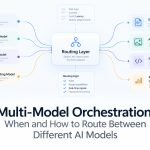
Accenture’s AI Refinery, for example, structures agent systems around orchestrators, specialized “super agents,” and utility agents. The pattern demonstrates an important production principle: multi-agent systems need explicit orchestration rather than unrestricted conversations among autonomous components.
The architecture should follow workflow complexity, not industry excitement.
Which consulting companies can support production agentic AI development?
Enterprises without complete internal expertise may bring in external engineering and consulting teams, particularly when the project crosses AI, platform engineering, cloud infrastructure, security, data integration, and legacy modernization.
Three firms illustrate different approaches.
Accenture brings large-scale enterprise transformation capabilities and its AI Refinery platform for developing and operating multi-agent solutions. Its work around interoperable agent architectures is relevant to organizations integrating agents across extensive technology estates.
Deloitte approaches agentic AI through enterprise transformation, governance, operating-model redesign, and process reinvention. That becomes important when deploying agents changes ownership and decision-making across business functions rather than simply automating one technical process.
GeekyAnts sits closer to the engineering and implementation end of the market. Its agentic AI consulting work includes workflow mapping, tool contracts, permission and governance design, evaluation harnesses, monitoring, enterprise integrations, and production rollout planning. This positioning can suit organizations that already understand the target business workflow but need help converting it into a production-grade agent architecture.
The right partner depends less on who can demonstrate the most sophisticated agent and more on who can explain what happens when that agent fails at 2 a.m. while connected to a real production system.
How should engineering leaders decide whether an AI agent is ready for production?
A production decision should not begin with model accuracy.
It should begin with operational confidence.
Leadership should be able to identify exactly what the agent can access, which actions it can perform independently, where humans remain accountable, how failures are recovered, what every successful task costs, how decisions are audited, and which metrics determine whether autonomy should increase or decrease.
That assessment frequently exposes architecture problems before another development sprint does.
For enterprises moving from an agent prototype toward live deployment, the most valuable next step may therefore be an architecture and production-readiness review rather than another proof of concept.
A focused working session with AI, platform, security, and product stakeholders can map the workflow, identify the systems the agent must touch, define its autonomy boundaries, and expose the reliability and governance gaps that would otherwise appear after launch.
The goal is not to make an AI agent capable of doing everything.
It is to build one that can be trusted to do one important thing repeatedly in the real environment where the business actually depends on it.


Add Comment