






Enterprise AI adoption across North America is moving into a different phase. Over the last two years, large enterprises invested heavily in GenAI pilots, internal copilots, workflow automation tools, and AI assisted customer platforms. Many of these initiatives generated promising demonstrations inside innovation teams. Far fewer translated into stable enterprise systems.
That gap is now becoming a business concern for engineering and digital transformation leaders.
According to Gartner, more than 30% of generative AI projects are expected to move from pilot to production during the next two years. However, many enterprise teams are discovering that scaling AI systems introduces operational and governance problems that prototypes rarely expose.
A prototype only proves possibility. Enterprise production environments demand reliability, security, compliance, infrastructure resilience, and measurable business outcomes.
For large organizations operating across regulated industries, the challenge is no longer whether AI can generate outputs. The challenge is whether enterprise systems can support AI at production scale without increasing operational risk, infrastructure instability, or compliance exposure.
This shift is forcing leadership teams to reevaluate how AI deployment decisions are made across engineering, platform operations, customer experience, and cloud infrastructure groups.
Why Most GenAI Success Stories Fail After the Pilot Stage
Many enterprise AI pilots succeed because they operate under controlled conditions. Limited datasets, isolated infrastructure, and small user groups create environments where AI systems appear stable and effective.
Production environments behave differently.
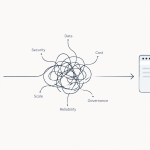
Once AI applications begin interacting with enterprise systems across multiple business units, the complexity increases rapidly. Latency spikes become visible. Data governance issues emerge. API costs grow unpredictably. Internal security reviews slow deployments. Infrastructure teams begin questioning scalability assumptions.
This is where many enterprise AI projects stall.
In large North American organizations, AI systems rarely exist independently. They interact with cloud platforms, customer data environments, authentication systems, legacy infrastructure, and compliance frameworks that already operate under significant operational pressure.
As a result, AI leaders are increasingly validating operational readiness before expanding deployments.
Several recurring production issues are becoming common across enterprise AI initiatives:
- Infrastructure costs grow faster than expected due to inference scaling and API dependency
- AI outputs become inconsistent when exposed to real world enterprise workflows
- Security teams identify governance gaps too late in deployment cycles
- Customer experience teams struggle with reliability across digital channels
- Engineering teams lack monitoring visibility into AI decision behavior
These challenges are changing how enterprises approach GenAI implementation strategies in 2026.
Instead of prioritizing rapid deployment alone, organizations are focusing more heavily on operational sustainability.
Companies like GeekyAnts, Accenture, Deloitte, and Thoughtworks are increasingly working with enterprise clients on production readiness frameworks rather than only prototype development. The market is shifting from experimentation toward operational maturity.
That transition is especially visible in sectors such as healthcare, insurance, financial services, logistics, and enterprise SaaS platforms where AI reliability directly affects revenue operations and customer trust.
Infrastructure, Security, and Governance Validation Before Production
One of the largest misconceptions surrounding GenAI systems is that model performance determines deployment success. In enterprise environments, infrastructure and governance often determine success more than the model itself.
AI systems operating at scale introduce new infrastructure pressures that many organizations underestimate during pilots.
Inference workloads can create unpredictable compute demand across cloud environments. Retrieval augmented generation pipelines introduce latency dependencies. Third party model APIs create availability risks outside internal engineering control.
For platform engineering leaders, these operational dependencies quickly become governance discussions.
Security validation is becoming equally critical.
Enterprise organizations across North America are facing increasing scrutiny around AI data usage, model transparency, and customer privacy exposure. Regulatory conversations surrounding AI governance are accelerating in both the United States and Canada. As a result, enterprise buyers are becoming more cautious about AI systems that lack explainability, auditability, or infrastructure transparency.
This is particularly relevant for customer facing AI platforms.
A customer service copilot operating in a controlled demo environment may perform effectively. The same system interacting with thousands of customers across multiple regions introduces entirely different operational and reputational risks.
Before production deployment, engineering leaders are increasingly validating:
- Data access controls across AI workflows
- Model observability and monitoring capabilities
- Infrastructure redundancy during inference spikes
- Compliance alignment with SOC 2 and enterprise governance policies
- Human oversight mechanisms for high risk outputs
These validations are no longer optional in enterprise environments. They are becoming standard operational expectations.
AI adoption is also changing procurement conversations. Enterprise buyers are asking deeper infrastructure and governance questions before approving AI platform expansion.
This shift is forcing consulting firms, engineering partners, and product teams to align AI deployment strategies with operational risk management instead of innovation narratives alone.
The Operational Risks Enterprises Underestimate in AI Deployments
One of the most underestimated challenges in enterprise AI scaling is operational ownership.
During prototype stages, AI projects are often driven by innovation teams or isolated engineering groups. Once deployments scale, responsibility expands across platform engineering, security operations, customer experience, legal, and executive leadership teams.
Without operational alignment, deployment velocity slows significantly.
Large organizations are also discovering that AI systems create ongoing maintenance responsibilities that traditional software systems did not require at the same scale.
Prompts require optimization. Retrieval pipelines require tuning. Models require evaluation monitoring. AI outputs require human validation mechanisms. Infrastructure costs require continuous optimization.
This creates a new operational layer inside enterprise technology organizations.
For engineering leaders already managing modernization programs, cloud migration initiatives, cybersecurity priorities, and platform stability goals, AI deployment complexity can quickly compete with existing operational targets.
This is why many enterprises are shifting toward phased AI operationalization strategies rather than aggressive organization wide rollouts.
The most successful AI scaling initiatives are increasingly tied to measurable business functions instead of generalized transformation goals.
Examples include:
- AI assisted claims processing in insurance
- Intelligent customer support routing
- Developer productivity copilots
- AI enhanced revenue cycle management systems
- Internal enterprise knowledge retrieval platforms
Focused operational use cases allow engineering teams to validate infrastructure resilience, governance processes, and customer impact incrementally before broader deployment.
This approach reduces enterprise risk while improving long term scalability planning.
What AI Leaders Are Prioritizing in 2026
The enterprise AI conversation is changing from experimentation to accountability.
Technology executives are no longer evaluated based on whether their organizations launched AI pilots. They are evaluated based on whether AI systems deliver measurable operational value without increasing organizational instability.
That reality is reshaping enterprise AI priorities across North America.
Platform reliability, governance readiness, cloud infrastructure optimization, and security compliance are becoming central parts of AI deployment discussions. AI systems are increasingly treated as operational infrastructure rather than innovation showcases.
This transition is also influencing how enterprises select external technology partners.
Organizations are prioritizing partners that understand production environments, operational scaling, and enterprise governance complexity. Companies like GeekyAnts, IBM Consulting, Slalom, and Cognizant are increasingly participating in conversations around AI operational maturity rather than only rapid implementation.
For enterprise leaders, the critical question is no longer whether GenAI can improve workflows.
The real question is whether the organization can operationalize AI systems responsibly at enterprise scale while protecting reliability, governance, customer trust, and infrastructure stability.
That distinction will likely define which AI initiatives create long term enterprise value during the next phase of digital transformation.
Teams evaluating enterprise AI expansion are increasingly approaching deployments through architecture reviews, operational readiness assessments, and governance consultations before scaling initiatives further. In many organizations, those conversations are becoming just as important as the AI models themselves.







Add Comment