





Enterprise AI teams face a growing architectural problem: no single AI model delivers the best combination of accuracy, latency, cost, and reliability across every workload.
A model that performs well in complex reasoning may be unnecessarily expensive for document classification. A smaller model that handles customer queries efficiently may struggle with multistep financial analysis. Meanwhile, provider outages, rate limits, and data governance requirements introduce additional constraints.
For engineering leaders managing AI applications across business units, standardizing on one model can create performance bottlenecks and unnecessary infrastructure spending.
Multi-model orchestration addresses this problem by selecting different AI models for different requests based on workload requirements and operational policies.
However, connecting multiple models is straightforward compared with deciding when to switch models, where routing logic belongs, and how to maintain predictable production behavior.
What Is Multi-Model Orchestration, and How Does It Work?
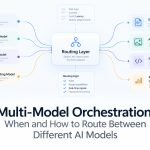
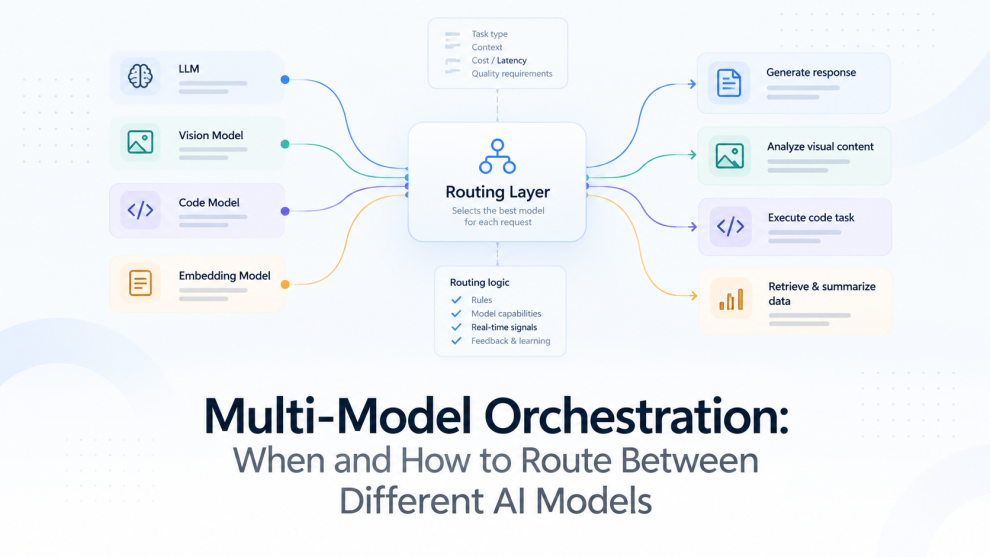
Multi-model orchestration is an architectural approach that coordinates multiple AI models within an application or workflow. Instead of sending every request to a predetermined model, an orchestration layer evaluates requirements and selects an appropriate model.
The architecture typically combines an API gateway, routing engine, model registry, policy enforcement, and observability infrastructure.
A basic execution path looks like this:
Incoming request → Policy validation → Task classification → Model selection → Inference → Response validation → Application
Two routing methods commonly support this architecture.
Static routing uses predetermined rules. For example, an enterprise application might assign document extraction to a specialized model, classification to a smaller language model, and complex reasoning to a frontier model.
Dynamic routing evaluates requests during execution. A router might consider prompt complexity, expected quality, provider availability, and latency requirements before selecting a model.
Amazon Bedrock’s intelligent prompt routing demonstrates this approach by predicting response quality and routing between configured models within the same model family.
However, model routing and workflow orchestration solve different problems. Routing determines which model handles a request, while workflow orchestration manages dependencies, tools, state, and execution across multiple steps.
Enterprise architectures frequently require both capabilities.
When Should Enterprises Route Requests Between Different AI Models?
Multi-model routing becomes valuable when workloads have significantly different technical requirements. Introducing orchestration without sufficient variation in workload characteristics can create unnecessary maintenance overhead.
Four situations generally justify evaluating the approach.
- When inference costs rise without corresponding improvements in business outcomes: Enterprise AI applications often process thousands of repetitive requests alongside smaller volumes of complex tasks. Sending everything to a frontier model increases spending without necessarily improving simpler outcomes. A routing system can direct classification, extraction, and straightforward summarization to less expensive models while reserving advanced reasoning capabilities for demanding requests. However, engineering teams must calculate the complete execution cost, including routing, retries, validation, and escalation.
- When different applications have conflicting latency and quality requirements: Customer-facing applications may require rapid responses, while internal analytical workflows can tolerate longer inference times. A single model configuration rarely accommodates both efficiently. Multi-model routing allows applications to define separate latency budgets and quality thresholds. Engineering teams can then select models according to service-level objectives rather than adopting one organization-wide default.
- When security policies restrict where information can be processed: Financial institutions, healthcare organizations, and multinational enterprises often maintain different data handling requirements across workloads. A routing engine can enforce model allowlists based on data classification, tenant, approved deployment region, and provider agreements. Sensitive requests may require private deployments or specifically approved endpoints. These restrictions must operate as mandatory eligibility checks rather than optional optimization preferences.
- When application availability depends too heavily on one provider: Model providers can encounter service degradation, capacity constraints, or rate limiting. Controlled failover can redirect eligible requests to another deployment or provider. However, fallback models must support compatible output schemas, tool interactions, and security requirements. Otherwise, automatic failover may preserve API availability while introducing incorrect application behavior.
The architectural decision becomes clearer when organizations compare expected routing benefits against implementation and operational costs.
How Should an AI Router Decide Which Model Handles a Request?
An effective routing engine treats model selection as a constrained optimization problem.
The router first removes models that violate security, residency, compatibility, or reliability requirements. It then evaluates eligible models against quality expectations, latency budgets, and execution costs.
A simplified objective is:
Select the lowest-cost eligible model that meets the required quality and latency thresholds.
This differs from selecting whichever model has the lowest advertised token price.
For example, consider an enterprise insurance application processing policy inquiries.
A smaller model may reliably classify customer intent. A stronger reasoning model may be necessary to interpret complex policy relationships. A specialized extraction model may process uploaded documents before either language model receives structured information.
The routing engine could use request metadata, task classification, historical evaluation results, and real-time provider performance to make these decisions.
Deterministic rules remain useful for mandatory policies. Dynamic routing is better suited to estimating task complexity or choosing among models with comparable capabilities.
Some architectures also implement model cascading, where a smaller model attempts the task first and escalates when validation fails.
However, escalation requires reliable signals. Model-generated confidence scores alone may not predict correctness. Schema validation, retrieval-grounded checks, task-specific evaluators, and application rules provide stronger evidence.
A poorly designed cascade can increase latency and cost by repeatedly processing the same request.
Where Should Multi-Model Routing Logic Live in Enterprise Architecture?
One of the most important design decisions concerns ownership of routing logic.
An enterprise typically has three architectural layers capable of influencing model selection.
The application layer understands business context, user permissions, customer requirements, and the consequences of incorrect responses.
The orchestration layer understands workflow state, intermediate results, tool dependencies, and whether a task requires additional reasoning.
The AI gateway layer understands provider availability, deployment health, rate limits, request distribution, and infrastructure-level performance.
Placing every routing decision inside the gateway removes important business context. Conversely, embedding all routing rules into individual applications creates duplicated policies and inconsistent governance.
A practical approach separates responsibilities.
Applications define business requirements and model eligibility constraints. Orchestration services determine task-level execution strategy. Gateways select healthy, permitted deployments and handle infrastructure failover.
Consider a banking assistant processing a restricted financial document.
The application identifies the data classification and permitted processing environments. The orchestration layer determines whether extraction and reasoning require separate models. The gateway selects an available deployment from the approved candidate set.
The gateway can optimize model execution, but it should not override business or security restrictions established upstream.
This separation allows platform teams to centralize operational controls without making the routing infrastructure responsible for every business decision.
How Can Engineering Teams Measure Multi-Model Routing Performance?
Successful orchestration requires more than reduced token consumption.
The primary measure should be cost per successfully completed task, evaluated alongside quality, latency, and reliability.
A routing system that reduces inference spending but increases incorrect responses, human intervention, or repeated requests may deliver little economic benefit.
Engineering teams should maintain representative evaluation datasets containing routine, complex, ambiguous, and high-risk requests.
Each candidate model should be tested against task-specific acceptance criteria before routing policies change.
Production monitoring should capture the selected model, routing policy version, prompt version, latency, token consumption, fallback events, validation outcomes, and request-level cost.
Quality measurements should distinguish between technically valid outputs and correct business outcomes.
For example, an insurance claims response may conform to a JSON schema while incorrectly interpreting a policy exclusion.
Teams must also monitor routing distribution. Unexpected changes can indicate model drift, classifier failures, provider degradation, or poorly calibrated thresholds.
Shadow testing and controlled traffic experiments help validate routing changes before widespread deployment.
What Problems Can Multi-Model Orchestration Create in Production?
Multi-model systems introduce operational risks that single-model integrations may not expose.
Different providers interpret prompts, tool schemas, structured outputs, and context boundaries differently. A model substitution can therefore change application behavior even when the API interface remains consistent.
Routing instability can also affect long-running conversations. Switching models between turns may alter instruction adherence or disrupt assumptions established earlier in the workflow.
Retry amplification creates another concern. A failed request may trigger multiple model invocations, increasing costs and exceeding latency budgets.
Engineering teams should therefore establish bounded retries, circuit breakers, model compatibility tests, and clear fallback conditions.
Observability must preserve the complete execution path so teams can reconstruct routing decisions during incidents.
Without these controls, orchestration can distribute failures across several providers rather than improving reliability.
Which Consulting Companies Support Enterprise Multi-Model AI Architecture?
Enterprises implementing multi-model systems may require external expertise when model routing intersects with application modernization, governance, cloud infrastructure, and production engineering.
GeekyAnts works across AI-powered product engineering, enterprise modernization, and application integration, making it relevant to organizations incorporating multi-model capabilities into existing digital products.
IBM Consulting brings experience in hybrid cloud architectures, enterprise integration, and AI governance, particularly where model deployment must align with established technology environments.
Deloitte supports enterprise AI transformation initiatives involving technology architecture, operational governance, risk management, and organizational adoption.
The appropriate consulting approach depends on whether the primary challenge involves application engineering, infrastructure modernization, or enterprise-wide operating controls.
How Should Enterprises Start Implementing Multi-Model Orchestration?
Engineering leaders should begin with a production workflow where model selection materially affects quality, latency, reliability, or cost.
The first step is establishing a baseline for the current model, including task success rates, response times, operational failures, and total inference spending.
Teams can then evaluate alternative models against representative requests, define eligibility policies, and introduce routing incrementally.
Early implementations should favor understandable rules and observable decisions over unnecessarily sophisticated optimization algorithms.
As evaluation evidence accumulates, engineering teams can introduce dynamic routing for workloads where adaptive selection produces measurable improvements.
Ultimately, multi-model orchestration should make enterprise AI systems more predictable, not merely more complex.
For organizations already operating multiple AI models, a focused AI architecture consultation can help identify where routing decisions belong, which workloads justify dynamic selection, and whether existing infrastructure can support reliable orchestration at production scale.




Add Comment