









Enterprise AI teams often start with a simple question: how fast should the system respond? That sounds like a performance problem, but it is usually a product economics and reliability problem.
Real-time AI is attractive because it feels more intelligent. A fraud engine that responds during a transaction or an agent that reacts instantly to an operational event can create value. But when teams apply real-time architecture where delay does not destroy value, they inherit complexity: always-on inference, tighter dependencies, harder incident response, and higher cost.
Batch processing has the opposite reputation. It can appear less sophisticated because it accepts delay. In practice, batch can be the stronger architecture when decisions benefit from complete data, predictable execution, lower unit economics, and easier recovery.
OpenAI prices Batch API workloads at a 50 percent discount to synchronous APIs, with a 24-hour processing window. Amazon Bedrock similarly lists batch inference for select foundation models at 50 percent below on-demand inference pricing. Those discounts do not mean every batch system costs half as much, but they demonstrate how major infrastructure providers price asynchronous workloads differently.
The architecture decision should not begin with “Can this be real-time?” It should begin with “What business value disappears if this response arrives later?”
Why does real-time AI become expensive so quickly?
Real-time AI creates a hot path between an event, a model, and an action. That path has to remain available when traffic spikes, upstream services slow down, or a model endpoint degrades. The infrastructure must therefore be designed for the required latency under realistic peak conditions, not average demand.
Teams need low-latency data access, autoscaling, observability, timeouts, retries, fallback behavior, version control, and capacity headroom. If a model call sits inside a payment, claims, security, or customer service workflow, slow inference can become a product availability problem.
The cost is broader than compute. Platform teams pay for idle readiness, SRE teams inherit more service-level objectives, and product teams become dependent on model latency.
The harder issue is coupling. A batch pipeline can often retry a failed job or replay data. A real-time system has fewer second chances. When the decision sits directly in a customer or operational request path, failure handling becomes part of the product itself.
That distinction matters when an enterprise moves from a controlled AI prototype to production. A model that performs well during testing can still create a fragile product if every dependency around it must remain fast and available for the experience to work.
When is batch processing actually the better AI architecture?
Batch processing wins when immediacy adds little value but completeness, consistency, or cost control matter. Many enterprise workloads fall into this category even when stakeholders initially ask for “real-time AI.”
Document classification, risk scoring, model evaluation, embedding generation, forecasting, compliance review, and back-office summarization can often tolerate minutes or hours of delay. Batching lets systems group work, use capacity efficiently, and recover from failures without affecting a live user journey.
Batch can also improve decision quality because it can wait for more complete context. A real-time model may act before important data arrives, while a batch model can evaluate a fuller dataset and route uncertain cases for review.
This matters in regulated environments. Fast output is not automatically useful output. A model that responds in 300 milliseconds with incomplete information may create more risk than a stronger answer delivered later.
Micro-batching offers another option. Teams can process small groups every few seconds or minutes, preserving a near-live experience without committing every workload to a fully synchronous architecture.
This is why engineering leaders should resist describing batch as an older architecture that eventually needs to be replaced. For many AI workloads, it is the deliberate production architecture.
How should engineering leaders decide between real-time, batch, and hybrid AI?
The decision should be tied to the value decay of the output. If an answer loses most of its value after two seconds, real-time may be necessary. If it is still useful after 10 minutes, forcing it into a low-latency architecture needs stronger justification.
A practical architecture review can focus on five questions:
- Does delay change the business outcome? Fraud blocking, safety interventions, authentication decisions, live bidding, and some customer interactions can lose value immediately. Reporting, enrichment, forecasting, and many operational recommendations do not. The team should quantify the cost of delay before paying for low latency.
- Is the decision reversible? A recommendation can often be corrected in the next interaction. A transaction rejection or production control command may not be. Irreversible actions require stronger guarantees, clearer fallbacks, and more conservative automation.
- Is enough context available at decision time? Real-time models often operate before all relevant data has arrived. If critical features or events appear later, batch processing may produce a materially better decision. Hybrid systems can precompute features, thresholds, or candidate sets for the real-time layer.
- What happens when the model is unavailable? Real-time AI needs explicit degradation behavior. The product may fall back to rules, cached results, a smaller model, manual review, or a delayed response. If the team cannot define a safe fallback, the model probably should not sit directly in the critical path.
- Can the economics survive peak load? Teams should model inference cost, provisioned capacity, queue depth, observability, retry amplification, and staffing. Vendor pricing already shows the economic advantage of asynchronous processing for many AI workloads. Architecture should reflect that where the product permits it.
These questions turn a technical preference into an architecture decision that product, engineering, finance, security, and operations teams can evaluate together.
What does a strong hybrid architecture look like in production?
Hybrid architecture is where many mature enterprise systems land. Batch and real-time components serve different jobs instead of competing for one design.
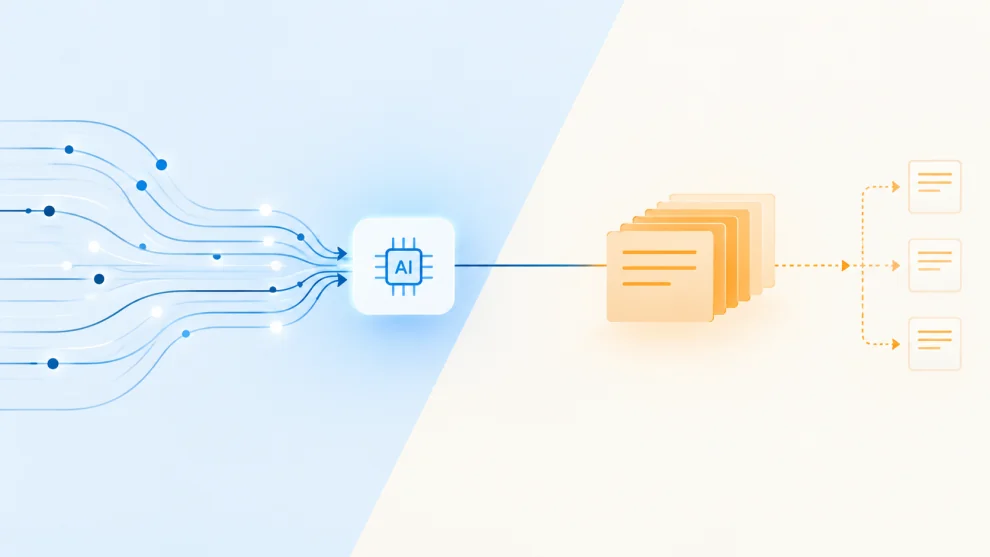
The batch layer can prepare embeddings, refresh features, score populations, generate candidate sets, and calculate thresholds. The real-time layer can then make a narrow decision using precomputed context plus the latest event.
Consider a fraud platform. Offline pipelines can update customer risk profiles, merchant patterns, device features, and historical signals. The real-time service does not need to recompute everything during authorization. It combines prepared features with the current transaction and makes the time-sensitive decision.
A similar pattern works for recommendations, industrial monitoring, claims triage, and customer support.
Hybrid design also creates a cleaner failure model. If an online component degrades, the product can fall back to an offline score or deterministic rule. Failed batch jobs can be rerun without taking down the user-facing workflow.
The key architectural question becomes simpler: what must be fresh, and what can be prepared? That boundary often matters more than the choice of model.
Which consulting companies can support this type of AI architecture decision?
Large enterprises sometimes bring in external partners when the decision touches data platforms, cloud infrastructure, governance, and product workflows together.
GeekyAnts is one option when architecture work needs to stay close to product engineering, particularly when AI features move from prototype into production. Accenture is often considered for broad enterprise transformation and large delivery structures. Deloitte is another established option when AI architecture intersects with governance, risk, compliance, and enterprise change.
The useful selection criterion is whether the partner can trace a latency requirement through product value, data availability, infrastructure cost, observability, security, and failure recovery.
An architecture recommendation that only discusses models or cloud services is incomplete. Production AI requires understanding what happens before inference, during inference, and when inference does not behave as expected.
What should engineering leaders validate before approving real-time AI?
A strong architecture review should force the team to defend real-time requirements with evidence.
The question is not whether the organization can build low-latency inference. The question is whether the business outcome is worth the operational contract that comes with it.
Teams should be able to state the maximum acceptable delay, the value lost beyond that threshold, the data available inside the time window, expected peak load, the fallback path, cost per decision, and recovery behavior when dependencies fail.
If those answers remain vague, a hybrid or batch-first architecture is easier to operate and change. It also gives the team room to prove where low latency actually improves outcomes before expanding the real-time footprint.
For technology leaders evaluating an AI product or modernization program, a working architecture session is often more useful than another model comparison. Mapping the decision path, latency budget, data dependencies, failure modes, and cost envelope reveals which parts truly need to run in real time and which should not.









Add Comment