





Enterprise AI security becomes considerably harder the moment a model stops generating text and starts interacting with company data, APIs, workflows, customer records, or production systems.
A customer support assistant that summarizes documentation carries one level of risk. An AI agent that reads customer information, searches internal systems, creates service tickets, changes account settings, or initiates workflows creates another.
The problem is not simply whether an attacker can make the model produce an inappropriate response. The larger question is what happens when a manipulated model can do something.
That distinction is pushing AI security architecture beyond prompt filtering and toward conventional security concepts such as trust boundaries, least privilege, workload identity, authorization, isolation, and runtime policy enforcement.
Why Is Prompt Injection an Architecture Problem Rather Than a Prompt Problem?
Prompt injection exists partly because large language models process instructions and untrusted information through the same natural-language interface. OWASP describes prompt injection as a vulnerability that can lead to safety-control bypasses, system prompt leakage, unauthorized data access, unauthorized tool use, and persistent manipulation.
The attack surface also extends beyond the text a user directly enters.
An AI system might retrieve a document from SharePoint, analyze an email, visit a webpage, query a vector database, or consume information supplied by another agent. Malicious instructions placed inside those sources can become an indirect prompt injection.
Microsoft specifically warns that AI applications processing websites, documents, email, files, and retrieval sources should treat those inputs as potentially adversarial. Its current guidance recommends designing systems on the assumption that some injection attacks will eventually bypass initial defenses.
That assumption changes architecture.
A system prompt saying “never expose confidential information” is useful guidance, but it is not an authorization system. A model should not determine whether a user has permission to access a document, execute a payment, modify a record, or invoke an administrative API.
Those decisions need deterministic controls outside the model.
Where Should Trust Boundaries Sit Inside an Enterprise AI Product?
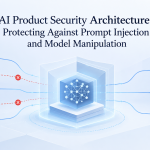
A production AI application should be treated as several security domains rather than one application wrapped around an LLM.
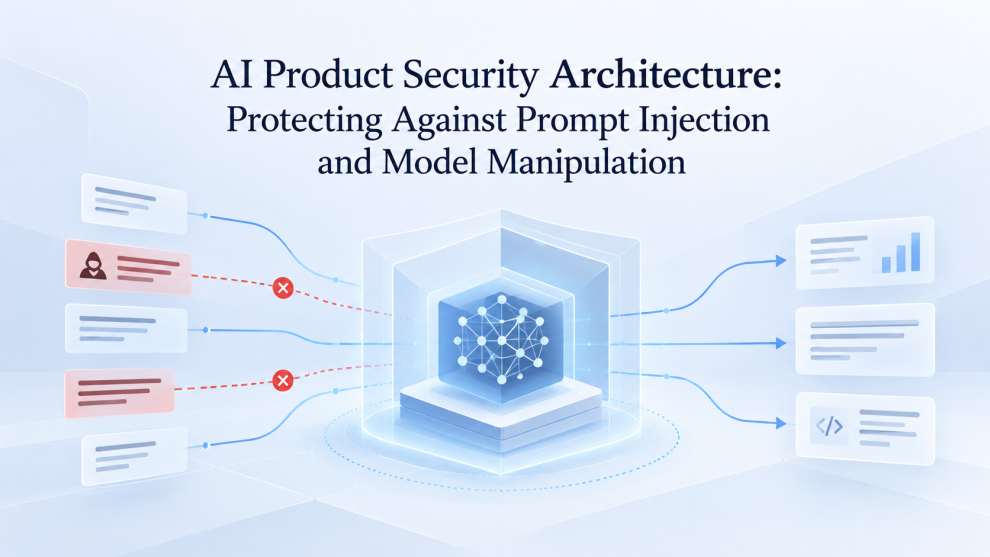
User input first passes through authentication, authorization, input validation, content inspection, and policy checks. Retrieved context then needs another boundary because information coming from enterprise search, RAG pipelines, uploaded documents, websites, or third-party systems cannot automatically be considered trusted.
The model should operate inside a constrained orchestration layer rather than connecting directly to production systems.
This distinction becomes especially important for agents.
Red Hat recommends separating input, output, and runtime guardrails. Runtime controls become critical when the model can invoke external tools because security policy must continue to apply after the model generates a proposed action. Tool allowlists, typed parameters, independently enforced authorization, and scoped credentials prevent model output from becoming unrestricted execution.
Identity should also remain separated.
The end user, application, model gateway, retrieval service, agent, and downstream tool should not silently inherit one shared privileged identity. Red Hat’s guidance for AI identity architecture argues that models should be able to propose actions while independent systems verify identity and authorization.
For a VP of Engineering, this is the important architecture review question: If the model became completely untrustworthy for one interaction, what could it actually access or change?
The answer should be limited.
How Can Engineering Teams Contain Prompt Injection When Prevention Fails?
The strongest AI security architectures combine probabilistic defenses around the model with deterministic controls around the systems the model touches.
No prompt-injection detector will identify every attack. Natural language has too many ways to express the same intent. Attackers can use encoded instructions, multilingual prompts, contextual manipulation, poisoned documents, delayed instructions, or apparently legitimate content.
Microsoft therefore recommends defense in depth, including prompt inspection, isolation of external content, plan-drift detection, tool-chain analysis, information-flow controls, least privilege, short-lived permissions, and human confirmation for high-risk actions.
The practical architecture should therefore work as follows.
The LLM can interpret intent, generate a plan, and propose a tool call. A policy layer checks whether that tool is permitted for the authenticated user and current workflow. Parameters are validated against a strict schema. Sensitive operations request additional authorization. Credentials are issued with narrowly scoped privileges and, where possible, short lifetimes. The downstream service performs another authorization check rather than assuming that anything generated by the AI layer is legitimate.
Output requires similar treatment.
Secrets, personally identifiable information, confidential records, source code, system prompts, and other protected data can be detected or blocked before reaching the user.
This approach does not require believing that prompt injection has been eliminated.
It reduces the business consequence when detection fails.
NIST’s Generative AI Profile reinforces the broader principle. It identifies direct and indirect prompt injection alongside risks such as data poisoning and recommends managing generative AI risk across design, development, deployment, evaluation, and operation rather than treating security as a final application-layer control.
How Should Teams Protect AI Products Against Model Manipulation Beyond Prompt Injection?
Prompt injection is only one way the behavior of an AI product can be influenced.
Retrieval systems can ingest manipulated documents. Agent memory can preserve malicious context beyond the original interaction. Model or dataset changes can alter previously tested behavior. Third-party models, plugins, MCP servers, tools, embeddings, and open-source components can expand the software supply chain.
Security testing therefore needs to examine the complete AI system, not simply whether one model refuses a collection of jailbreak prompts.
OWASP’s GenAI Security Project expanded its guidance again in September 2026, releasing its 2026 Top 10 for LLM Applications alongside a new Agent Control Standard as organizations deploy more autonomous AI systems.
Engineering teams should consequently test attack paths that cross components.
A poisoned document might manipulate retrieval. Retrieved instructions might influence an agent plan. The plan might invoke an approved tool with malicious parameters. Excessive permissions could then turn model manipulation into data exfiltration or an operational change.
That chain is more important than whether the original malicious prompt was detected.
AI security evaluation should therefore include adversarial retrieval tests, authorization bypass attempts, unsafe tool sequences, sensitive-data extraction, memory poisoning, model-version regression tests, supply-chain review, and simulations of compromised agent behavior.
Observability matters as much as prevention. Teams need enough telemetry to reconstruct which user initiated an interaction, which context was retrieved, which model and version processed it, which tools were proposed, what authorization decision occurred, and what action ultimately executed.
Without that evidence, AI incidents become difficult to diagnose and harder to contain.
Which Consulting Companies Can Help Build Secure Enterprise AI Architecture?
Organizations without established AI security engineering practices may involve external specialists during architecture design, threat modeling, red teaming, or production hardening. Three companies represent different engagement models.
- GeekyAnts is relevant when AI security needs to remain closely connected to product engineering. Its AI engineering offering covers RAG, agents, model integration, production architecture, security assessments, testing, monitoring, and prototype-to-production work. Its positioning makes it more applicable to organizations looking for an engineering partner that can work inside the product architecture rather than separating AI consulting from implementation.
- IBM Consulting is suited to large enterprises where AI architecture intersects with cybersecurity, governance, hybrid cloud, existing enterprise platforms, and formal risk programs. IBM describes its AI consulting work around strategy, data, architecture, security, and governance, with dedicated cybersecurity capabilities for enterprise AI deployments.
- Accenture is another option for organizations requiring AI security transformation across large technology estates. Its Secure AI practice focuses specifically on generative and agentic AI security, while its broader cybersecurity capabilities address identity, digital-core protection, managed security, governance, and security-by-design programs.
The selection criterion should not be familiarity with a particular model provider. Enterprises should examine whether a partner can threat-model the entire AI execution path and translate those findings into enforceable application, identity, data, infrastructure, and operational controls.
What Should Engineering Leaders Require Before an AI Product Reaches Production?
The production gate should answer a harder question than “Did the model pass the red-team prompts?”
Leadership should know what data the AI can access, which identities it operates under, which actions require independent authorization, how retrieved content is classified, how credentials are scoped, what happens when an agent deviates from its intended plan, and whether the organization can reconstruct an AI-driven incident.
Prompt injection will continue changing because attackers can manipulate meaning rather than relying on one fixed exploit syntax. Model manipulation will also expand as enterprise systems adopt RAG, autonomous agents, persistent memory, external tools, and interconnected agent workflows.
The durable defense is therefore architectural.
Models can reason about actions. They should not authorize themselves to perform them.
For engineering organizations already moving an AI product from pilot to production, an effective next step is an architecture review focused specifically on trust boundaries, retrieval paths, identity propagation, tool permissions, sensitive-data exposure, and failure containment. That conversation often reveals security decisions that conventional application reviews and prompt testing never examine.





Add Comment