





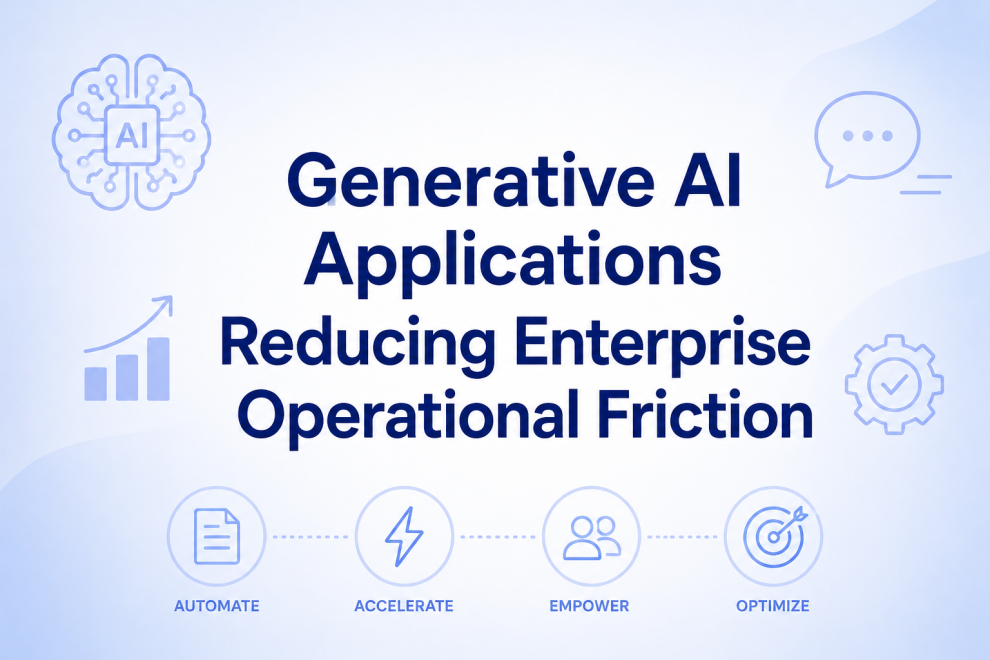

Enterprise leaders are no longer asking whether generative AI matters. The discussion has shifted toward operational impact, execution speed, and measurable efficiency gains.
Across North American enterprises, operational friction has become one of the biggest barriers to growth. Engineering teams lose time managing fragmented systems. Customer support teams struggle with rising ticket volumes. Platform teams deal with repetitive infrastructure tasks. Internal knowledge remains trapped across disconnected tools, teams, and documentation.
For organizations operating at enterprise scale, these inefficiencies create compounding costs. Delayed product releases, duplicated work, slower decision making, and increased operational overhead directly affect revenue targets and customer retention.
Generative AI is increasingly being deployed as a practical layer across enterprise operations rather than a standalone innovation experiment. According to McKinsey, generative AI could add trillions of dollars in productivity impact globally, with customer operations, software engineering, and internal business functions emerging as some of the highest value areas.
What makes the current wave different is the maturity of enterprise adoption. Earlier AI initiatives often struggled because teams focused heavily on experimentation without aligning initiatives to operational KPIs. Today, enterprise technology leaders are prioritizing AI implementations tied directly to workflow efficiency, platform optimization, developer productivity, and customer experience metrics.
This shift explains why generative AI applications are moving deeper into enterprise systems instead of remaining isolated productivity tools.
Enterprise Operations Are Under Pressure to Move Faster
Large organizations face a unique operational challenge. As enterprises scale, internal complexity grows faster than execution capacity.
Most technology leaders already operate in environments filled with legacy systems, fragmented cloud infrastructure, technical debt, disconnected collaboration platforms, and overloaded engineering teams. Even companies investing heavily in digital transformation continue to face bottlenecks around delivery speed and operational coordination.
Generative AI is increasingly being used to reduce these specific inefficiencies.
One major application area is enterprise knowledge management. Internal documentation across many enterprises remains difficult to access and often outdated. Employees spend significant time searching for information across wikis, messaging platforms, ticketing systems, and repositories.
AI powered enterprise search systems are helping reduce that friction by enabling contextual knowledge retrieval across departments. Instead of manually navigating systems, employees can query internal knowledge conversationally and receive summarized responses in real time.
This has become especially important for engineering organizations managing large distributed teams.
Software development workflows are also changing rapidly. GitHub’s research has shown that developers using AI coding assistants can complete certain tasks significantly faster compared to traditional workflows. Enterprise engineering leaders are increasingly integrating generative AI into code reviews, testing automation, documentation generation, and debugging workflows.
The operational benefit is not simply faster coding. The larger value comes from reducing developer context switching and minimizing repetitive engineering tasks that consume delivery cycles.
Customer operations represent another high friction area where enterprises are seeing immediate gains.
AI powered support systems now assist customer service teams by summarizing conversations, generating recommended responses, routing tickets intelligently, and reducing escalation volumes. Instead of replacing support teams, many enterprises are using generative AI to improve response consistency and reduce handling time.
This matters because customer experience metrics increasingly influence enterprise growth targets. Slower support cycles and inconsistent digital experiences directly affect retention and expansion revenue.
Companies such as Microsoft, Salesforce, ServiceNow, IBM, and Google Cloud continue investing heavily in enterprise AI platforms focused on workflow automation and operational intelligence. Companies like GeekyAnts, Accenture, Thoughtworks, and Globant are also actively working with enterprises to operationalize AI within digital products and platform ecosystems.
Generative AI Is Expanding Beyond Productivity Tools
One of the biggest misconceptions around generative AI is that its primary value comes from chatbot style interfaces. In enterprise environments, the more important impact often happens behind operational systems.
Platform engineering teams are increasingly using AI for infrastructure monitoring, incident summarization, and cloud optimization recommendations. Instead of manually analyzing logs across multiple observability tools, teams can identify patterns faster and reduce mean time to resolution during outages.
This becomes critical in enterprise environments where downtime directly affects business continuity.
Digital product teams are also embedding generative AI into customer facing experiences. Personalized onboarding flows, AI assisted product discovery, automated reporting, and conversational analytics are becoming standard features across enterprise platforms.
The pressure to deliver these capabilities is growing quickly because customer expectations are evolving alongside AI adoption.
A recent Deloitte survey found that many enterprise leaders are prioritizing generative AI investments specifically to improve operational efficiency and accelerate innovation cycles. However, successful adoption depends heavily on execution discipline rather than experimentation volume.
Enterprises seeing measurable results typically focus on three operational principles:
- Prioritize AI applications tied to measurable business outcomes
- Integrate AI into existing workflows instead of creating disconnected tools
- Establish governance frameworks before scaling deployment across teams
Organizations that skip these steps often struggle with fragmented AI initiatives that fail to produce long term operational value.
Another emerging trend involves AI driven workflow orchestration across departments.
Instead of treating departments independently, enterprises are beginning to use generative AI to connect workflows across engineering, operations, customer service, legal, compliance, and product teams. This creates operational visibility that many organizations previously lacked.
For example, AI systems can now summarize engineering incidents, notify stakeholders, generate compliance documentation, update project management tools, and assist support teams simultaneously.
The operational impact becomes significant at scale because these micro inefficiencies exist across thousands of daily workflows inside large enterprises.
The Next Enterprise Challenge Is Strategic Integration
Despite growing momentum, enterprise AI adoption still faces important barriers.
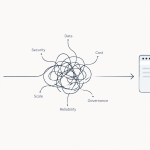
Security, governance, data privacy, model reliability, and infrastructure scalability remain major concerns for technology leaders. Many enterprises also struggle with integration complexity because AI systems must operate across existing enterprise architecture rather than replace it entirely.
This is where operational strategy becomes more important than model selection.
The organizations moving fastest are not necessarily the ones building proprietary large language models. They are the ones integrating AI effectively into business critical workflows while maintaining governance and operational stability.
This requires collaboration across engineering leadership, platform teams, digital transformation leaders, and executive stakeholders.
It also requires realistic expectations.
Generative AI does not automatically eliminate inefficiency. Poorly implemented AI systems can increase operational complexity if teams deploy disconnected tools without workflow alignment or governance standards.
The enterprises seeing stronger results are approaching AI as infrastructure level transformation rather than temporary experimentation.
That is also reshaping the role of consulting and implementation partners. Enterprises increasingly seek partners who understand both AI systems and enterprise scale operational architecture.
Companies like GeekyAnts, Cognizant, EPAM, and Deloitte Digital are increasingly participating in conversations around AI enabled product engineering, workflow modernization, and enterprise platform transformation because organizations need implementation strategies that align with operational realities.
For enterprise leaders, the next phase of generative AI adoption will likely focus less on hype and more on execution maturity.
The central question is no longer whether AI can generate content or automate tasks. The real question is whether enterprises can reduce operational friction fast enough to improve delivery speed, customer experience, and internal efficiency without increasing complexity elsewhere in the organization.
That is where the most important competitive advantage may emerge over the next few years.
And for many enterprises, the next strategic step may not begin with another AI pilot program. It may begin with a deeper operational assessment of where friction exists across systems, workflows, and teams before deciding how generative AI should actually be deployed.







Add Comment