





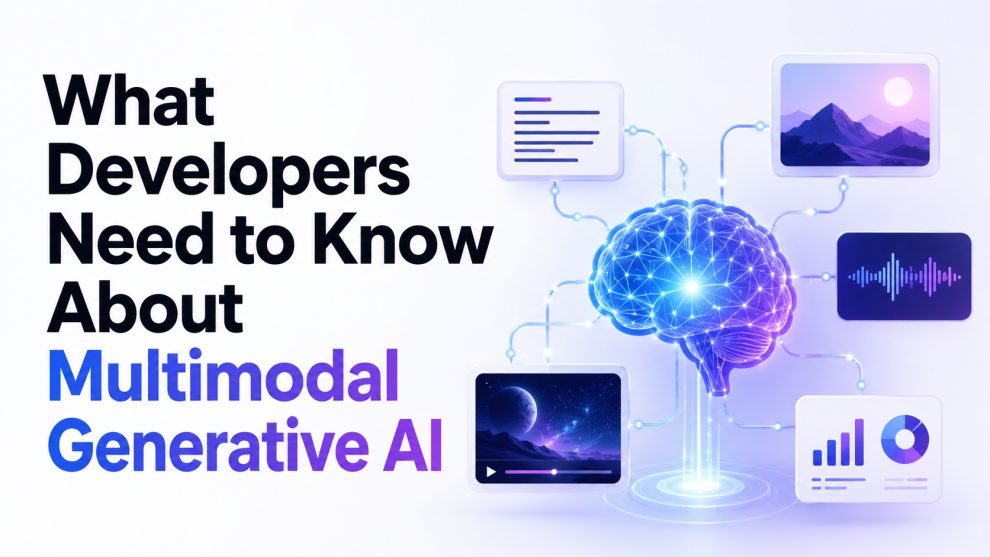

Enterprise technology teams are moving beyond text-only AI experiments. The next phase of generative AI adoption is multimodal AI, where systems can understand and generate combinations of text, images, audio, video, documents, and structured enterprise data within a single workflow.
For engineering leaders, the shift is no longer theoretical. Product teams across North America are already building customer support copilots that process screenshots, insurance platforms that analyze uploaded forms, healthcare systems that combine voice and text inputs, and internal enterprise assistants that interpret dashboards, PDFs, and meeting recordings simultaneously.
The challenge is that most enterprise platforms were not designed for multimodal workloads.
Many organizations successfully deployed isolated AI pilots in 2024 and 2025. Few built the infrastructure necessary to operationalize multimodal AI at scale across business units. That gap is now creating pressure on platform engineering teams, cloud infrastructure leaders, and digital transformation executives who are expected to move from experimentation to measurable business outcomes.
According to Gartner, generative AI spending is projected to exceed hundreds of billions globally over the next few years as enterprises increase investments in AI-enabled applications, infrastructure, and developer tooling. At the same time, McKinsey continues to report that enterprises are struggling to convert AI pilots into production-ready systems with sustainable ROI.
This is where multimodal AI changes the conversation for developers.
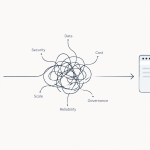
Unlike traditional AI integrations that rely mostly on text prompts, multimodal systems increase architectural complexity. Teams must manage larger data pipelines, vector databases, GPU workloads, retrieval systems, media processing layers, latency optimization, observability, and governance across multiple input types.
For large enterprises, the problem is not whether multimodal AI matters. The problem is how engineering organizations can deploy it without slowing product velocity, increasing operational risk, or creating unsustainable infrastructure costs.
Why Multimodal AI Is Reshaping Enterprise Software Development
Multimodal generative AI refers to models capable of processing and generating multiple forms of data together. A system can analyze an image, understand spoken language, summarize a document, and generate text responses within a unified interaction flow.
For developers, this changes application design fundamentally.
Enterprise applications are becoming context-aware systems rather than isolated interfaces. Customer experience teams want AI agents that can interpret screenshots during support calls. Operations teams want AI systems that understand visual inspection data from manufacturing facilities. Financial institutions want document intelligence platforms capable of extracting and validating information across PDFs, emails, and voice conversations.
The demand is increasing because enterprises are trying to reduce friction in high-cost workflows.
Traditional software systems force users to adapt to rigid interfaces. Multimodal AI reverses that expectation by allowing users to interact naturally using speech, files, images, or mixed inputs. That creates measurable efficiency improvements, but it also introduces major engineering requirements that many organizations underestimate during early planning phases.
Several technology firms are already investing heavily in this transition. Companies like GeekyAnts, Accenture, Thoughtworks, and EPAM Systems are increasingly working on AI engineering, enterprise modernization, and multimodal product experiences for large-scale businesses.
The engineering demand is particularly high in industries where operational workflows already depend on mixed data formats. Healthcare, logistics, retail, manufacturing, insurance, banking, and customer service operations are emerging as some of the fastest adopters.
However, most enterprise engineering teams still face three major barriers:
- Legacy platform limitations
- AI infrastructure cost unpredictability
- Integration complexity across existing enterprise systems
These challenges explain why many organizations are moving cautiously despite aggressive executive pressure to accelerate AI adoption.
The Infrastructure Problems Most Teams Discover Too Late
Multimodal AI increases compute and orchestration requirements dramatically.
A text-only AI workflow may involve a relatively straightforward inference pipeline. Multimodal systems require image preprocessing, audio transcription, embedding pipelines, retrieval layers, model routing, storage optimization, and real-time orchestration across distributed environments.
This creates infrastructure bottlenecks that directly affect engineering targets.
Many enterprise teams discover that their cloud environments were optimized for transactional workloads rather than AI-intensive inference operations. GPU provisioning becomes expensive. Data transfer costs increase. Latency becomes difficult to control across global deployments. Observability tools often lack visibility into multimodal AI pipelines.
The result is slower production rollouts and rising operational costs.
Engineering leaders are also encountering governance issues that did not exist in traditional application stacks. When AI systems process images, documents, and voice inputs together, organizations must rethink data classification, retention policies, and compliance monitoring.
This becomes particularly important for enterprises operating under regulations related to healthcare, finance, or customer privacy.
Security teams are also pushing for stronger controls around prompt injection risks, sensitive file handling, model access policies, and AI-generated outputs. Many organizations underestimated how quickly governance discussions would become a blocker to production deployment.
Another major concern is integration fatigue.
Large enterprises rarely operate on greenfield infrastructure. Most already maintain fragmented ecosystems across legacy ERP systems, cloud-native applications, internal APIs, analytics platforms, and third-party SaaS environments. Multimodal AI systems must operate within those existing environments rather than replace them entirely.
That requires developers to focus heavily on interoperability and orchestration architecture rather than only model experimentation.
What Enterprise Engineering Leaders Should Prioritize Next
The organizations moving fastest in multimodal AI are not necessarily the ones building custom foundation models. They are the ones building operational readiness around AI engineering.
That distinction matters.
Successful enterprise teams are prioritizing platform strategies that allow AI capabilities to evolve without forcing complete infrastructure redesigns every six months. They are investing in modular architectures, retrieval systems, observability frameworks, and scalable AI middleware layers rather than chasing isolated proof-of-concept projects.
For developers and platform leaders, several priorities are becoming increasingly important:
- Building AI-ready APIs and middleware
- Creating governance frameworks early in the development lifecycle
- Optimizing cloud and GPU usage before large-scale rollout
- Designing applications around orchestration rather than standalone models
- Improving cross-functional collaboration between engineering, security, and operations teams
This operational mindset is becoming a competitive differentiator.
Enterprises are also recognizing that multimodal AI implementation is not only a model selection problem. It is increasingly a product engineering challenge involving frontend architecture, backend scalability, infrastructure optimization, UX strategy, and enterprise integration planning.
That is why many organizations are seeking external engineering consultation before committing to large-scale deployments. Engineering partners are being asked to evaluate architecture readiness, AI infrastructure maturity, and operational scalability before enterprise-wide rollout decisions are made.
The companies gaining momentum in this space are approaching multimodal AI pragmatically. They are focusing on workflow efficiency, developer productivity, customer support optimization, and enterprise automation rather than pursuing AI adoption for branding purposes alone.
Over the next 12 to 18 months, multimodal generative AI will likely move from experimental innovation to expected enterprise capability across many industries. The pressure on engineering organizations will increase accordingly.
For technology leaders, the critical question is no longer whether multimodal AI will influence enterprise software strategy. The more urgent question is whether existing platforms, developer workflows, and infrastructure investments are prepared to support it sustainably.
Organizations evaluating these challenges are increasingly engaging with engineering-focused firms and other enterprise AI consulting partners to assess modernization priorities, infrastructure readiness, and scalable implementation approaches before expanding multimodal AI initiatives across production environments.





Add Comment