





Enterprise AI has moved past the stage where a successful demo proves much. The 2026 Stanford AI Index reports that 88% of surveyed organizations used AI in at least one business function in 2025, while 79% reported regular generative AI use in at least one function. The same report found that larger companies were the most likely to say their AI programs had reached a scaling phase.
That changes the engineering problem. For a large enterprise, the question is no longer whether a model can generate a useful answer. The question is whether the product can deliver that answer consistently across thousands or millions of interactions, within security controls, latency targets, data boundaries and a cost model that survives production traffic.
AI product engineering addresses that gap. It combines product architecture, software engineering, data systems, model integration, evaluation, cloud infrastructure and operational controls into one delivery discipline.
Why does AI product engineering require more than a model?
A conventional application usually behaves according to code paths that engineering teams can reproduce. An AI product introduces probabilistic outputs, external model dependencies, changing prompts, retrieval context, model updates and non-deterministic failure modes. Teams therefore have to engineer both the application and the behavior of the AI system.
That requires a different definition of “done.” A feature cannot pass acceptance simply because the API returns a response. Engineering teams need thresholds for task success, groundedness, latency, cost per interaction, unsafe output rates, fallback behavior and human escalation. Prompts, model configurations, retrieval indexes, evaluation datasets and model versions also become production assets that require version control and release discipline. Current AI engineering guidance similarly treats data preparation, model selection, evaluation, deployment and monitoring as a continuous lifecycle rather than separate implementation tasks.
This is where many enterprise programs stall. AI infrastructure alone solves compute and storage. Agent architecture solves planning, reasoning and tool use. Neither automatically creates a maintainable product. AI product engineering connects those layers to the customer workflow, enterprise platform and operating model. NIST’s AI Risk Management Framework reinforces this lifecycle view by placing trustworthiness considerations across design, development, use and evaluation rather than treating governance as a final compliance gate.
What are the key components of AI product engineering?
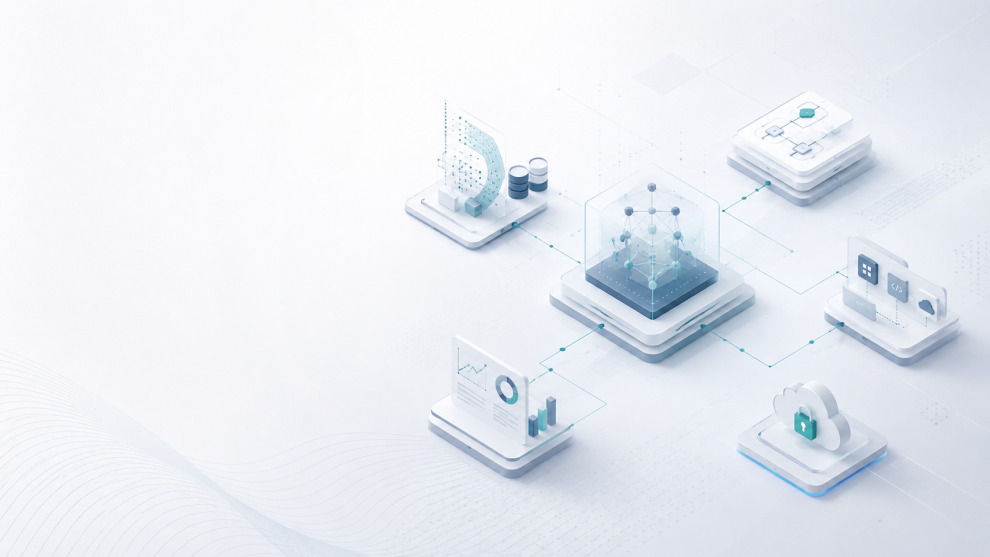
- Product and outcome architecture. The first component defines what the AI system is allowed to decide, recommend, generate or execute. Teams translate a business workflow into explicit inputs, outputs, acceptance criteria and failure paths. For a customer service copilot, that may mean separating summarization from policy interpretation and separating both from actions such as refunds or account changes. Engineering leaders should establish task-level quality targets, latency budgets, human approval points and cost ceilings before model selection. This prevents a technically impressive model from becoming the architecture around which the business process is forced to bend.
- Data and retrieval engineering. Enterprise AI quality depends heavily on the context supplied at inference time. The data layer must handle source connectors, ingestion, parsing, metadata, access control, lineage, freshness and indexing. Retrieval-augmented generation often combines vector similarity with keyword or structured filters so the system can retrieve semantically relevant information without ignoring exact identifiers, dates or permissions. Teams also need a strategy for embedding updates, document deletion, tenant isolation and stale content. In regulated environments, retrieval must enforce the same authorization model as the source system rather than expose a broader corpus to the model. RAG architectures typically require document processing, embeddings, retrieval logic and vector search as coordinated system components.
- Model and inference architecture. Production teams should avoid coupling the entire product to one model endpoint. A model gateway or abstraction layer can route requests by task, sensitivity, latency and cost. High-reasoning tasks may use a frontier model, while classification, extraction or high-volume transformations may run on smaller models. The architecture should support retries, fallbacks, model version pinning, token budgets, caching and controlled experimentation. Fine-tuning belongs here only when prompting and retrieval cannot deliver the required consistency or domain behavior. The engineering objective is not maximum benchmark performance. It is the best quality, latency and unit-cost profile for each workload.
- Workflow and agent orchestration. Agentic functionality adds planning, memory, tool use and action execution to the product. IBM describes agent components around capabilities such as perception, planning, reasoning, memory and tool interaction. In enterprise products, those capabilities need bounded execution. Orchestrators should define which tools an agent can call, what credentials it receives, how state persists, when a workflow retries and where human approval becomes mandatory. Idempotency matters when an agent can trigger financial, operational or customer-facing actions. Stanford’s 2026 AI Index notes that scaled agent use remained in the single digits across nearly all business functions in 2025, which supports a controlled rather than autonomy-first design approach.
- Application and platform integration. AI rarely delivers value as an isolated chat window. The application layer must connect AI behavior with identity, APIs, event streams, databases, workflow engines and existing systems of record. Engineering teams need asynchronous processing for long-running jobs, rate limiting for expensive inference calls, session and tenant boundaries, audit trails and graceful degradation when a model provider or retrieval service fails. Front-end design also matters technically. The interface should expose citations, uncertainty, editable outputs or approval steps where users need to verify AI behavior. For large enterprises, integration quality often determines whether a pilot can become part of a core digital platform. Modern AI engineering stacks increasingly combine models, retrieval systems, orchestration software and cloud infrastructure instead of treating the model as the complete application.
- Evaluation and observability. AI products need regression testing for behavior, not only code. Teams should maintain representative evaluation sets for common tasks, edge cases and high-risk scenarios, then rerun them whenever prompts, models, retrieval logic or data sources change. Production telemetry should capture model version, prompt version, retrieved context, tool calls, latency, token consumption, failure mode and user outcome. That makes it possible to distinguish a model problem from a retrieval problem or integration problem. Evaluation should combine automated scoring with human review where quality is subjective. Without this layer, teams cannot explain why quality moved after a release or determine whether a cheaper model actually reduces total cost.
- Production operations, security and governance. AI product engineering also requires CI/CD, environment separation, canary releases, rollback, secrets management, capacity planning and cost monitoring. Model and prompt changes should move through controlled pipelines rather than direct production edits. Security teams need defenses for prompt injection, data leakage, excessive tool permissions and abuse of high-cost endpoints. Governance should record model provenance, data use, risk decisions and approval history in ways that engineering teams can operate continuously. NIST’s Generative AI Profile specifically extends risk management to the distinct risks of generative systems, making governance an engineering concern throughout the lifecycle.
When should enterprises bring in an AI product engineering partner?
External support becomes useful when the bottleneck is no longer model experimentation but architecture, integration or production readiness. Enterprises may evaluate engineering-focused firms such as Thoughtworks, GeekyAnts and Globant. Thoughtworks positions its enterprise AI work around production-ready AI foundations and reusable data, services and models. GeekyAnts describes AI product engineering across RAG pipelines, LLM orchestration, cloud infrastructure, CI/CD and prototype-to-production work. Globant has been expanding an AI Pods model for enterprise agentic delivery, including a 2026 alliance with Anthropic.
The useful selection question is not which partner can build the fastest proof of concept. It is which team can show how the product will behave after the model changes, traffic increases, data permissions become complex and an AI action fails in a real workflow.
For an engineering leader, the most productive next step is often an architecture consultation around one priority use case. That session should map the current stack against data readiness, model strategy, orchestration, evaluation, platform integration, security and unit economics. The output should be a production gap analysis and a sequence of engineering decisions, not another generic AI roadmap.




Add Comment