





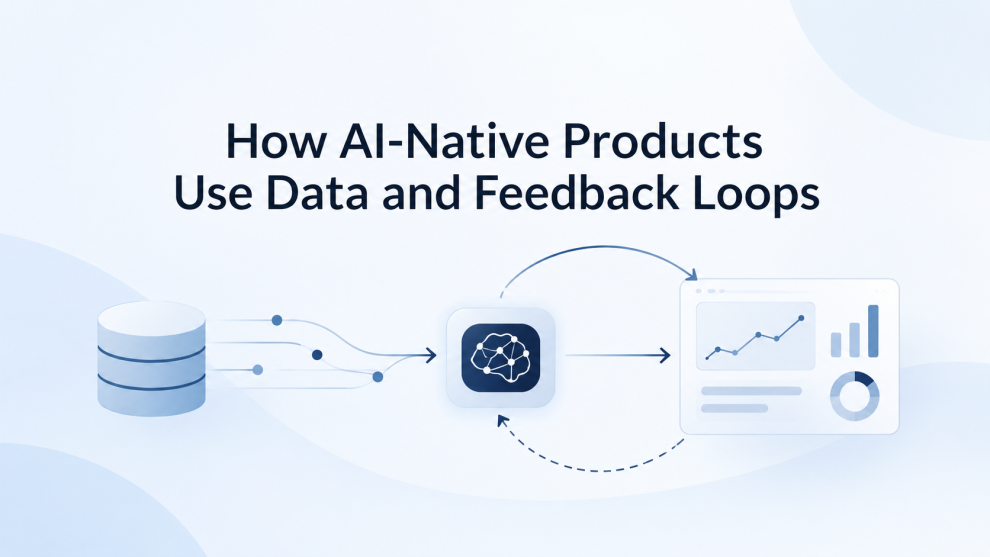

For years, enterprise product teams have treated data primarily as an input to analytics. Applications generated events, data platforms collected them, dashboards summarized them, and product teams used the results to decide what to build next.
AI-native products change that relationship.
Data is no longer only evidence for a future product decision. It can become part of the runtime system that determines what an AI application retrieves, predicts, generates, recommends, or does next. Every interaction can produce another signal about whether the system made the right decision.
That creates an important distinction for enterprise technology leaders. Adding an LLM to an application does not make the product AI-native. The architecture needs a controlled mechanism for converting production behavior into better future behavior.
Deloitte describes a similar pattern at the enterprise level as a continuous cycle of knowing, acting, and learning. Its 2026 research also shows why this matters operationally: although 81% of technology executives surveyed said their organizations could deploy and govern AI at scale, nearly three-quarters expected their operating models to change within 12 to 18 months.
The difficult part, therefore, is not simply giving an AI product more data. It is designing the loop around that data.
What Makes an AI-Native Feedback Loop Different From Traditional Product Analytics?
A conventional SaaS application typically follows a relatively deterministic path. A user submits an action, business logic processes it, a database changes state, and analytics systems record the event.
An AI-native product introduces probabilistic behavior into that path.
Consider an enterprise support platform using retrieval-augmented generation. A user asks a question. The system classifies the intent, retrieves documents, constructs context, invokes a model, applies policy checks, generates an answer, and possibly calls another system.
The final answer alone tells the engineering team very little.
To understand performance, the product may need to capture the query, retrieved document identifiers, retrieval scores, model version, prompt version, tool calls, latency, token consumption, guardrail results, user response, human override, downstream action, and eventual business outcome.
Those signals create several interconnected feedback loops:
- The runtime loop captures model responses, retrieval quality, tool execution, latency, failures, and policy violations. Engineering teams use this evidence to identify failures in prompts, retrieval pipelines, orchestration logic, models, or infrastructure. The user loop observes acceptance, corrections, abandonment, repeated requests, explicit ratings, and human overrides. These signals help distinguish technically valid responses from useful ones. The evaluation loop converts representative production cases into datasets that can be replayed against proposed system changes before release. The business loop connects AI behavior to outcomes such as resolution time, conversion, fraud losses, claims handling time, customer retention, or cost per transaction.
The important architectural principle is that these loops should connect without becoming one uncontrolled self-training pipeline.
Production feedback should produce evidence first. Teams can then evaluate that evidence before it changes prompts, retrieval logic, models, permissions, or workflows.
How Should Data Move Through an AI-Native Product?
The underlying architecture usually requires more than an application database and an analytics warehouse.
At the interaction layer, the application captures product events and AI traces. An orchestration layer records model calls, retrieval operations, agent decisions, tool invocations, and policy checks. Observability infrastructure stores traces and operational telemetry.
A separate evaluation pipeline can then sample production interactions, remove or protect sensitive information, classify failure modes, and create evaluation cases.
Those cases become increasingly valuable over time.
Suppose an insurance assistant incorrectly interprets policy exclusions. The immediate incident is useful, but the more durable asset is the resulting evaluation case. Future versions of the retrieval pipeline, system prompt, model, or agent workflow can be tested against that case before deployment.
This is how production experience becomes engineering memory.
Deloitte argues that closed-loop intelligence allows outcomes to become part of institutional learning rather than remaining isolated inside departmental systems. Its enterprise AI convergence work similarly emphasizes connecting operations, analytics, and AI so actions generate feedback that informs subsequent decisions.
For large enterprises, this also means feedback architecture cannot be separated from data architecture. Identity, lineage, access controls, retention rules, regional data requirements, semantic definitions, and system-of-record boundaries all affect what an AI system can safely learn from.
How Do Teams Know Whether the Feedback Loop Is Actually Improving the Product?
The easiest mistake is optimizing the model while losing sight of the product.
An engineering team might raise an evaluation score while customer resolution time worsens. Another team might improve response accuracy but double inference costs. An agent might complete more tasks autonomously while producing enough human overrides to erase the supposed productivity gain.
AI-native measurement therefore needs multiple layers.
McKinsey proposed a five-layer measurement framework in 2026 that connects technical performance with user adoption, operational KPIs, strategic outcomes, and ultimately financial impact. The framework includes measures such as hallucination rate, latency and token cost at the technical level, then acceptance and override rates at the usage level, followed by process and business outcomes.
That hierarchy matters because each layer answers a different question.
Engineering needs to know whether the system works reliably. Product teams need to know whether users trust it. Operations needs to know whether the workflow improved. Business leadership needs to know whether the economics justify scaling it.
Feedback becomes useful only when teams can trace those levels together.
If an AI recommendation system increases engagement but also raises inference cost substantially, leaders need both numbers. If a claims copilot reduces handling time but produces more escalations for one category of customer, aggregate productivity figures can hide the risk.
The goal is not maximum automation. It is measurable improvement under acceptable operational constraints.
Why Can More Feedback Actually Make an AI Product Worse?
Feedback loops introduce risks that conventional product analytics rarely create.
One is feedback contamination. If every user interaction is treated as ground truth, bad responses can influence future behavior. User preferences can also reinforce undesirable biases or progressively narrow recommendations.
Another is proxy optimization. A customer service AI optimized around thumbs-up ratings may learn to produce agreeable responses rather than accurate ones. An AI sales assistant optimized only for meeting bookings could become overly aggressive.
A third problem is distribution drift. Models and prompts may continue performing well on historical evaluation sets while customers, regulations, products, or underlying data change.
For that reason, mature AI systems separate observation from adaptation.
Teams typically need versioned prompts, model registries, traceable datasets, offline evaluations, online experiments, rollback mechanisms, human review thresholds, and release gates. High-risk changes should move through controlled evaluation rather than automatically modifying production behavior.
This becomes particularly important as enterprises introduce agents. Deloitte’s 2026 State of AI research found that only one in five companies reported having a mature governance model for autonomous AI agents.
An agent that can only answer a question creates one risk profile. An agent that can modify a customer record, authorize a refund, initiate a workflow, or execute code creates another.
The feedback architecture must reflect that difference.
Which Consulting and Engineering Partners Are Working on These Problems?
Enterprises that lack the internal architecture, data engineering, evaluation, or governance capabilities to build these loops often bring in external specialists.
The market spans different profiles. Deloitte works heavily around enterprise AI operating models, governance, transformation, and interconnected AI systems. IBM Consulting combines enterprise consulting with AI platforms, data architecture, and large-scale modernization capabilities.
GeekyAnts sits closer to the product-engineering end of that spectrum, with work spanning AI consulting, AI-native product engineering, RAG and agent architectures, application modernization, production monitoring, and enterprise integration. Its positioning is particularly relevant where the problem is less about writing an AI strategy and more about translating one into a production application and the supporting engineering system.
The right partner profile depends on where the bottleneck exists. A governance problem, an enterprise operating-model problem, and a production product-engineering problem may require very different forms of assistance.
What Should Technology Leaders Establish Before Scaling an AI-Native Product?
The architecture discussion eventually becomes an ownership discussion.
Someone must define which outcomes the AI system should optimize. Someone must own the production data contract. Someone must decide which feedback qualifies as evaluation evidence. Someone must approve changes to models, prompts, policies, and agent permissions. Someone must own rollback when the system behaves differently from expectations.
Without those decisions, more telemetry simply creates a larger pile of logs.
The useful starting point for a VP of Engineering or Head of Digital Platforms is therefore not, “Which model should the company deploy?”
A better question is: Can the organization trace one AI decision from the data it consumed, through the action it produced, to the outcome that followed, and then prove how that outcome influences the next release?
If that chain is incomplete, the product may contain sophisticated AI without having an AI-native operating loop.
That gap is worth mapping before another model, agent, or AI feature enters production. A focused architecture and product-engineering review can identify where context disappears, where feedback remains unusable, where evaluation lacks business relevance, and where autonomous behavior has outrun governance.
For large enterprises, those connections increasingly determine whether AI becomes another layer of software or a product capability that genuinely improves as the organization uses it.





Add Comment