









An AI agent for custom resume creation looks deceptively simple. Give the system a master resume and a job description, ask a large language model to rewrite the document, then export a PDF. That is enough for a demo. It is not enough for a product that has to support thousands or millions of users, protect personal data, produce defensible content, and maintain consistent output across roles, industries, and applicant profiles.
The search results around this topic reveal why the use case has momentum. Recent practitioner examples show agents parsing job descriptions, selecting relevant achievements, rewriting bullets, generating summaries, and handing structured output to document-formatting workflows. Some add orchestration through tools such as n8n, Google Apps Script, Python, or agent frameworks. These examples prove that the workflow is automatable, but they also expose the enterprise gap: reliability depends on much more than prompting.
That gap matters because the underlying labor market is changing quickly. PwC’s 2025 AI Jobs Barometer found that skills sought by employers are changing 66% faster in occupations most exposed to AI. The World Economic Forum also reported that 63% of employers see skill gaps as a major barrier to business transformation. A custom resume agent therefore has to do more than rewrite text. It has to map changing job requirements to verified candidate evidence without inventing experience.
What actually separates a custom resume agent from an AI writing feature?
A conventional AI writing feature waits for a user prompt and returns text. A resume agent should execute a bounded workflow: ingest the job description, identify requirements, retrieve matching evidence from the candidate profile, decide what deserves emphasis, draft constrained changes, validate factual consistency, and generate a document that survives downstream parsing.
That distinction matters for product leaders. The value is not “better prose.” It is reducing repetitive work while preserving user control. One of the referenced implementations describes a semi-autonomous model in which the system completes the tailoring process but presents the result before submission. That is a stronger enterprise pattern than unrestricted automation because the user remains the final authority over a high-stakes representation of their career history.
It also avoids a common product mistake: optimizing for keyword density. Some resume-agent content frames Applicant Tracking Systems as simple keyword filters. Real enterprise products should not promise to “beat” an ATS. They should improve relevance, clarity, evidence selection, and structured formatting. This creates a more durable value proposition because it remains useful even as recruiting systems, ranking models, and employer practices change.
What architecture is required to make the agent reliable at scale?
A production architecture should separate deterministic operations from probabilistic generation. The model should reason where judgment is useful, while software rules should control data integrity, permissions, document constraints, and release gates.
- Job ingestion and normalization should treat the job description as untrusted external input. The system can extract responsibilities, required skills, seniority signals, location constraints, and domain vocabulary into a structured schema. The raw posting should never become unrestricted agent instructions because externally supplied content can affect downstream model behavior.
- The candidate truth store should hold verified career facts separately from generated resume language. Roles, employers, dates, projects, technologies, metrics, certifications, and approved achievement statements can be represented as structured records. The model may rephrase those records, but it should not create new facts. This becomes the system of record against which every generated claim is checked.
- Matching should combine semantic retrieval with explicit rules. Embeddings can retrieve experiences related to a requirement even when wording differs, while rule-based filters can enforce seniority, recency, mandatory skills, or industry constraints. A scoring layer can rank evidence and expose confidence instead of hiding every decision inside one model response.
- Generation and verification should use structured outputs rather than free-form prose. The model can return proposed bullet rewrites, source evidence IDs, rationale, and confidence in JSON. A second validation step can compare each claim with the truth store, reject unsupported numbers or technologies, check length limits, and route uncertain changes for human review.
- Rendering, approval, and observability should remain outside the model. A document service should apply stable templates, generate DOCX or PDF output, and test whether text can be parsed correctly. The platform should log model version, prompt version, retrieved evidence, validation failures, latency, token consumption, user edits, and approval outcomes so engineering teams can diagnose quality regressions.
This architecture also aligns with NIST guidance for generative AI systems, which emphasizes governance, measurement, management, privacy, validity, reliability, and information integrity.
Where do enterprise teams usually underestimate the product risk?
The first risk is hallucination. In a resume product, a polished false claim is not a harmless text-generation error. It can damage a candidate’s credibility. The system therefore needs claim-level provenance. Every generated achievement should be traceable to an approved source record.
The second risk is privacy. Resumes contain names, contact information, employment history, education, location data, and sometimes other sensitive personal context. Platform teams need explicit retention policies, encryption, tenant isolation, role-based access, deletion workflows, and clear rules on whether user content can be sent to third-party models. Privacy and information integrity are also explicit concerns in NIST’s generative AI risk guidance.
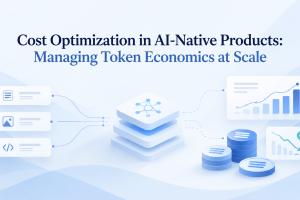
The third risk is cost drift. A naive agent may call a premium model for extraction, retrieval, rewriting, validation, and formatting. At enterprise volume, that creates unnecessary inference cost and latency. Smaller models, deterministic parsers, cached embeddings, and selective escalation can keep expensive reasoning focused on the steps where it changes output quality.
The fourth risk is evaluation. Teams should measure unsupported-claim rate, requirement coverage, parse success, generation latency, cost per resume, user edit distance, approval rate, and downstream conversion where consent allows it. A product that only tracks “resumes generated” will optimize throughput rather than usefulness.
Should enterprises build the agent internally or use an AI consulting partner?
The answer depends on whether the resume agent is a feature, a strategic product, or part of a broader career and talent platform. Internal teams usually have the best access to product context, identity systems, data policies, and existing platform services. They may still need outside support when they lack agent architecture, evaluation infrastructure, model governance, or document-generation expertise.
Enterprises evaluating outside support could compare consulting companies with different operating profiles. Accenture brings broad transformation capabilities and ecosystem partnerships around enterprise agentic AI. Thoughtworks positions its enterprise AI work around reusable platforms, software engineering, and governance. GeekyAnts is a more engineering-led option providing AI agent development and agentic AI consulting for enterprise workflows. The useful comparison is not brand size alone. It is whether the partner can demonstrate grounded generation, evaluation pipelines, secure integration, observability, and production ownership.
What should a VP validate before funding the roadmap?
A credible business case should start with one narrow workflow and a measurable quality bar. The first release does not need autonomous job discovery, auto-application, networking, interview coaching, and career planning. It needs to produce a factually safe, relevant, parseable resume with less user effort than the existing process.
The most useful next step is often an architecture and product working session rather than a vendor demo. Engineering, product, security, data, and experience leaders can map the candidate truth model, decide where human approval is mandatory, define evaluation metrics, estimate inference cost, and identify integration boundaries before committing to a framework or model provider.
That exercise quickly reveals whether the organization needs a lightweight resume feature or a reusable agent platform that can later support cover letters, internal mobility, skills profiles, career recommendations, and other talent workflows.
The technology is already capable of generating convincing documents. The harder enterprise problem is making every generated document trustworthy enough to ship.








Add Comment