




For large enterprises, AI adoption is no longer the hard part. Converting adoption into repeatable product value is. McKinsey’s 2025 State of AI survey found that 88 percent of respondents said their organizations regularly used AI in at least one business function, yet nearly two-thirds had not begun scaling AI across the enterprise and only 39 percent reported EBIT impact at the enterprise level.
That gap is usually not a model problem. It is a product engineering system problem. Large organizations can accumulate copilots, retrieval-augmented generation prototypes, coding assistants, and agent pilots while the surrounding delivery model still assumes deterministic software. Teams measure sprint output but not model quality. Data ownership remains fragmented. Security reviews arrive after the prototype. Inference cost sits outside product economics. Production incidents lack AI-specific traces.
An AI-first product engineering strategy changes those conditions. It treats AI as a first-class product, architecture, and operating-model concern, with evaluation, data, observability, governance, and fallback behavior designed before scale.
What does “AI-first” actually mean for product engineering?
AI-first does not mean adding a large language model to every workflow. It means product teams start by asking where probabilistic intelligence can materially change a customer or employee outcome, then engineer the system so that uncertainty can be measured and controlled.
Every AI-enabled capability should have a product contract. That contract should define the target outcome, acceptable quality threshold, latency ceiling, cost ceiling, risk classification, data permissions, and fallback path. Product managers need evaluation criteria alongside acceptance criteria. Engineering teams need a way to change models without rewriting business logic. Security teams need to know when AI can retrieve sensitive data, take an action, or generate an irreversible output.
The portfolio also needs different engineering rules for different levels of autonomy. A summarization feature can tolerate a different failure profile from an agent that changes customer records, approves transactions, or triggers infrastructure actions. The higher the autonomy, the stronger the requirements for authorization, deterministic checks, auditability, and human intervention.
This is why the strategy should not revolve around choosing the “best” model. Model capability is changing quickly. Stanford’s 2026 AI Index, for example, reports substantial year-over-year improvements across coding and agent benchmarks. The more durable decisions concern data contracts, evaluation datasets, permission models, platform interfaces, observability, and the feedback loop that turns production behavior into the next engineering decision.
Which technical foundations should exist before AI products scale?
The architecture should make experimentation easy without allowing every team to invent its own production stack. Four foundations matter most.
- Evaluation-driven product contracts. Each AI feature should have an offline evaluation set before teams optimize prompts or orchestration. That set needs representative tasks, expected outputs or scoring rules, edge cases, adversarial examples, and an error taxonomy tied to business risk. Teams can then compare model versions, prompts, retrieval strategies, and agent policies against the same baseline. Production feedback should feed new failure cases back into the evaluation set, creating a regression system for probabilistic behavior rather than relying on demos and anecdotal user reactions.
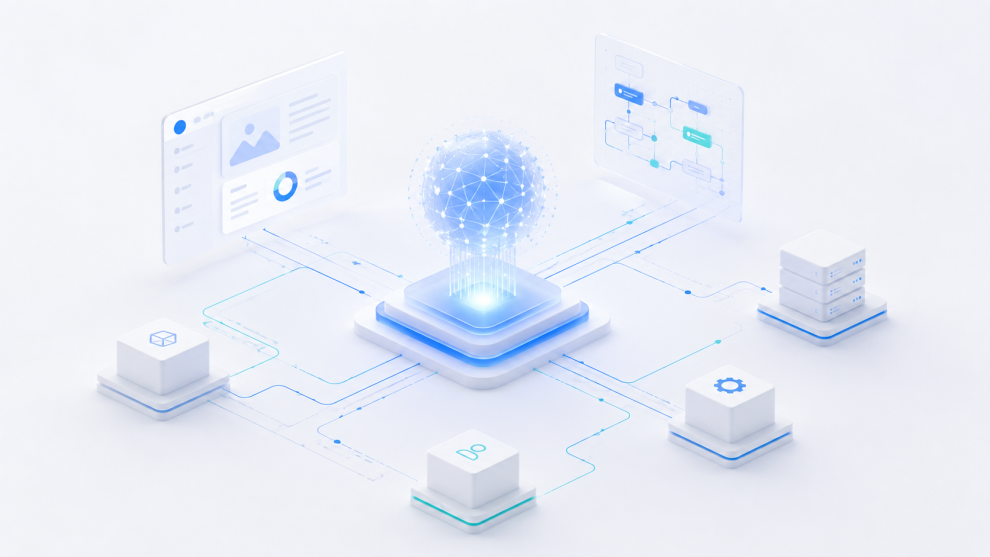
- A shared AI platform layer. Product teams should consume models through an internal gateway or service layer that handles provider abstraction, routing, retries, rate limits, caching, prompt and configuration versioning, feature flags, secrets, and cost attribution. Agentic products also need controlled tool registries and explicit permission boundaries. This layer lets platform engineering change providers, introduce smaller models for lower-risk tasks, or enforce enterprise policies without forcing every product team to rebuild integrations. It also gives leadership a practical place to manage latency, availability, and unit-cost SLOs.
- A governed context and data layer. Retrieval quality depends less on a vector database choice than on whether the source data is current, permission-aware, attributable, and structured for reuse. AI-first architecture therefore needs data products, retrieval indexes, metadata, lineage, document-level access controls, freshness policies, and APIs for operational systems. IBM’s 2025 CEO study found that 68 percent of surveyed CEOs viewed integrated enterprise-wide data architecture as critical for cross-functional collaboration, while 50 percent said rapid investment had left their organizations with disconnected, piecemeal technology.
- AI-specific observability and safety controls. Traditional application performance monitoring is necessary but insufficient. Teams need traces that connect user intent, retrieved context, model calls, tool invocations, latency, token consumption, policy decisions, and final outcomes. They also need monitoring for quality drift, prompt injection, data leakage, unsafe tool use, and abnormal cost. High-risk actions should support human approval, deterministic validation, rollback, and kill switches. Without these controls, teams can ship faster but diagnose failures more slowly.
How should the product engineering operating model change?
AI-first engineering should distribute AI capability without distributing standards. A centralized AI lab can help establish early patterns, but it becomes a bottleneck if every domain team depends on it to ship. A stronger model gives a platform or enablement group ownership of the paved road while domain product teams own customer outcomes, domain data, evaluation quality, and production performance.
That changes team composition. Product engineering increasingly needs product managers, software engineers, data or ML engineers, security specialists, and domain experts working against the same measurable product contract. For higher-risk systems, legal, privacy, and compliance requirements must enter discovery and architecture, not the release checklist.
It also changes what engineering leaders optimize. DORA’s 2025 research, based on survey responses from nearly 5,000 technology professionals, found that 90 percent reported using AI at work and more than 80 percent perceived a productivity increase. DORA also found that higher AI adoption can increase delivery throughput while increasing instability when underlying engineering systems are weak. Faster code generation therefore creates more value only when automated testing, small batch sizes, code review, platform reliability, and production feedback loops can absorb the additional change.
For enterprises that want external capacity or an outside architecture perspective, a practical shortlist of AI and product engineering consulting companies can include Thoughtworks, Slalom, and GeekyAnts. Thoughtworks combines product development with enterprise AI services, Slalom spans AI strategy through production engineering and governance, and GeekyAnts combines AI-powered product engineering with hands-on delivery.
How can leaders prove that an AI-first strategy is working?
The measurement model has to connect AI behavior to business and engineering outcomes. Product metrics should show whether the feature changes conversion, task completion, service deflection, cycle time, or another target that already matters. AI quality metrics should track task success, groundedness, error severity, policy violations, and human escalation. Engineering metrics should track lead time, deployment frequency, change failure, recovery, and reliability. Unit economics should include cost per successful task, not just tokens or monthly model spend.
That combination prevents two common reporting failures. One is declaring success because developers generated more code. The other is declaring success because an AI feature attracted usage without improving the workflow around it. Senior leaders need evidence that the system is both useful and operable at scale.
The strongest AI-first strategy is therefore not a roadmap to one model or one agent framework. It is an engineering system that can absorb rapidly changing models while keeping product outcomes, risk, and economics visible.
For leadership teams deciding what to standardize, what to decentralize, and which pilots deserve production investment, a focused architecture and operating-model review can be more useful than another broad AI roadmap workshop. Such a session can map the current product portfolio, identify shared platform capabilities, define evaluation thresholds, and select a small set of production use cases with measurable economics. That creates a concrete starting point for AI-first product engineering without forcing the organization into a multi-year transformation program before it learns what works.




Add Comment