




Enterprise AI has moved past the stage where a successful demo counts as meaningful progress. The harder question for engineering leaders is whether an AI capability can survive real traffic, imperfect data, changing models, security controls, latency targets and quarterly ROI scrutiny.
Stanford’s 2026 AI Index reports that 88% of surveyed organizations now use AI, while generative AI appears in at least one business function at 70%. Yet AI agent deployment remains in the single digits across nearly all functions. For VPs of Engineering and digital platform leaders, this changes the delivery conversation.
Model selection matters, but it is only one layer. Production AI also depends on data pipelines, retrieval, identity, APIs, observability, evaluation, security controls, infrastructure and product workflows. Weakness in any one of those layers can turn a promising pilot into an expensive support burden.
Why do AI pilots become difficult when they reach production?
Traditional software gives teams relatively deterministic behavior. AI systems do not. Output quality can vary by model version, prompt construction, retrieved context, tool responses and small changes in user input.
That makes production readiness harder to define. A chatbot that answers most test questions correctly may still fail if its misses include high-risk customer actions. An agent that works in a sandbox can become dangerous when it gains permission to update records, trigger payments or modify operational systems.
The 2025 DORA State of AI-assisted Software Development report found that 90% of surveyed technology professionals use AI at work and more than 80% believe it improves productivity, but 30% report little or no trust in AI-generated code. DORA’s central finding is that AI amplifies the systems and teams already in place rather than fixing weak delivery foundations.
For large enterprises, AI product engineering therefore becomes a systems problem before it becomes a model problem.
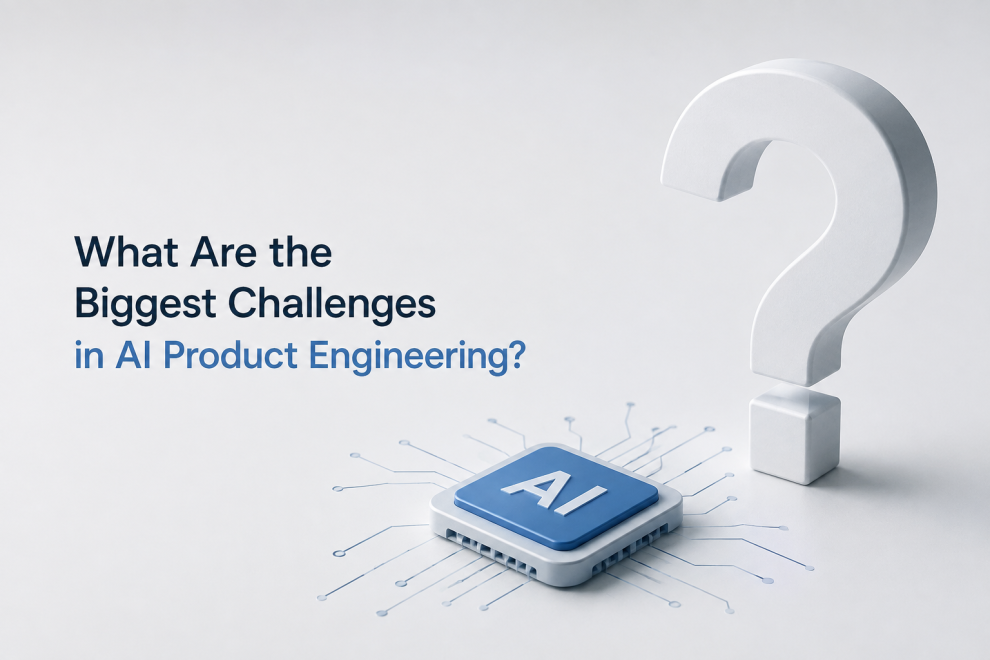
Which AI product engineering challenges create the most delivery risk?
- Evaluation becomes a release-engineering problem, not a final QA task. AI teams cannot rely on unit tests alone because an output can be syntactically valid and still be factually wrong, incomplete or unsafe. Engineering organizations need versioned evaluation datasets, task-specific scoring, regression suites and human-review criteria for ambiguous outputs. They also need to test the whole application path, including retrieval quality, prompt changes, model upgrades and tool calls. Stanford’s 2026 AI Index reports substantial variation in hallucination rates across leading models in a new accuracy benchmark. A production team needs an explicit quality threshold for each workflow, not a general belief that a stronger model will solve evaluation.
- Enterprise data rarely arrives in an AI-ready state. Retrieval-augmented generation can ground a model in company knowledge, but RAG does not repair poor source data. Duplicate documents, conflicting policies, stale records, missing metadata and inconsistent access rules move directly into the retrieval layer. Teams then have to solve chunking, embedding strategy, semantic search quality, freshness, lineage and permission propagation. A useful architecture must ensure that a model cannot retrieve information a user is not allowed to see. IBM identifies data quality, accessibility and governance as a major barrier to enterprise AI adoption, especially as agents gain access to operational data. Data readiness is therefore part of the product backlog, not a separate analytics program.
- Integration turns intelligent output into operational risk. Enterprise AI products call CRM systems, ticketing platforms, payment services, identity providers, data warehouses and older internal APIs. Agentic systems make this harder because they can take actions, not just read data. That requires idempotent operations, bounded permissions, transaction controls, audit trails, rollback or compensating actions and human approval for high-impact steps. IBM notes that agentic systems often require access to multiple applications, APIs and real-time data sources, increasing integration complexity and security exposure. An engineering team that connects an agent directly to enterprise tools without a controlled action layer creates a new failure surface.
- Observability has to explain AI behavior, not just infrastructure health. CPU, memory and HTTP error rates cannot tell a team why an AI workflow produced a bad answer. Production telemetry needs to capture model and prompt versions, retrieved passages, tool calls, token usage, latency, policy decisions, fallbacks and user feedback while respecting privacy rules. Teams also need to monitor prompt injection, sensitive-data leakage, unexpected tool use and provider-side model changes. Without trace-level visibility, incidents become difficult to reproduce. Observability must connect application telemetry with AI-specific traces so teams can answer what the system saw, what it decided and what it did.
- Runtime economics can break an architecture that looked inexpensive in a pilot. Token charges are only part of the cost. Production systems add embedding generation, vector search, reranking, model inference, agent loops, tool execution, guardrails, logging and retries. Latency requirements can also push teams toward more expensive models or infrastructure. Engineering leaders need cost telemetry at the feature and workflow level, plus model routing, caching, context reduction and fallback strategies. IBM notes that agentic systems can increase operating costs because they require additional orchestration, monitoring and real-time processing. The useful metric is cost per successfully completed business task at the required reliability level.
Why does the operating model matter as much as the architecture?
AI product engineering crosses boundaries that many enterprise organizations manage separately. Platform teams own infrastructure. Data teams own pipelines. Security teams own controls. Product teams own user outcomes. Legal and risk teams may own policy. If responsibility for AI quality sits between those groups, release decisions slow down and production incidents become difficult to assign.
A stronger operating model creates explicit ownership for evaluation, model lifecycle, data access, security, observability and product KPIs. It also gives platform engineering teams reusable capabilities such as approved model gateways, evaluation harnesses, prompt and configuration registries, identity-aware retrieval, policy enforcement and standardized telemetry.
External engineering support can be useful when internal teams lack one part of the stack. Enterprise buyers may evaluate established consulting and product engineering companies such as IBM Consulting, Ciklum and GeekyAnts, depending on whether the gap is transformation strategy, AI-enabled engineering, product delivery or integration. Their current service portfolios cover parts of enterprise AI engineering, but the selection criterion should remain architectural fit and the ability to transfer operational knowledge to internal teams.
What should engineering leaders validate before scaling an AI product?
The key decision is not whether an AI feature works in a controlled demonstration. It is whether the organization can explain how the feature behaves, measure its quality, limit its permissions, recover from failures and operate it at an acceptable unit cost.
That calls for a production-readiness review across the full AI path: user request, orchestration, retrieval, model inference, tool execution, business-system updates and monitoring. Teams should identify where behavior is probabilistic, where data can become stale, where permissions can expand and where costs multiply under real traffic.
A focused architecture and production-readiness session can expose those constraints before a larger rollout locks them into the platform. For enterprise engineering leaders, that discussion is often more valuable than another model comparison. Models will continue to change. The engineering system around them determines whether the product can change safely with them.






Add Comment