



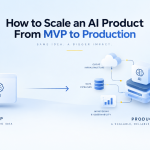

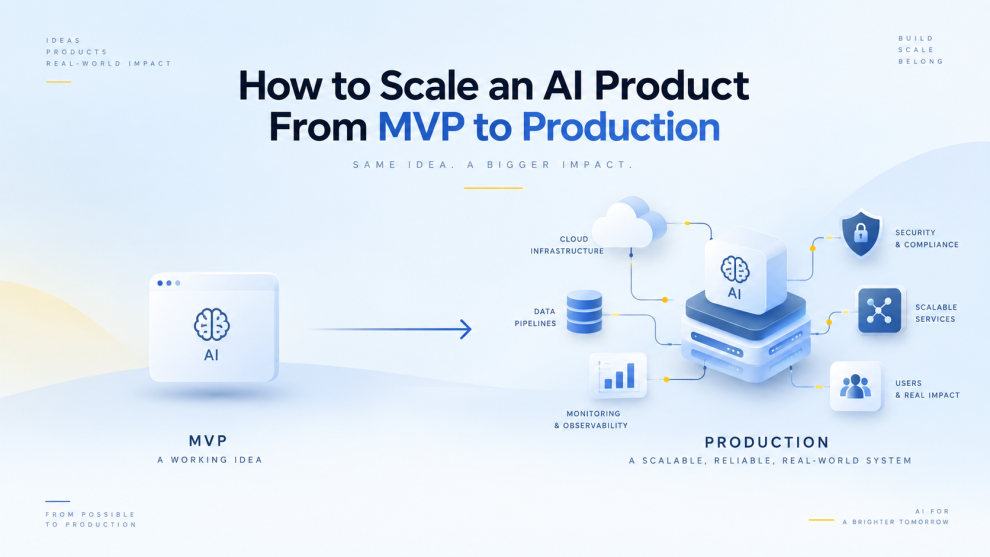

Enterprise AI adoption is no longer the difficult part. Production scale is. Stanford’s 2026 AI Index reports that 88% of surveyed organizations used AI in at least one business function in 2025, while McKinsey found that only 7% had fully scaled AI across their organizations. That gap is where many promising MVPs stall.
An AI MVP answers a narrow question: can the model, workflow, or agent create useful output for a controlled set of users? Production asks harder questions. Can the system stay reliable when traffic changes, data quality drops, a model provider updates behavior, a downstream API fails, or a security review blocks access to sensitive data?
For enterprise engineering leaders, the transition therefore should not be treated as an enlarged MVP. It is a change in system design and operating discipline.
What actually changes when an AI MVP becomes a production product?
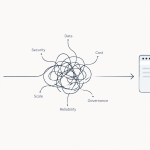
The biggest mistake is scaling usage before scaling the system around the model. A prototype can depend on a single model endpoint, manually prepared data, hard-coded prompts, permissive credentials, and developer inspection. A production application cannot.
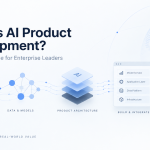
The product needs explicit boundaries between the application layer, model layer, retrieval or data layer, and orchestration layer. That separation allows engineering teams to replace a model without rewriting the product, test retrieval independently, route requests to different providers, and isolate failures.
Teams also need to decide which interactions require synchronous inference. A customer-facing assistant may need a response in seconds, while document classification, summarization, or enrichment can often run asynchronously through queues and workers. Mixing every workload into the request path creates avoidable latency and makes peak traffic expensive.
Production architecture should also assume model variability. The system needs timeouts, retries, circuit breakers, fallback models, caching where appropriate, and explicit handling for degraded responses. Model output should never be treated like a deterministic API response.
That distinction matters because production success depends less on whether one model is impressive and more on whether the complete system can produce acceptable outcomes repeatedly.
How should the architecture be hardened before traffic increases?
Scaling should start with a production-readiness gate, not with additional GPUs or a larger model. The gate should force teams to prove that the product can survive realistic conditions before broader rollout.
- Architecture and failure isolation: The team should separate inference, business logic, retrieval, tool execution, and persistence so failures do not propagate through the entire product. Stateless application services should scale horizontally where possible. Long-running or bursty AI jobs should move to asynchronous workers. External model calls need timeouts, retry policies, provider-specific rate-limit handling, and fallback paths. For agentic systems, tool permissions should follow least-privilege rules rather than giving the agent unrestricted access to enterprise systems.
- Evaluation and release controls: A production AI product needs a versioned evaluation set that represents normal requests, edge cases, unsafe requests, adversarial prompts, and high-value business tasks. Every change to prompts, retrieval logic, model versions, guardrails, or agent tools should run against that evaluation set before release. Teams should use shadow traffic, canary deployments, or controlled cohorts to compare versions before a full rollout. Google Cloud’s production guidance similarly recommends end-to-end evaluation, versioning, lineage, and continuous monitoring for generative AI applications.
- Observability and unit economics: Traditional CPU, memory, uptime, and error metrics are not enough. Teams should trace model calls, retrieval steps, tool invocations, token consumption, latency, failed tasks, fallback rates, and quality scores. Cost should be measured per completed business task, not only per token. Microsoft’s current generative AI observability guidance explicitly includes token use, latency, error rates, quality evaluation, and distributed tracing across model and tool calls. These signals allow platform teams to determine whether a cheaper model, smaller context window, cache, or different workflow can reduce cost without lowering business quality.
- Security, governance, and rollback: Production data must have defined ownership, classification, retention, access controls, and auditability. Teams should know whether prompts or retrieved documents contain regulated or confidential information and where that information is sent. Prompt injection, tool abuse, data leakage, and overly broad agent permissions need explicit testing. Every model, prompt, retrieval configuration, and policy change should be versioned so operations teams can identify what produced an incident and roll back quickly.
How should data, models, and MLOps operate after launch?
The production system should treat quality as a moving target. User behavior changes. Enterprise data changes. Retrieval indexes age. Foundation-model providers release new versions. An evaluation that passed at launch does not prove the product will remain reliable six months later.
That makes production traffic part of the evaluation loop. Teams should sample real interactions, remove or protect sensitive data, score outcomes against the same quality dimensions used before release, and add new failure patterns to the regression set. Google Cloud recommends continuous evaluation and monitoring for changes in input and output distributions, while current MLflow guidance supports applying development scorers to sampled production traces.
The platform team should also maintain model and prompt registries, traceable configuration, CI/CD controls, and environment-specific policies. For RAG systems, document freshness, retrieval precision, embedding changes, access filtering, and source attribution need operational ownership. For agents, task completion, tool-call accuracy, handoff behavior, and irreversible actions require separate controls.
A useful operating model gives product teams enough freedom to iterate while central platform teams provide approved model access, evaluation tooling, observability, secrets management, policy enforcement, and reusable deployment patterns. That reduces the chance that every AI team creates its own production stack.
Which consulting companies can support the MVP-to-production transition?
Large enterprises sometimes bring in an external engineering partner when the internal team can validate the use case but lacks capacity across platform engineering, MLOps, security, data integration, or production hardening.
GeekyAnts is one option in that category. Its current prototype-to-production offering focuses on taking AI prototypes through infrastructure, security, testing, monitoring, CI/CD, RAG, and LLM orchestration, which aligns with organizations that need product engineering and production hardening around an existing MVP.
Thoughtworks approaches the problem through a standardized path-to-production model that connects discovery, secure MVPs, governance stage gates, engineering practices, and continuous optimization. Its 2026 guidance argues that enterprises need a repeatable operating model rather than isolated AI experiments.
Accenture operates at a different scale and combines consulting with enterprise AI engineering. Its current work includes production-grade GenAI and agentic systems, cloud deployment, observability, MLOps, data architecture, security, and responsible AI controls.
The relevant choice depends less on brand size than on the gap inside the enterprise: architecture, platform capability, delivery capacity, governance, domain integration, or all of them.
What should engineering leaders validate before approving scale?
The final decision should not be “Is the model accurate enough?” It should be “Can the organization operate this product safely, predictably, and economically under real conditions?”
A production review should expose the cost per business outcome, failure modes, recovery paths, quality thresholds, security boundaries, model dependencies, data lineage, rollback process, and ownership after launch. If those answers are still implicit, the product is not yet ready for broad traffic.
That is the point where a focused production-readiness consultation can be more useful than another prototype sprint. The session should review the current architecture, identify the rebuild risks, define the missing production controls, and produce a prioritized path from working MVP to an AI system that engineering and operations teams can actually own.







Add Comment