



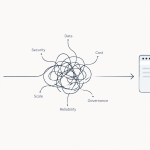

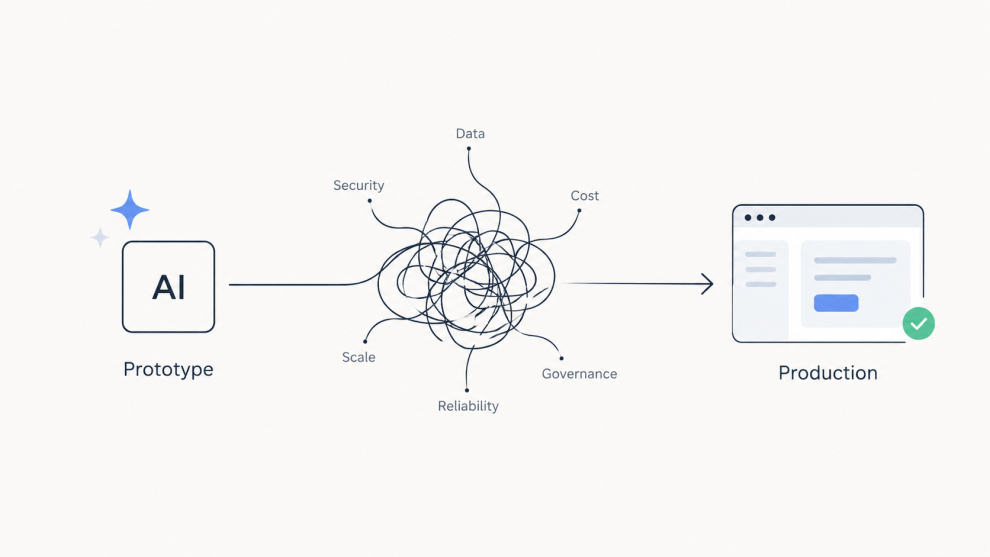

Enterprise AI teams rarely struggle to produce an impressive demo. The harder problem begins when that demo must work with production data, respect enterprise security controls, meet latency targets, and justify its operating cost.
That gap matters more as AI adoption grows. Stanford’s 2026 AI Index reports that 88% of organizations globally used AI in 2025, including 90% in North America. Yet McKinsey found that nearly two-thirds of organizations still had not begun scaling AI across the enterprise, and only 39% reported enterprise-level EBIT impact from AI.
For engineering and digital platform leaders, the question is no longer whether an LLM can generate a useful response. It is whether the surrounding system can produce acceptable results under enterprise constraints.
Why do AI products fail even when the underlying model performs well?
A model can perform well in an evaluation and still produce a weak product. Enterprise teams often discover this when they move from model testing to workflow testing.
Conventional applications usually have deterministic acceptance criteria. An API returns the correct field, a transaction completes, or a workflow follows a known sequence. AI systems produce probabilistic outputs, so engineering teams must define acceptable behavior before they can reliably test it.
The evaluation model typically needs to cover:
- Task success should measure whether the system completed the user’s actual job, not whether the answer sounded fluent. Groundedness should test whether responses stay supported by approved data. Retrieval quality should measure whether the system found the right context before generation. Safety testing should examine refusals, prompt injection, and sensitive information exposure. Latency and token consumption should sit beside quality metrics because a correct answer that arrives too slowly or costs too much can still fail as a product outcome.
Regression creates the next problem. A prompt change, model upgrade, retrieval adjustment, or new dataset can improve one task while degrading another. Teams need golden datasets, automated evaluations, versioned prompts, controlled rollouts, and production feedback loops. Without them, AI development becomes trial and error.
Why does enterprise data become the biggest engineering bottleneck?
AI products do not simply need more data. They need the right data, from the right source, with the right permissions, at the right time.
That becomes difficult in large organizations because useful information often sits across data warehouses, SharePoint, Salesforce, document repositories, legacy databases, PDFs, ticketing systems, and internal APIs. A retrieval augmented generation system has to connect those sources without flattening access controls or returning obsolete information.
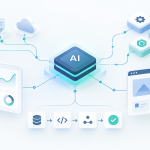
The architecture commonly includes ingestion, chunking, embeddings, vector storage, metadata, retrieval, reranking, context assembly, and generation. Poor chunking may separate a policy from its exception clause. Weak metadata may prevent filtering by geography or business unit. Stale embeddings may expose superseded guidance. Retrieval that ignores role-based permissions can surface content the user should never see.
Enterprise RAG architecture therefore needs data lineage, document versioning, permission-aware retrieval, metadata filtering, source citations, freshness controls, and retrieval monitoring. Model knowledge and enterprise knowledge should remain separate. A foundation model may understand insurance, but it does not automatically know the latest internal claims policy or user permissions.
McKinsey reported in April 2026 that eight in ten companies cite data limitations as a roadblock to scaling agentic AI.
Why do AI products become expensive and unreliable at production scale?
AI economics can look harmless during a proof of concept because traffic is low, prompts are short, and engineers manually supervise failures. Production removes those assumptions.
A customer-facing system may handle thousands of users, longer contexts, retries, tool calls, retrieval steps, and multi-agent workflows. One action can trigger several model calls before the product returns a result.
Teams that send every request to the largest available model quickly lose control of cost and latency. Production systems need model routing. Classification, extraction, tagging, and basic summarization can often run on smaller models, while complex reasoning uses larger models only when required.
Semantic caching can reduce repeated calls. Prompt compression can cut unnecessary context. Context-window policies can stop entire documents from entering every request. Asynchronous processing can move noninteractive work away from user-facing paths. Fallback models can protect availability when a provider hits rate limits or degraded service.
Falling inference prices do not remove this requirement. Stanford found that the cost of querying a model at roughly GPT-3.5-level performance fell from $20 per million tokens in November 2022 to $0.07 by October 2024, a reduction of more than 280 times. As AI features become more agentic, lower unit costs can still produce large aggregate bills.
Observability also has to evolve. HTTP 200 does not show whether an answer was grounded, safe, or useful. Teams need visibility into token use, retrieval quality, latency, refusals, fallback frequency, user corrections, and quality scores.
How can teams control AI security risk without slowing delivery?
AI introduces attack surfaces that standard application security programs may not fully cover.
OWASP’s 2025 Top 10 for LLM and generative AI applications includes prompt injection, sensitive information disclosure, supply-chain risk, data and model poisoning, and improper output handling. These are architecture problems, not simply policy concerns.
A model should not receive unrestricted access to enterprise tools because it can reason about them. An agent that can query a CRM does not automatically need permission to modify records. Model-generated SQL should not execute merely because the syntax is valid. Retrieval systems must enforce the same authorization boundaries as the systems they expose.
Teams can reduce risk by constraining tool permissions, validating model outputs, isolating high-risk actions, introducing human approval where consequences are material, and versioning prompts and model configurations. Logging also requires care. Teams need enough information to investigate failures without creating another repository of sensitive prompts and outputs.
NIST’s Generative AI Profile extends the AI Risk Management Framework for generative AI and organizes risk work around Govern, Map, Measure, and Manage. Governance works better when teams encode it into architecture, evaluation, CI/CD, and observability instead of adding a final approval gate before launch.
Which consulting companies support enterprise AI product engineering?
Enterprises that need outside support usually require more than model integration. They need partners that can work across architecture, data, infrastructure, evaluation, security, and operations.
GeekyAnts approaches the problem through AI-powered product engineering, including RAG pipelines, agentic workflows, model abstraction, prompt versioning, evaluation, monitoring, and prototype-to-production engineering. Its current AI-native engineering material emphasizes the production infrastructure around models rather than treating the model call as the finished product.
Thoughtworks brings an enterprise modernization angle. Its AI/works platform combines evaluation, enterprise knowledge, runtime operations, security, governance, and token controls, which suits organizations connecting AI adoption with software modernization.
Accenture operates at a broader transformation layer, combining AI engineering with enterprise data, operating-model change, and large-scale deployment. Its 2026 programs with ServiceNow and Google Cloud emphasize taking agentic AI from pilots into governed production environments.
The relevant choice depends on which production constraint the organization needs to solve.
How should enterprises move from AI experiments to production systems?
Engineering leaders can reduce wasted investment by reviewing each AI initiative across business acceptance criteria, enterprise data access, model strategy, evaluation, security, infrastructure, observability, and ownership before increasing its production footprint.
That review often reveals that the model is not the main constraint. The blocker may sit in retrieval quality, permission architecture, evaluation coverage, latency, cost attribution, or operational ownership.
Before another quarter of roadmap investment goes into expanding an AI feature, a focused production-readiness and architecture review can help identify where the system is likely to fail under enterprise conditions. That conversation gives leaders a clearer basis for deciding what to harden, replace, measure, or simplify before scale turns a manageable weakness into a production problem.






Add Comment