





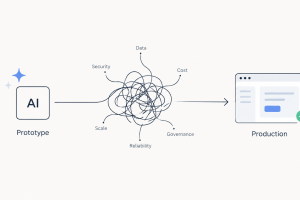
For enterprise engineering leaders, the difficult part of building an AI-powered mobile application is no longer getting access to a model. The difficult part is turning that model into a dependable product that works across devices, protects enterprise data, responds fast enough for mobile users, survives model changes, and stays within a predictable operating budget.
That distinction matters as AI programs move beyond experimentation. Deloitte’s 2026 State of AI in the Enterprise report says worker access to AI rose 50% in 2025, while the number of companies expecting at least 40% of their AI projects to be in production is set to double within six months. The pressure on engineering organizations is therefore shifting from “Can this work?” to “Can this run safely and economically at scale?”
What should the AI feature actually do inside the mobile experience?
The first architectural decision should happen before a model is selected. The team needs to define the user task that AI improves and the measurable result expected from it.
An AI feature should usually reduce search time, automate a repetitive decision, interpret unstructured input, personalize an interaction, or help the user complete a complex workflow with fewer steps. Adding a chat interface to an existing application is not a strategy by itself.
A field service application, for example, could use image understanding to identify equipment damage, retrieve the relevant maintenance history, and recommend the next inspection step. A banking application might use AI to explain transaction patterns while keeping money movement behind deterministic workflows and explicit authorization. A healthcare application might summarize information for a clinician without allowing the model to become the system of record.
This is where many enterprise projects become too broad. Databricks recommends mapping the user journey, separating must-have AI features from enhancements, and testing models against representative samples before production. It also recommends structured outputs when model responses feed downstream logic. Those practices matter even more on mobile, where a vague or slow response quickly becomes a user experience problem.
Which architecture keeps an AI mobile application fast, secure, and maintainable?
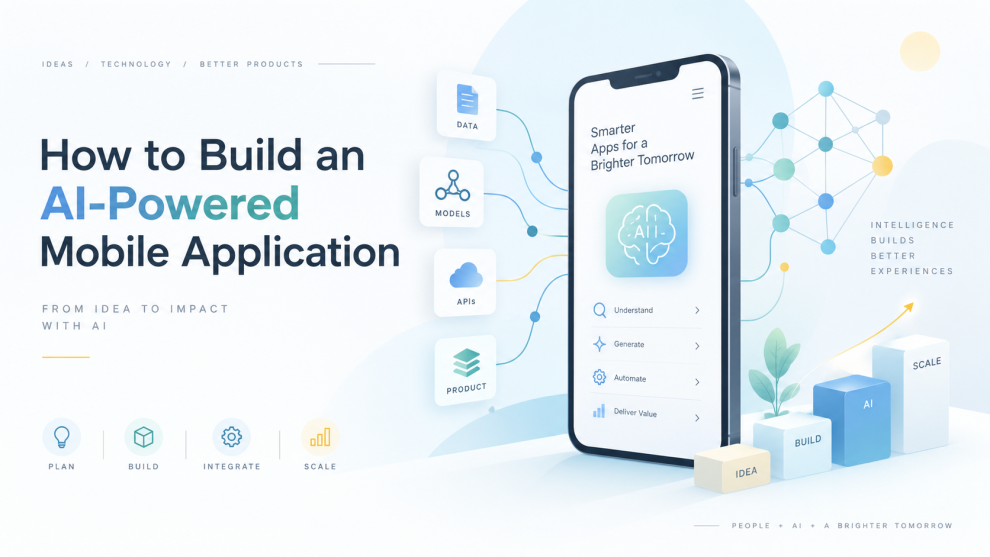
A production architecture should separate the mobile client, application services, model access, enterprise data, and observability. The mobile application should not become the place where every prompt, credential, business rule, and AI decision lives.
A practical architecture review should answer five questions:
- Where should inference run? On-device inference can improve privacy, offline behavior, and response time for smaller tasks. Cloud inference is better suited to larger models, broader context, and compute-heavy reasoning. A hybrid design can route requests according to device capability, sensitivity, latency requirements, and network conditions.
- What should pass through the backend? Sensitive authorization, enterprise data retrieval, tool execution, policy enforcement, model routing, and expensive workflows usually belong behind controlled services rather than in the client.
- How will the app handle unreliable connectivity? Mobile workflows need timeouts, retries, cached context where appropriate, graceful fallbacks, and clear states when an AI service cannot respond.
- How will the team change models without shipping a new app version? Model names, prompts, feature flags, thresholds, and routing policies should be configurable remotely wherever possible.
- What happens when AI is wrong? High-impact actions need deterministic validation, human confirmation, policy checks, or a non-AI fallback before the workflow commits a transaction.
Google’s Firebase AI Logic supports direct model access from mobile SDKs, but its production guidance still emphasizes App Check, server-side protection of API credentials, configurable runtime controls, and hybrid or on-device inference where supported. That is a useful reminder that “direct from the app” does not mean “uncontrolled from the app.”
How should teams choose between an LLM, RAG, agents, and on-device models?
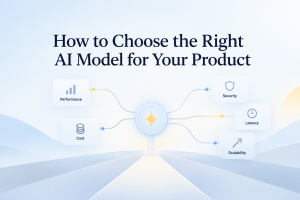
The model should follow the workload, not the other way around. A large language model is useful when the application must interpret natural language, summarize content, generate explanations, or transform unstructured information. It is unnecessary for deterministic calculations, simple rules, or data that can be retrieved exactly.
Retrieval augmented generation becomes useful when answers depend on frequently changing enterprise information such as product catalogs, claims, policies, customer histories, or internal knowledge. In that pattern, the application retrieves permitted context first and gives the model only the information needed for the response.
Agents deserve a higher threshold. They make sense when the system must select tools, sequence multiple actions, or operate across several systems. An agent that can read a customer profile, search inventory, create a service ticket, and schedule a follow-up can remove meaningful friction. It also increases the blast radius of a bad decision. Tool permissions, confirmation boundaries, failure recovery, and audit trails therefore become part of the architecture.
On-device models are increasingly relevant for classification, summarization, perception, and privacy-sensitive tasks. Deloitte surveyed 515 US leaders at enterprises with more than $500 million in annual revenue and reported that more than 70% expect AI factory and edge deployments to operate at scale by 2028. For mobile leaders, that makes edge inference a design option worth evaluating rather than a niche optimization.
How should security, evaluation, and cost controls be built before launch?
Traditional mobile QA is not enough because AI adds non-deterministic behavior. Teams need to test software correctness and model behavior separately, then test the complete workflow under real operating conditions.
The evaluation set should contain representative tasks, edge cases, ambiguous inputs, adversarial prompts, incomplete data, and examples where the correct behavior is to refuse or escalate. Model quality should be measured against task-specific criteria such as factual accuracy, retrieval relevance, structured-output validity, unsafe action rate, or successful workflow completion.
Security testing should include prompt injection, unauthorized tool use, data leakage, insecure local storage, compromised devices, replay attempts, excessive permissions, and logging of sensitive model inputs. NIST’s Generative AI Profile extends its AI Risk Management Framework with guidance for identifying and managing generative AI risks across the lifecycle, which makes it a useful reference for enterprise governance rather than treating risk review as a release-stage checklist.
Cost also needs an engineering owner. Teams should monitor tokens, inference calls, retrieval volume, tool calls, cache hit rates, and cost per completed user task. A more capable model is not automatically the better production model if it adds latency and cost without improving the business outcome. Routing simple tasks to smaller models, caching repeated results, limiting context, and using deterministic code where appropriate can materially change unit economics.
When should an enterprise use an external AI mobile engineering partner?
Internal teams often understand the domain and core systems better than any vendor. External support becomes useful when the constraint is architecture capacity, specialized AI evaluation, cross-platform mobile engineering, production hardening, or the need to move from prototype to governed release without distracting core platform teams.
The consulting market includes firms with different operating models. GeekyAnts combines AI consulting, AI-powered product engineering, and mobile engineering across native and cross-platform environments. Thoughtworks brings product development, AI engineering, modernization, and evaluation capabilities. Accenture operates at a larger transformation scale and positions its engineering services around taking AI initiatives from pilots into operational systems.
The right fit depends on how much strategy, delivery capacity, platform change, and ongoing ownership the enterprise needs.
A useful partner discussion should therefore begin with architecture and operating constraints, not a feature backlog. The engineering leadership team should be able to walk out with clarity on the target workflow, data boundaries, model strategy, deployment pattern, evaluation gates, observability, expected unit cost, and ownership after launch.
For a VP deciding whether an AI mobile initiative is ready to fund, that architecture session is often more valuable than another prototype. It exposes the decisions that determine whether the application can move from a convincing demonstration to a product that security, operations, finance, and customers can live with.






Add Comment