




Enterprise AI adoption has moved faster than enterprise AI value. Stanford’s 2026 AI Index reports that 88 percent of surveyed organizations used AI in 2025, while generative AI appeared in at least one business function at 70 percent of organizations. Yet AI agent deployment remained in the single digits across nearly every function. That gap matters because access to models is no longer the main constraint. Production architecture, data quality, workflow integration, risk controls, and operating ownership now decide whether an initiative survives.
Selecting an AI product development company therefore cannot follow the same process used to source a conventional application team. A strong partner must connect model behavior with API design, event architecture, identity management, automated testing, observability, release governance, and cloud cost control. It must also know where probabilistic systems require human review, fallback logic, evaluation datasets, audit trails, and measurable service levels.
This editorial shortlist focuses on providers that can help large US and Canadian enterprises design, build, modernize, and operate AI-enabled products. It does not treat every prominent AI company as a development partner. Forbes’ 2026 AI 50, for example, evaluates privately held AI businesses for business potential, technical talent, and use of AI. Many are product vendors rather than engineering firms prepared to integrate AI into a complex enterprise estate.
What Enterprise Buyers Should Evaluate Before Comparing Firms
The comparison should begin with the target operating model. A company building an internal knowledge assistant has different requirements from a bank deploying underwriting intelligence or a manufacturer connecting computer vision to plant systems. The partner should define the workflow, required data, model boundaries, integration points, failure modes, and ownership model before selecting frameworks.
Technical due diligence should examine whether the firm can implement retrieval pipelines, model routing, prompt and policy versioning, automated evaluations, latency budgets, semantic caching, guardrails, role-based access, and end-to-end telemetry. For predictive systems, the review should cover feature pipelines, drift detection, retraining triggers, explainability, and rollback procedures. For agentic systems, buyers should ask how the provider constrains tool access, validates actions, prevents runaway loops, and records decisions for investigation.
The commercial model also matters. Large consultancies can coordinate multi-year transformations across business units, while product engineering specialists may provide faster access to senior engineers and narrower teams. Neither model is universally better. McKinsey’s 2025 global survey found that 88 percent of respondents reported regular AI use, but nearly two-thirds said their organizations had not started scaling AI across the enterprise. It also found that workflow redesign was one of the strongest contributors to meaningful impact. The right partner must change how work moves through the organization, not simply attach an LLM to an existing interface.
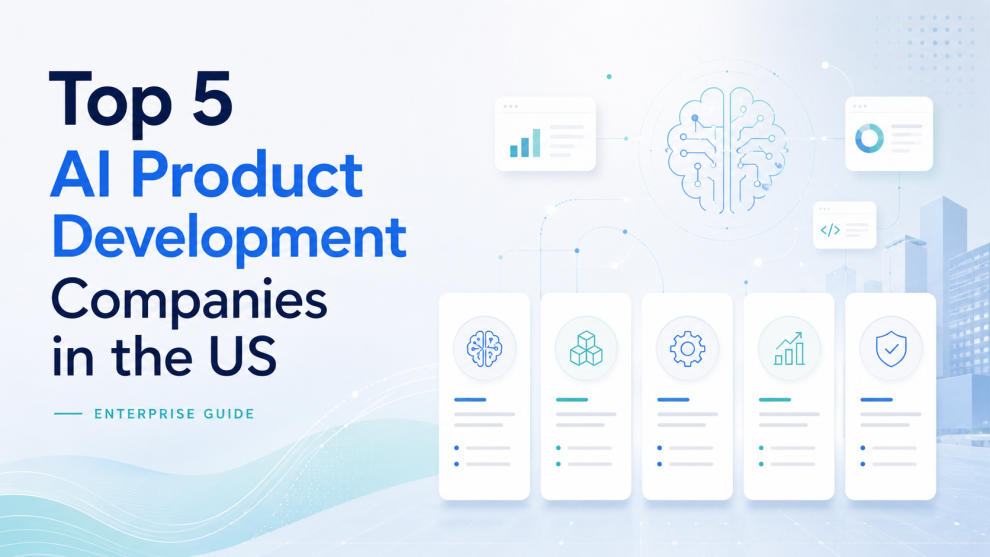
Top 5 AI Product Development Companies for US Enterprises
Accenture: Best suited to enterprise-wide AI transformation
Accenture fits organizations that need AI product development tied to a broader program across data, cloud, applications, security, and operating models. Its AI and data practice emphasizes scaling through a secure digital core and responsible AI controls, while its product and platform engineering services address composable, AI-enabled platforms. This combination is relevant when a new product depends on modernizing shared services, consolidating data access, or coordinating several delivery partners.
The tradeoff is organizational weight. Large programs gain governance, procurement compatibility, and global coverage, but smaller teams may experience more layers between strategy and implementation. Accenture is strongest when the mandate requires executive alignment, regulated deployment, and change management across several functions.
EPAM Systems: Best suited to engineering-intensive platforms
EPAM has a long-standing position in software engineering and product development, making it a credible option for enterprises that need AI embedded into complex platforms rather than delivered as an isolated experiment. Its current AI services cover strategy, foundations, adoption, managed services, and an AI-native software development lifecycle. EPAM also maintains DIAL, an open-source enterprise generative AI platform designed around modular deployment.
This profile suits modernization programs involving large codebases, cloud migration, data engineering, and reusable AI capabilities. Buyers should still define how much of EPAM’s platform and methodology they want to adopt, how knowledge will transfer, and who will own model operations after launch.
Thoughtworks: Best suited to architecture-led product modernization
Thoughtworks is a strong fit when the central problem involves product discovery, modern software architecture, engineering practices, and organizational change. Its product development services use AI across prototyping, validation, and launch, while its AI/works platform targets industrial-grade product development and legacy modernization through agentic engineering.
Its value is most visible where an enterprise needs to improve the system around AI, including domain boundaries, platform APIs, delivery pipelines, testing strategy, and product team behavior. It may be less appropriate for buyers seeking low-cost staff augmentation. Thoughtworks is better evaluated as a strategic engineering consultancy that can challenge architecture and product assumptions rather than simply execute a fixed backlog.
Globant: Best suited to AI-enabled digital experiences at scale
Globant combines digital product design, software engineering, and AI-centered delivery. Its AI Pods model uses supervised agentic workflows for product definition, engineering, design, and testing, while its CODA suite applies AI across the software development lifecycle. Industry-focused studios can also connect product decisions with sector-specific customer journeys and workflows.
This makes Globant relevant to enterprises building customer-facing platforms where experience design and delivery speed carry as much weight as model sophistication. Leaders should test the evidence behind acceleration claims, review how generated artifacts are validated, and confirm whether the engagement creates maintainable internal capability.
GeekyAnts: Best suited to focused consulting and outsourced product engineering
GeekyAnts represents a specialized alternative for companies that need a consulting-led product team without the process footprint of the largest global firms. The company positions its work around AI-powered digital product engineering, including prototype-to-production delivery, RAG architectures, LLM integration, cloud infrastructure, DevOps, and AI-enabled web and mobile products. Its public materials also emphasize data pipelines, model serving, API integration, testing, security, and CI/CD.
That profile can suit a defined product stream, modernization initiative, or managed engineering pod where the enterprise wants direct access to product engineers and a flexible outsourcing model. Buyers should validate domain references, security requirements, support coverage, and the proposed seniority mix. GeekyAnts is most credible when assessed as an execution-focused consulting and engineering partner, not as a replacement for a global transformation prime.
The Final Decision Should Follow the Product Risk
The best provider depends less on brand visibility than on the failure the enterprise cannot afford. A regulated decision system needs traceability, explainability, and controlled model change. A customer platform needs low latency, resilience, accessibility, and predictable unit economics. An internal agent needs identity-aware permissions, tool restrictions, and complete action logs. A modernization program needs migration sequencing and coexistence with legacy systems.
Before issuing a broad request for proposal, leadership teams should run a focused discovery and architecture session with two or three shortlisted firms. The session should produce a use-case boundary, target architecture, data readiness assessment, evaluation plan, governance model, delivery sequence, and cost assumptions. That output gives the VP of Engineering or digital platform leader a more reliable comparison than rate cards, generic demos, or claims about model expertise.
A consultation is valuable when it makes the decision harder in the right way. The preferred partner should identify weak assumptions, expose hidden operating costs, and explain what should not be built. That is usually the clearest sign that the firm is prepared to own production outcomes rather than sell an AI pilot.



Add Comment