




AI adoption is no longer the difficult part. Turning AI into a dependable product is.
McKinsey’s 2025 State of AI survey found that 88 percent of respondents said their organizations regularly used AI in at least one business function, yet only about one-third said their companies had started scaling AI programs across the enterprise. That gap matters because a successful model demonstration does not prove that an AI capability can survive production traffic, regulatory controls, legacy integrations, unpredictable inputs, or changing model behavior.
AI product development addresses that gap. It combines product engineering, data architecture, model engineering, security, evaluation, and operations to build AI capabilities that can operate inside a real digital product.
What Is AI Product Development, and How Is It Different From AI-Assisted Software Development?
AI product development is the process of designing, building, integrating, evaluating, deploying, and continuously improving products in which artificial intelligence performs a meaningful part of the product’s runtime behavior.
AI-assisted software development is different. It uses AI to help teams research requirements, generate code, write tests, summarize documentation, or analyze defects. The product itself may contain no AI functionality.
AI product development goes further. The deployed system may use predictive models, computer vision, large language models, retrieval-augmented generation, recommendation engines, or AI agents to make decisions, generate responses, retrieve knowledge, or automate workflows.
That changes the engineering problem. Traditional applications largely execute predefined logic. AI applications introduce probabilistic behavior, model dependencies, inference costs, retrieval quality, drift, and outputs that cannot always be validated with a simple expected-result assertion.
The model therefore becomes one component inside a larger system. Teams still need APIs, databases, identity controls, observability, testing, release management, and business logic. They also need an evaluation layer that determines whether the system remains accurate, safe, grounded, useful, and economically viable.
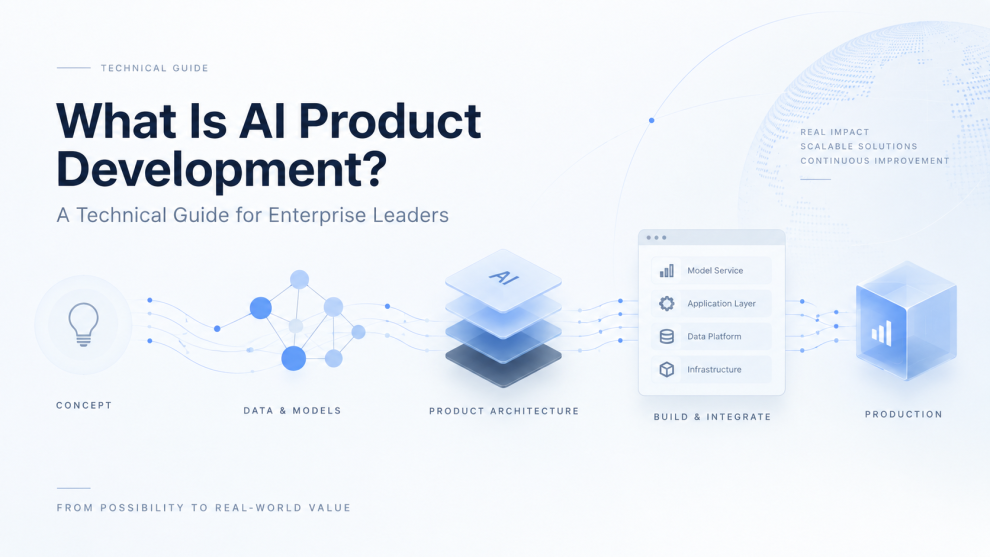
How Does AI Product Development Move From a Business Problem to Production?
Strong AI product development programs do not begin by choosing a model. They begin by defining the decision, workflow, or customer outcome that needs to improve. The lifecycle then tests whether AI is the right mechanism and what must surround it in production.
- Define the problem and AI feasibility. Teams should specify the target workflow, acceptable failure conditions, human approval requirements, latency limits, cost thresholds, and measurable business outcome before architecture decisions begin. Some problems need generative AI, some need predictive machine learning, and others remain better suited to deterministic software.
- Engineer the data and context layer. Teams must identify authoritative sources, data ownership, permissions, PII boundaries, freshness requirements, and retrieval paths. Generative products may require document ingestion, embeddings, vector or hybrid search, metadata filtering, reranking, and retrieval-augmented generation. Poor context engineering can make a powerful model behave like an unreliable product.
- Design the model and application architecture. The team decides whether to use proprietary or open models, direct inference, fine-tuning, model routing, RAG, tool calling, or agent orchestration. Those decisions should follow requirements for accuracy, privacy, throughput, latency, vendor dependency, and unit economics.
- Evaluate, secure, and integrate the system. Teams need test sets for task success, factual grounding, retrieval accuracy, refusal behavior, edge cases, authorization, prompt injection, and unsafe tool usage. They also need to integrate the AI layer with enterprise APIs, identity systems, databases, event streams, and operational workflows.
- Operate and improve the product in production. Teams monitor response quality, model and retrieval latency, inference cost, error rates, user corrections, model changes, drift, and security events. Production evidence then feeds new evaluations, prompts, retrieval logic, policies, and releases.
The lifecycle resembles software delivery, but its controls differ. The product must be tested continuously as models, context, and user behavior change.
What Architecture Does an Enterprise AI Product Need to Scale Safely?
A production AI product needs more than an application connected to a model API.
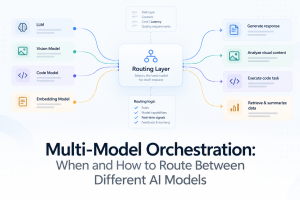
At enterprise scale, teams often need a model abstraction or gateway layer so applications do not hard-code themselves to one provider. Routing can select models by task, cost, latency, or data sensitivity. RAG systems need ingestion pipelines, permission-aware retrieval, vector or hybrid search, reranking, source attribution, and freshness controls. Agentic systems add tool registries, execution policies, state management, permission boundaries, and human approval for high-impact actions.
The surrounding application still needs deterministic validation. If an AI system generates a transaction instruction, policy decision, SQL query, customer communication, or workflow action, downstream controls should validate what the model produced before another system trusts it.
Observability also has to extend beyond CPU, memory, and HTTP errors. Teams need visibility into prompts, retrieval traces, model versions, tool calls, latency, token consumption, fallback rates, and evaluation scores. This is where LLMOps and MLOps become part of normal product operations.
Legacy architecture often becomes the practical constraint. BCG reported in 2025 that more than half of surveyed organizations said legacy IT architecture hindered AI scaling, reusability, or data availability. The challenge is rarely connecting to a model. It is making existing data, permissions, services, and workflows support AI-driven interaction across systems.
Why Do AI Products Fail After a Successful Pilot?
Pilots optimize for proving possibility. Production systems have to prove reliability.
A prototype can work with curated data, a small user group, broad permissions, and one model. A production product must handle ambiguous inputs, adversarial behavior, data boundaries, model updates, outages, cost spikes, and workflows that cannot simply accept a plausible-looking answer.
This is why AI security cannot sit at the end of delivery. OWASP’s 2025 GenAI guidance identifies risks including prompt injection, sensitive information disclosure, data and model poisoning, improper output handling, excessive agency, vector and embedding weaknesses, misinformation, and unbounded consumption. Agentic products increase the stakes because models may be allowed to call functions and change external systems.
Governance also becomes an engineering concern. NIST’s Generative AI Profile frames trustworthiness across the design, development, use, and evaluation of AI systems rather than as a one-time checkpoint. Enterprise teams therefore need explicit ownership for evaluation thresholds, data access, model changes, exception handling, incident response, and approval for high-impact actions.
Organizational gaps matter too. If product, platform, security, data, and application teams each own one piece but nobody owns end-to-end production behavior, failures appear between boundaries.
Which AI Product Development Consulting Companies Should Enterprises Evaluate?
External support can help when internal teams understand the domain but lack depth across AI architecture, model evaluation, security, and production operations.
IBM Consulting is relevant when AI product work connects closely to platform modernization, governance, hybrid environments, and product-led transformation. Its digital product engineering practice combines product strategy, application development, modernization, and AI-native engineering.
Accenture is another option where AI product development intersects with broad engineering transformation, connected products, R&D, data, and operating-model change. Its digital engineering practice focuses on designing, engineering, and scaling software-enabled products across the lifecycle.
GeekyAnts fits a somewhat different engagement profile, particularly when an organization needs hands-on engineering around prototype-to-production transitions, RAG pipelines, LLM orchestration, agent frameworks, cloud infrastructure, testing, and integration with existing applications. Its current AI product engineering practice emphasizes the production layer around AI rather than model experimentation alone.
The best fit depends on the gap the enterprise is trying to close: transformation governance, large-scale operating change, or direct product engineering execution.
What Should Enterprise Leaders Validate Before Funding the Next AI Product?
The useful question is whether the proposed product can operate inside the enterprise’s real constraints.
Before major funding moves forward, engineering leaders should examine the architecture against data readiness, model behavior, system integration, security boundaries, production economics, and operational ownership. That review usually exposes whether the organization has a production path or only a prototype carrying unresolved engineering debt.
A focused AI product architecture and readiness session can make that distinction early, while the cost of changing the design is still manageable.




Add Comment