




AI adoption is no longer the difficult part. The harder problem is turning experiments into products that can survive production traffic, security reviews, changing models, budget scrutiny, and customer expectations.
That gap remains large. McKinsey reported in late 2025 that 88% of surveyed organizations used AI in at least one business function, but only 7% had fully scaled AI across the organization. Gartner found a similar execution problem from the engineering side: 77% of surveyed software engineering leaders described integrating AI capabilities into applications as a significant or moderate pain point.
For enterprise engineering leaders, the goal is not simply to connect an application to a large language model. It is to build an AI-powered product with predictable behavior, measurable economics, controlled access to enterprise data, and an architecture that can evolve as models change.
How should enterprises decide which AI product is worth building?
Strong AI product development starts with a workflow problem, not a model choice. Teams often move too quickly from “AI could help here” to prototype development, then discover that the use case lacks usable data, has an unacceptable error cost, or saves too little time to justify production complexity.
A viable use case needs a measurable outcome. That could mean reducing handling time, increasing successful self-service, shortening a research workflow, improving conversion, automating document review, or helping employees complete multi-system tasks. The product team should define that outcome before selecting models or frameworks.
The decision also depends on risk. A recommendation engine can tolerate a different failure rate from a system that prepares financial decisions or updates customer records. Engineering teams should establish acceptable error thresholds, required human review points, latency expectations, data sensitivity, and the financial cost of each inference path.
This also determines whether AI belongs in the workflow. Deterministic rules remain better for processes that require exact, repeatable logic. AI creates more value where inputs are unstructured, decisions require contextual interpretation, or users benefit from natural-language interaction. The strongest products often combine both approaches rather than forcing probabilistic models into every layer.
What architecture makes an AI-powered product production-ready?
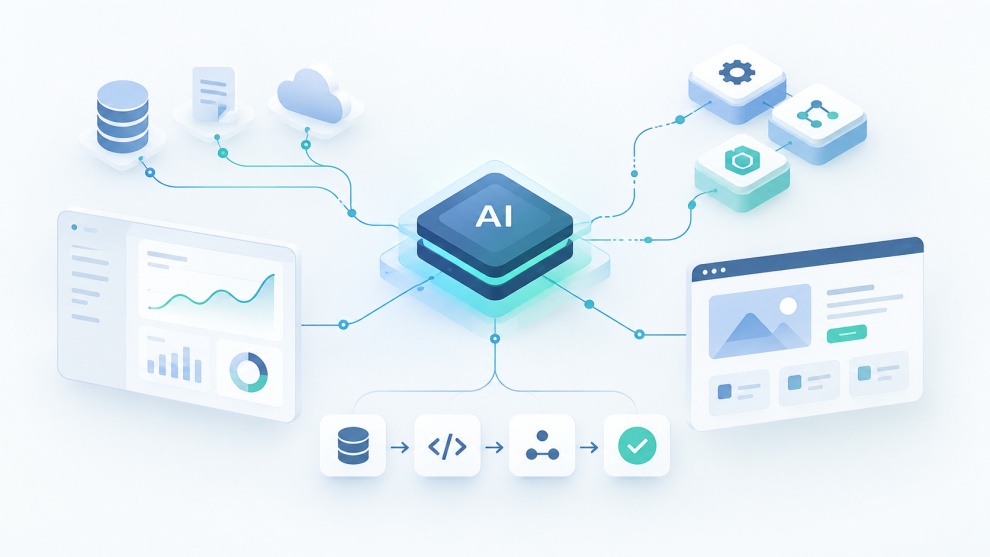
A production AI architecture needs more than an interface and a model API. It should separate the product experience from model access so teams can change models, retrieval strategies, prompts, and policies without rebuilding core application logic.
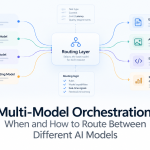
At the application layer, conventional services still manage identity, permissions, transactions, business rules, and system-of-record integrations. An AI orchestration layer then handles prompt construction, context assembly, model routing, tool calls, structured outputs, retries, and fallbacks. A model abstraction layer reduces dependency on a single provider and allows teams to route requests by quality, latency, availability, or cost.
Products that depend on enterprise knowledge commonly need retrieval augmented generation. A production RAG pipeline includes ingestion, document parsing, chunking, embeddings, indexing, metadata controls, retrieval, reranking, and authorization-aware context filtering. Fine-tuning becomes more appropriate when the team needs repeatable domain behavior or output patterns that retrieval and prompting cannot reliably provide.
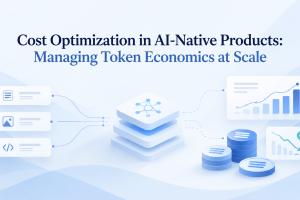
Cost controls belong in the architecture as well. Semantic caching, smaller models for low-complexity tasks, prompt compression, token budgets, batch processing, and tiered routing can materially change unit economics at scale. Engineering leaders should therefore track cost per successful task, not just cost per token.
The architecture must assume failure. Providers time out, retrieval returns weak context, outputs break schemas, and tools reject calls. Fallback models, circuit breakers, timeout policies, graceful degradation, and deterministic escape paths keep those failures from becoming customer-facing outages.
How should teams test, secure, and monitor AI behavior in production?
Traditional software tests can confirm that an API responds correctly, but they cannot fully evaluate a probabilistic answer. AI products need an evaluation layer that measures whether the system completed the intended task correctly.
Teams should build representative evaluation datasets from real workflows and test groundedness, factual accuracy, retrieval relevance, tool-call correctness, output structure, policy adherence, and task completion. Offline evaluations can block regressions before deployment. Online evaluations can detect changes in live behavior using sampled production traces, user feedback, escalation patterns, and business outcomes.
Observability should connect those results with model version, prompt version, retrieved context, latency, token usage, tool execution, and failure reasons. Without that traceability, an engineering team may know that quality dropped but still lack the evidence to explain why.
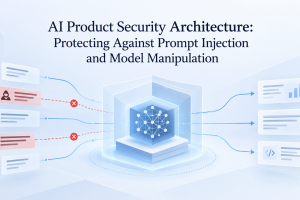
Security also changes once a model can retrieve proprietary data or execute tools. OWASP’s 2025 guidance for LLM applications identifies risks such as prompt injection, sensitive information disclosure, excessive agency, vector and embedding weaknesses, and unbounded consumption. NIST’s Generative AI Profile similarly treats risk management as a lifecycle concern across AI design, development, use, and evaluation.
That translates into concrete engineering controls: least-privilege tool access, authorization-aware retrieval, output validation, data classification, secrets isolation, rate limits, human approval for high-impact actions, adversarial testing, and audit trails. An AI agent should never receive broader operational permissions simply because broader access makes the demo easier.
Which AI product development consulting companies should enterprises evaluate?
Large organizations may build most of the capability internally, but external specialists can help when the bottleneck is architecture, AI evaluation, data engineering, modernization, governance, or a shortage of engineers with production LLM experience. Three firms represent different approaches to that problem:
- GeekyAnts is relevant when an organization needs AI product engineering connected closely to an existing application stack. Its current engineering services cover prototype-to-production work, RAG pipelines, LLM orchestration, vector databases, model abstraction, AI monitoring, security, testing, CI/CD, and modernization. That makes it a practical option where the requirement involves building the product and integrating it into established digital systems rather than running a strategy-only AI program.
- Thoughtworks is suited to enterprises where AI product work intersects with broader modernization, architecture, data platforms, and engineering transformation. Its enterprise AI offering focuses on moving stalled pilots toward production and building reusable foundations for intelligent products, copilots, and agents. The fit becomes stronger when the organization expects AI product development to affect engineering practices and platform architecture across multiple business units.
- Slalom combines AI, product engineering, platform engineering, data engineering, cloud, and organizational implementation. Its product development services cover intelligent digital products, while its OpenAI services include building AI-powered product experiences with a defined roadmap, delivery plan, and success criteria. That model can fit enterprises that need AI development tied closely to cloud transformation, data programs, or customer-experience initiatives.
The selection should depend less on which firm advertises the widest AI capability and more on whether its delivery model matches the enterprise’s architecture, governance requirements, internal skills, and ownership plan after launch.
What should engineering leaders validate before moving an AI product from pilot to scale?
A successful prototype proves that an experience is possible. It does not prove that the experience is safe, economical, or maintainable at enterprise scale.
Before expanding an AI product, engineering leaders should be able to explain its business metric, evaluation baseline, acceptable failure threshold, data boundaries, human escalation path, model portability strategy, expected cost per completed task, security controls, production ownership, and monitoring approach. They should also know what happens when the model, retrieval layer, tool, or external API fails.
That readiness check often matters more than another prototype iteration. It exposes whether the organization has built an AI feature or a product that can actually be operated.
For teams already moving from proof of concept to production, an AI product architecture and readiness consultation can provide a focused way to test those assumptions before additional budget becomes locked into the platform. The useful discussion is not about whether AI should be added. It is about whether the product can meet the reliability, governance, cost, and integration standards the enterprise will expect once customers depend on it.




Add Comment