




For enterprise technology leaders, the argument around vibe coding is easy to misread. The real question is not whether developers should use generative AI. Most already do. The question is how much engineering judgment an organization is willing to delegate to a probabilistic system when the software sits behind revenue, customer data, regulated workflows, or business-critical operations.
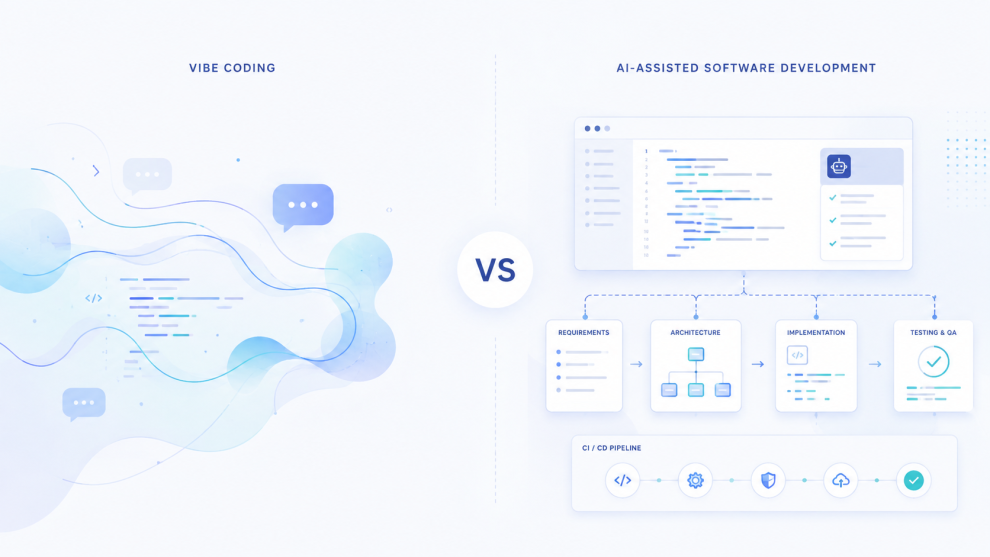
That distinction matters because two teams can use the same coding model and operate in completely different ways. One can prompt until an application appears to work. The other can use AI to accelerate implementation inside a controlled software development lifecycle with architecture decisions, tests, code review, security scanning, observability, and accountable owners.
For a large enterprise, those are not two versions of the same method. They create very different risk profiles.
What is the real difference between vibe coding and AI-assisted software development?
Vibe coding is generally understood as an outcome-first workflow in which a developer or non-developer describes what the software should do, lets an AI system generate substantial portions of the implementation, then iterates through prompts until the result appears correct. Addy Osmani makes a useful distinction: the defining issue is not AI-generated code itself, but whether the engineer remains responsible for understanding, reviewing, and shaping the system.
AI-assisted software development keeps that responsibility intact. Engineers may use models for boilerplate, refactoring, test generation, documentation, code explanation, migration work, or alternative implementations. But architecture, data boundaries, interfaces, failure modes, security controls, performance targets, and acceptance criteria remain explicit engineering decisions.
That difference becomes visible in the artifacts a team produces. A vibe-coded prototype may have working screens and endpoints but no clear threat model, dependency policy, test strategy, service-level objective, rollback design, or ownership map. An AI-assisted engineering team can generate code quickly, but still expects every production change to survive the same controls as manually written code.
The enterprise question, therefore, is not “Was AI used?” It is “Can the organization explain why this system is correct, secure, observable, and maintainable?”
Why does vibe coding become risky inside enterprise systems?
Vibe coding works best when the cost of being wrong is low. Enterprise software has the opposite characteristics. It depends on existing identity systems, data contracts, internal APIs, regulatory controls, legacy behavior, infrastructure policies, and operational assumptions that rarely fit inside a single prompt.
The production gap usually appears in three places:
- Architecture and context become implicit. An LLM can generate a locally plausible implementation while missing system-wide constraints. It may introduce a new dependency where an approved internal library exists, bypass a service boundary, duplicate business logic, or choose a storage pattern that conflicts with retention and residency requirements. The code can compile while the architecture quietly deteriorates.
- Verification moves downstream. Generated code often looks convincing before it has been proven correct. Stack Overflow’s 2025 Developer Survey found that 66% of developers cited AI solutions that were “almost right, but not quite” as a major frustration, while 45% said debugging AI-generated code could take more time. In a large codebase, review effort can shift from writing code to reconstructing what the model did and why.
- Governance becomes harder to evidence. Enterprises need traceability for who approved a change, which data entered a model, what licenses apply to dependencies, whether secrets were exposed, which tests ran, and how a release can be reversed. ACM’s 2026 TechBrief on AI-assisted software development warns that AI-driven coding can bypass safeguards and create security, technical debt, and accountability concerns unless teams maintain testing, auditing, governance, and human oversight.
None of these risks require banning generative AI. They require treating generated code as untrusted input until engineering controls establish otherwise.
Does AI-assisted development actually make enterprise teams faster?
The answer depends on what the organization measures.
If the metric is code generation, AI can clearly compress work. If the metric is reliable production change, the result depends on codebase maturity, documentation quality, platform engineering, test automation, review practices, and developer familiarity with the system.
DORA’s 2025 research found that AI acts primarily as an amplifier. In a March 2026 follow-up, DORA reported that 90% of technology professionals use AI at work and more than 80% believe it has increased productivity. The same analysis also noted a tension: higher AI adoption is associated with greater delivery throughput and greater delivery instability. Time saved during creation can reappear during auditing and verification.
METR found an even sharper warning in a randomized study of experienced open-source developers working on mature projects. Developers expected AI to reduce completion time by 24%. Instead, the study measured a 19% increase in completion time with early-2025 AI tools. The result should not be generalized to every environment, but it shows why enterprise leaders should avoid equating token output or lines of code with engineering productivity.
The better measurement model tracks lead time, review time, escaped defects, change failure rate, security findings, rollback frequency, rework, and maintainability. AI is valuable when it improves that system, not merely when it increases code volume.
Where should enterprises use vibe coding and where should they require engineering discipline?
Vibe coding can be useful at the edge of the delivery lifecycle. Teams can use it for disposable prototypes, interface experiments, exploratory internal tools, proof-of-concept integrations, test-data generators, or technical spikes where the objective is learning rather than production durability. In those situations, speed can be the dominant constraint and discarding the output may be acceptable.
The boundary should tighten when software touches customer identity, payments, regulated data, core business rules, shared services, production infrastructure, or high-volume workflows. At that point, AI-generated code needs specifications, review ownership, automated testing, software composition analysis, secrets detection, static analysis, infrastructure controls, observability, and release gates.
This is also where consulting partners can be useful when internal teams are still defining an AI-assisted engineering operating model. Among the consulting companies enterprise buyers may evaluate, GeekyAnts positions its AI-powered product engineering work around moving prototypes into production with testing, security, architecture, and modernization discipline. Thoughtworks has been developing AI/works around specification, code generation, testing, governance, and observability for enterprise systems. EPAM similarly emphasizes governance, process, performance measurement, and AI-enabled delivery across the software development lifecycle.
The important evaluation criterion is not which partner uses the most AI. It is whether the partner can show how AI-generated work is constrained, reviewed, measured, and transferred into an operating environment the client can own.
How should engineering leaders decide what comes next?
The practical path is not to choose between vibe coding and traditional development as competing ideologies. Enterprises need a graduated model of autonomy.
Low-risk experimentation can allow broad prompting and rapid generation. Production engineering should progressively add context controls, specifications, architecture rules, tests, security checks, human review, deployment policies, and measurable accountability as the business impact increases.
For VPs of Engineering and platform leaders, one question can expose whether the operating model is mature: if an AI-generated change causes a customer-impacting incident six months later, can the organization quickly explain what changed, why it was accepted, what evidence supported the release, and who owns the fix?
If the answer is unclear, the problem is not AI adoption. It is engineering governance.
A focused architecture and delivery consultation can help teams map where AI should accelerate the SDLC, where human approval must remain mandatory, and which controls need to exist before generated code reaches production. That conversation is usually more valuable than another debate about whether vibe coding is the future.




Add Comment