



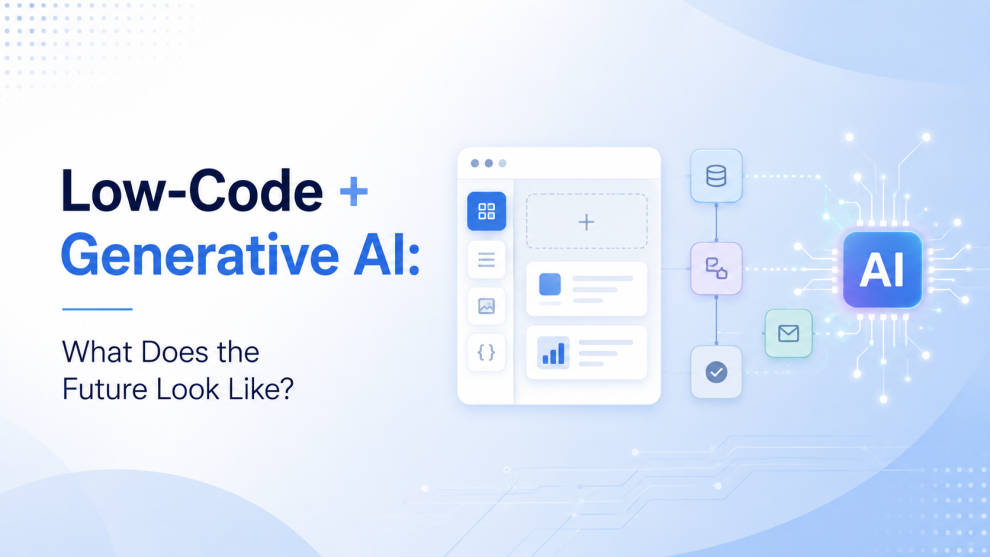

Enterprise engineering teams have spent years trying to close the gap between application demand and delivery capacity. Low-code helped by abstracting repetitive development work. Generative AI changes the equation again because it can translate natural language into interfaces, workflows, data models, integrations, tests, and code.
That does not make software engineering disappear. It moves the constraint. For a large enterprise, the difficult work is no longer producing the first version of an application. It is ensuring that hundreds of AI-assisted applications remain secure, observable, integrated, maintainable, and compliant in production.
Gartner now describes enterprise low-code application platforms as using model-driven development, generative AI, and prebuilt component catalogs. It also forecasts the broader low-code development technologies market to reach $58.2 billion by 2029 at a 14.1% CAGR. Gartner’s 2026 research is already describing the direction of the category as AI-augmented low-code.
The future is therefore not low-code versus AI. It is an AI-augmented application platform model in which abstraction, generation, governance, and traditional engineering operate together.
How will generative AI change low-code development?
Traditional low-code platforms reduce the amount of code a team must write. Generative AI reduces the amount of platform-specific modeling a team must perform.
A product analyst could describe an insurance claims intake process, provide the relevant data schema, identify approval rules, and ask the platform to create the first working flow. An engineer could then refine the logic, connect enterprise APIs, add exception handling, and promote the application through governed environments.
The important technical change sits between the prompt and the deployed application. Mature platforms increasingly generate structured artifacts such as process models, UI definitions, business rules, data entities, connectors, and code extensions inside a controlled runtime. That differs from prompt-driven code generation that produces a repository and leaves governance to the team afterward.
Gartner’s 2025 analysis argues that AI will enhance rather than replace low-code platforms. The distinction matters because enterprise LCAPs can provide code abstraction, maintainability, governance and lifecycle controls around AI-assisted development rather than treating generated code as an unmanaged output.
Engineering leaders should expect these platforms to behave less like visual builders and more like supervised application engineering systems. They will generate, test, validate, deploy, monitor, and eventually propose changes based on telemetry. Human teams will still own architecture, risk, data boundaries, and acceptance criteria.
Where does low-code plus generative AI create real enterprise value?
The largest opportunity is not replacing every custom application. It is attacking the backlog of software that is valuable enough to build but too repetitive to justify a full custom delivery team.
Internal case-management systems, operations portals, approval workflows, field applications, employee self-service products, compliance workflows, and modernization front ends are strong candidates. Generative AI can accelerate requirements translation and implementation, while low-code provides reusable components, permissions, environments, and deployment controls.
The combination also changes legacy modernization. Many enterprises cannot replace a core policy administration system, ERP, or mainframe simply because its interface is slow to change. An AI-augmented low-code layer can expose modern workflows around stable systems through APIs, event streams, and governed integration services. That improves experience without forcing a high-risk core rewrite.
The productivity upside is credible, but leaders should separate local development speed from system-level performance. DORA’s 2025 research, based on nearly 5,000 technology professionals, found that AI primarily acts as an amplifier of the underlying engineering system. Google Cloud reports that around 90% of technology professionals in the research use AI at work and more than 80% report productivity gains, while emphasizing that internal platforms and workflows determine whether those gains scale.
That is the practical future: not fewer engineers, but more application throughput per governed platform team.
What technical risks come with AI-powered low-code platforms?
Speed can hide complexity. A generated workflow may look correct in a demo while carrying fragile integration assumptions, overly broad permissions, weak exception handling, or model behavior that changes when prompts, data, or foundation models change.
That risk increases when business users can generate applications without understanding data classification, identity boundaries, API rate limits, transaction semantics, or regulatory obligations. Controls therefore need to sit at the platform layer rather than depend on every builder making the right decision.
The required architecture starts with governed identity and role-based access, approved connectors, secrets management, API management, environment separation, automated testing, policy checks, and auditable production promotion. GenAI adds prompt and model versioning, evaluation datasets, retrieval controls, model routing, token and latency monitoring, content filtering, and traceability for generated outputs.
Trust remains a real constraint. Stack Overflow’s 2025 Developer Survey found that 84% of respondents use or plan to use AI tools, but 46% actively distrust AI output accuracy. Sixty-six percent cited AI solutions that are almost correct as a major frustration. For enterprise teams, that translates directly into review cost.
Vendor lock-in also deserves attention. Leaders should determine which artifacts can be exported, which business logic remains proprietary, whether APIs and custom code can extend platform boundaries, and how data can move if the vendor or model strategy changes. The best platform is not the one that generates the fastest demo. It is the one that preserves operational control after the demo succeeds.
Which consulting companies can help enterprises implement low-code plus GenAI?
Platform selection alone will not solve the operating model problem. Enterprises often need support to decide what belongs in low-code, what requires custom code, how GenAI should access enterprise data, and where governance must sit. Three consulting companies represent different approaches worth evaluating:
- GeekyAnts: GeekyAnts sits toward the hands-on product engineering end of the consulting market. Its portfolio spans low-code and no-code development, AI engineering, product engineering, integration, modernization, and DevOps. That combination is relevant when an enterprise wants to use low-code selectively while retaining custom frontend, mobile, backend, API, or AI components around the platform. Its public AI engineering work also covers RAG, agents, LLM integration, and production architecture, making it a practical option where rapid application development must coexist with code-level extensibility rather than become an isolated low-code initiative.
- Accenture: Accenture brings the scale and operating-model depth expected in multi-business-unit programs. Its application transformation practice combines modernization, architecture, software delivery, platform implementation, and generative AI. GenWizard also applies GenAI across reverse engineering, modern engineering, migration, and enterprise platforms. That makes Accenture relevant when low-code plus GenAI forms part of a broader cloud, ERP, CRM, or application-estate transformation with portfolio-wide governance requirements.
- Thoughtworks: Thoughtworks approaches the issue through software engineering, platform engineering, modernization, and AI-assisted delivery. Its AI/works platform and advisory services focus on integrating AI into the delivery lifecycle while strengthening internal platforms and engineering practices. That makes the firm relevant when leaders want low-code and AI-assisted development to coexist with strong architectural standards rather than create a parallel citizen-development estate that engineering teams eventually have to support.
What should enterprise engineering leaders do next?
The next decision should not be whether to “adopt AI-powered low-code.” That question is too broad to produce a useful architecture.
Leaders should classify application portfolios by integration complexity, data sensitivity, regulatory exposure, expected scale, and need for custom logic, then determine which classes belong on an AI-augmented low-code platform. The operating model should define who can generate applications, who approves integrations, what requires professional engineering review, and what evidence must exist before production release.
The future will favor enterprises that make software creation easier without making production control weaker. Low-code provides the abstraction. Generative AI provides the acceleration. Platform engineering, governance, and experienced software teams provide the discipline.
For organizations already evaluating platforms or moving pilots into production, a focused architecture and governance consultation can help map application classes, integration boundaries, AI controls, and build-versus-platform decisions before they harden into another layer of technical debt.




Add Comment