




For large organizations, the debate between traditional product engineering and AI-powered product engineering often gets reduced to coding speed. That framing is too narrow. The real decision concerns how an enterprise discovers opportunities, designs systems, controls risk, releases changes, and learns from production.
Traditional product engineering already includes agile delivery, DevOps, cloud platforms, automated testing, and product analytics. AI-powered product engineering adds machine intelligence across that operating model. Teams use AI to interpret research, generate and review code, create tests, analyze incidents, automate documentation, and build intelligent product capabilities.
Adoption has moved faster than operational maturity. DORA’s 2025 research found that 90 percent of technology professionals used AI at work and more than 80 percent believed it improved productivity. The research described AI as an amplifier that strengthens capable engineering systems but also magnifies weak architecture, fragmented workflows, and poor controls.
That distinction matters to engineering leaders. An organization can increase code output without improving deployment stability, customer outcomes, or cost efficiency. The relevant question is where AI can improve flow without weakening the controls that keep complex products reliable.
The Technical Difference Is an Operating Model, Not a Tool Choice
Traditional product engineering organizes work around deterministic artifacts. Product managers define requirements, architects create system boundaries, engineers implement logic, QA validates expected behavior, and operations monitors known failure modes. Each release should behave predictably against specified inputs.
AI-powered product engineering introduces probabilistic components and AI-assisted decisions. A retrieval-augmented generation service may produce different responses from similar prompts. An engineering agent may create valid code that conflicts with internal architecture. A recommendation model may deteriorate as customer behavior changes. The delivery model must govern both software behavior and model behavior.
The most important differences appear across six technical areas:
- Discovery and requirements move from static documentation to evidence synthesis. Traditional teams rely on interviews, analytics, workshops, and product requirements documents. AI-powered teams can summarize support tickets, cluster customer feedback, analyze usage patterns, and generate prototype variants faster. The gain comes from reducing research latency, not replacing product judgment. Domain experts still need to identify false correlations, privacy constraints, operational exceptions, and underrepresented customer segments. The output should become a testable hypothesis, not an automatically approved feature request.
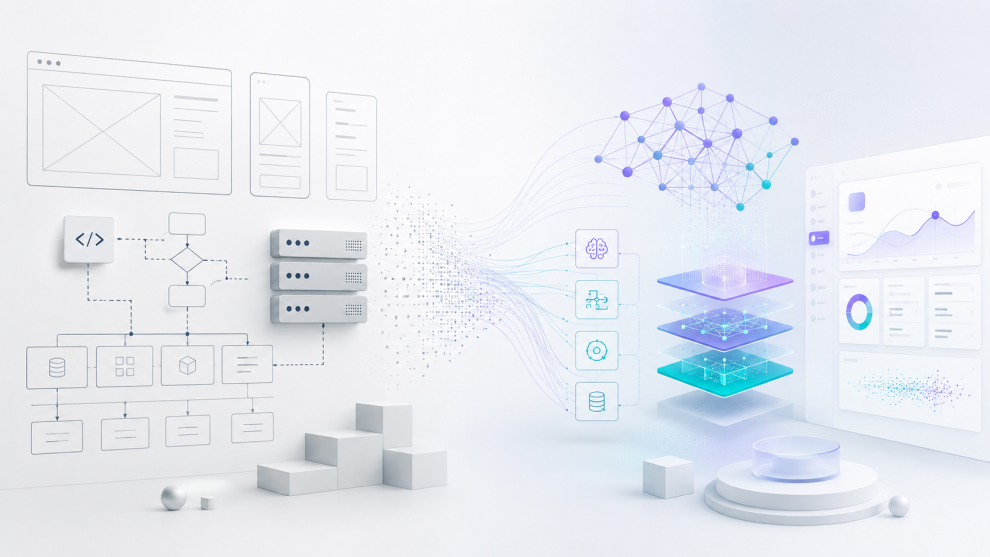
- Architecture expands from application components to data, model, and context layers. A conventional architecture focuses on services, APIs, databases, event flows, identity, and infrastructure. An AI-powered architecture may also require model gateways, vector stores, retrieval pipelines, prompt management, evaluation datasets, routing, caching, and human escalation. Architects must decide which workloads require a frontier model, a smaller model, conventional rules, or no AI. They also need abstraction boundaries so model vendors can change without forcing a rewrite of the customer experience or core business logic.
- Implementation shifts from code production to code supervision. AI assistants can generate boilerplate, migrations, tests, documentation, and refactoring suggestions, but faster generation increases the material teams must verify. DORA found that saved creation time frequently moves into auditing and validation. Stack Overflow’s 2025 survey showed the same tension: 84 percent of respondents used or planned to use AI tools, while only 29 percent trusted AI outputs. Engineering capacity therefore moves toward design review, dependency analysis, threat modeling, and validation against repository conventions.
- Quality engineering must test ranges of acceptable behavior. Traditional automated tests usually compare actual outputs with expected outputs. AI features require evaluation suites for groundedness, relevance, retrieval quality, toxicity, bias, tool-selection accuracy, latency, and cost. Teams need golden datasets, adversarial cases, regression thresholds, and sampling. They must version prompts, models, retrieval configurations, and evaluation data alongside application code. Otherwise, a minor model or prompt change can alter product behavior without triggering a conventional test failure.
- Security extends beyond application vulnerabilities. Secure coding, composition analysis, secrets management, and access control remain essential, but AI systems add prompt injection, sensitive information disclosure, model supply-chain risk, poisoned retrieval content, unsafe output handling, and excessive agent permissions. OWASP’s 2025 guidance identifies these as distinct LLM application risks. Veracode’s Spring 2026 testing found that leading models exceeded 95 percent syntax correctness while security pass rates remained around 55 percent. AI-generated code and system outputs should enter the pipeline as untrusted artifacts that require scanning, policy checks, and human review.
- Operations becomes continuous evaluation, not only observability. Traditional observability tracks availability, errors, traces, saturation, and service-level objectives. AI-powered products must also monitor answer quality, model drift, retrieval failures, fallback rates, token consumption, latency, and human override patterns. A service can remain technically available while producing commercially damaging responses. Teams need release gates that combine software metrics with model evaluations, plus rollback paths for prompts, models, indexes, and agent policies.
Faster Delivery Only Matters When the Control System Can Absorb It
AI-powered product engineering creates a throughput challenge. If developers generate more changes but architecture reviews, test environments, security approvals, and release processes remain constrained, work accumulates at the next bottleneck. The organization gets more pull requests, more review load, more tool sprawl, and potentially more instability.
The practical response is to redesign the engineering system around smaller batches and automated evidence. Platform teams can provide approved model access, reusable retrieval components, secure prompt templates, evaluation services, policy-as-code, and standardized telemetry. Product teams can then experiment within defined boundaries instead of assembling a new AI stack for every use case.
Measurement must move beyond lines of code or tool adoption. Useful portfolio metrics include lead time from validated opportunity to production, change failure rate, escaped defects, evaluation pass rate, cost per successful AI task, human escalation rate, and customer outcome improvement. These measures reveal whether AI removes friction or merely increases output.
Governance should operate through engineering workflows rather than a separate committee that reviews products near launch. NIST’s Generative AI Profile recommends integrating trustworthiness into the design, development, use, and evaluation of AI systems. In practice, that means risk classification during discovery, approved data boundaries during architecture, automated CI/CD checks, documented evaluation evidence before release, and production monitoring tied to clear owners.
Most Enterprises Need a Hybrid Model, Not a Replacement Program
Traditional engineering discipline remains the foundation for systems that process payments, manage identities, control industrial workflows, or handle regulated data. AI-powered methods add value where teams face high information volume, repetitive work, uncertain user needs, or workflows that benefit from prediction and natural-language interaction.
A sensible transition begins with one product value stream, not a company-wide mandate. Leaders can map bottlenecks, classify work by risk, select two or three AI-assisted interventions, and establish baseline delivery and quality metrics. Lower-risk starting points include test generation, codebase explanation, documentation, incident summarization, and internal knowledge retrieval. Customer-facing agents and autonomous actions require stronger evaluation, access controls, and escalation design.
External consulting and outsourcing partners can help when internal teams lack AI platform patterns or production experience. Thoughtworks combines product development with AI-enabled prototyping and software engineering transformation. EPAM emphasizes AI-native engineering across tools, processes, governance, and team operations. GeekyAnts focuses on moving AI products from prototype to production through RAG pipelines, cloud infrastructure, CI/CD, testing, and observability. These approaches reflect a shift from staff augmentation toward accountable engineering systems.
The decision between traditional product engineering and AI-powered product engineering is not binary. The stronger model preserves deterministic engineering controls while adding AI where it improves discovery, delivery, or product behavior. Enterprises that treat AI as a coding shortcut may ship more artifacts. Enterprises that redesign architecture, quality, security, and operations around it have a better chance of shipping better products.
A focused engineering consultation can help leadership teams identify where AI will create measurable leverage, where conventional methods should remain dominant, and which platform capabilities must exist before wider adoption. That conversation is often more valuable than starting with another tool rollout.




Add Comment