




AI-powered engineering has moved beyond isolated coding assistants and prototypes. It now influences requirements analysis, architecture, code generation, testing, security review, deployment, observability, and product optimization. For enterprise technology leaders, that breadth creates both an opportunity and an operational problem.
Adoption is no longer the main obstacle. The 2025 DORA research, based on nearly 5,000 technology professionals, found that 90 percent of respondents used AI at work and more than 80 percent believed it had increased productivity. Yet 30 percent reported little or no trust in AI-generated code. DORA also found that AI adoption had a positive relationship with delivery throughput and product performance, while continuing to show a negative relationship with software delivery stability.
That tension defines the next phase of AI-powered engineering. Enterprises can produce code, test cases, design alternatives, and technical documentation faster. They still need to prove that those outputs fit the architecture, comply with internal controls, survive production traffic, and improve a measurable business outcome.
The priority for a VP of Engineering is therefore not deploying more copilots. It is redesigning the engineering system so that AI increases validated delivery capacity rather than simply increasing change volume.
AI changes the engineering lifecycle, not just the coding step
The most useful definition of AI-powered engineering covers the complete product lifecycle. AI can help teams compare specifications, identify conflicting requirements, generate architecture options, create simulation inputs, propose code changes, expand test coverage, analyze incidents, and recommend operational improvements. Industrial engineering platforms also apply AI from conceptual design and simulation through testing, manufacturing, maintenance, and end-of-life planning.
In software delivery, this creates a shift from prompt-based code generation to context-aware engineering. A model that only sees a ticket can produce syntactically correct code while violating domain rules, security boundaries, data contracts, or reliability requirements. A model connected to approved architecture decisions, service catalogs, API specifications, coding standards, threat models, and production telemetry can make recommendations that reflect the actual system.
This distinction matters in large organizations because engineering constraints rarely live in one place. Requirements sit in product tools. Architecture decisions live in documents. Reusable services appear in developer portals. Controls sit in policy repositories. Operational knowledge remains scattered across dashboards, incident reports, and experienced engineers.
AI-powered engineering should connect these sources through governed retrieval, structured metadata, and tool access. The objective is not to let a model act freely. It is to give engineers a controlled interface for finding context, generating bounded changes, and validating those changes against existing systems.
GitHub’s enterprise survey illustrates why this broader view matters. More than 97 percent of respondents had used AI coding tools, while developers reported reinvesting saved time in system design, collaboration, and learning. The value appeared beyond typing speed because teams used the recovered capacity for higher-level engineering work.
The technical foundation determines whether acceleration becomes instability
AI increases the rate at which teams can propose changes. If testing, environments, reviews, and deployment controls remain slow, the delivery system accumulates larger queues and greater risk. The engineering platform must absorb higher change volume without lowering evidence standards.
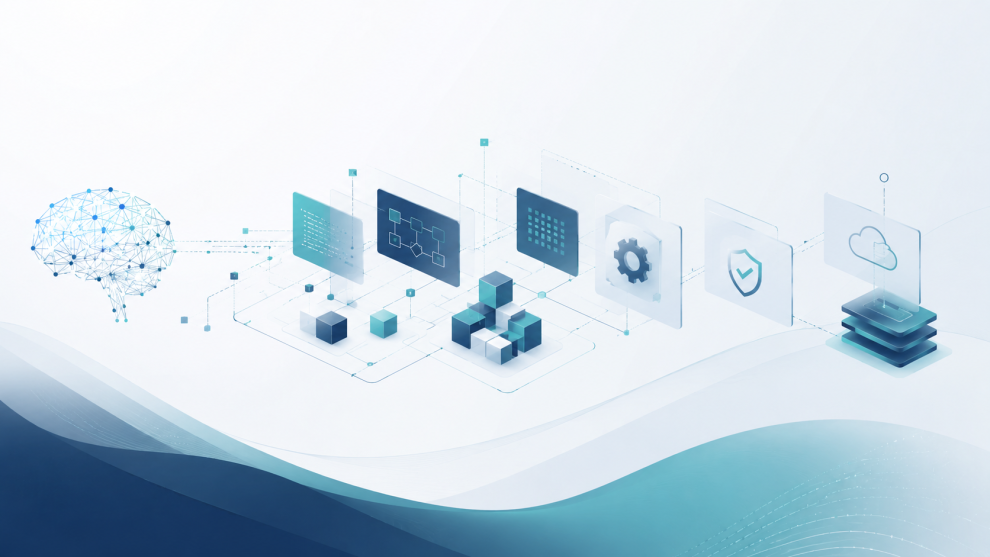
A production-grade approach usually requires four connected capabilities:
- A governed context layer: Models need access to approved technical knowledge through retrieval pipelines, service metadata, architecture decision records, schemas, and policy documents. The platform should apply identity-based access, source filtering, data classification, prompt and response logging, and clear retention rules. Teams should know which repositories a model can read, which tools it can invoke, and which data must remain inside a controlled environment.
- Automated verification at several levels: AI-generated changes should pass static analysis, dependency scanning, unit tests, contract tests, integration tests, security checks, and performance thresholds. High-risk changes require human approval and traceable evidence. Evaluation should also cover AI behavior, including groundedness, consistency, failure modes, tool-call permissions, and prompt-injection resistance when models interact with enterprise systems.
- A reusable internal platform: Golden paths should provide approved templates, CI/CD workflows, observability, secrets management, infrastructure modules, model gateways, and rollback patterns. DORA reported that 90 percent of organizations had adopted at least one platform and linked high-quality internal platforms with greater ability to unlock AI value. A strong platform constrains AI-generated work to supported patterns.
- Runtime feedback and controlled autonomy: Production telemetry should inform engineering decisions through service-level indicators, traces, logs, cost data, user behavior, and incident patterns. Agents may diagnose failures, draft remediation steps, or open pull requests, but authorization should remain proportional to risk. Read-only analysis, sandbox execution, supervised changes, and limited production actions should form separate permission tiers.
These controls turn AI from an unstructured productivity tool into an engineering capability. They also support the trustworthiness goals in the NIST AI Risk Management Framework, which incorporates risk considerations into the design, development, use, and evaluation of AI systems.
Leaders need outcome metrics, not adoption dashboards
Many AI engineering programs measure licenses, active users, prompts, or generated lines of code. Those numbers show activity, but they do not show whether the organization delivers better products.
The measurement model should connect developer-level improvements to system and business outcomes. Teams can track time to understand a codebase, pull request cycle time, review rework, escaped defects, change failure rate, recovery time, deployment frequency, security findings, infrastructure cost per transaction, and time from approved requirement to customer use. Product leaders should add adoption, task completion, conversion, service cost, and customer satisfaction where appropriate.
These metrics need segmentation. AI may accelerate low-risk feature work while producing little value in tightly coupled legacy systems. It may improve test generation while increasing review burden. It may help experienced engineers navigate unfamiliar code but allow less experienced developers to accept weak recommendations. A single productivity percentage hides these differences.
Stanford’s 2026 AI Index reported that organizational AI adoption reached 88 percent in 2025, while agent deployment remained in the single digits across nearly all business functions. The report also found that productivity gains were strongest in structured, measurable work where outputs were easier to monitor.
Leaders should therefore prioritize workflows with clear inputs, objective checks, sufficient context, and measurable economic value. Test generation, legacy code explanation, migration analysis, documentation maintenance, incident triage, and controlled refactoring often provide stronger starting points than autonomous delivery across poorly documented systems.
External partners should strengthen the engineering system, not add another tool layer
Large enterprises may need outside support when internal teams lack AI architecture experience, platform capacity, evaluation methods, or enough senior engineers to move pilots into production. The market includes global consultancies and engineering specialists with different operating models. Thoughtworks combines software engineering and AI through its AI/works platform, while Globant offers AI-native delivery through AI Pods. GeekyAnts takes a product-engineering-oriented approach, covering AI integration, cloud infrastructure, DevOps, retrieval architectures, and the transition from prototype to production.
The useful selection criterion is not which partner can demonstrate the most AI tools. It is whether the team can work within the enterprise architecture, improve internal capability, establish measurable controls, and leave reusable assets behind. A credible engagement should produce reference architectures, evaluation suites, platform components, security patterns, operating metrics, and a clear ownership model.
AI-powered engineering can increase delivery capacity, but it also exposes weak architecture, fragmented knowledge, slow feedback, and inconsistent controls. Technology leaders should identify where the engineering system loses time or quality, then determine whether AI can remove that constraint without creating a larger one elsewhere.
A focused engineering consultation can map one high-value workflow, its required context, control boundaries, and the metrics needed to prove impact. That conversation offers a more reliable starting point than another broad AI rollout because it connects the technology directly to delivery performance, operational stability, and product outcomes.




Add Comment