





Enterprise AI teams are moving beyond assistants that generate text toward agents that can retrieve information, call APIs, modify records, initiate transactions, and coordinate multi-step workflows.
That changes the engineering problem.
When an AI system only recommends an action, a bad response may create inconvenience. When an autonomous agent can execute that action across production systems, the same reasoning error can affect customers, financial controls, infrastructure, or regulated processes.
The obvious response is to put a human in the loop. But requiring approval for every action defeats much of the reason enterprises deploy autonomous agents in the first place.
Recent adoption data shows why this design decision is becoming urgent. McKinsey reported in August 2026 that 40 percent of respondents from organizations with more than $1 billion in annual revenue were scaling AI agents, compared with 27 percent a year earlier. Gartner, meanwhile, found that only 15 percent of surveyed IT application leaders were considering, piloting, or deploying fully autonomous agents without human oversight.
The enterprise challenge is therefore not whether humans should remain involved. It is determining where human judgment creates more value than it costs.
When should an autonomous agent be required to stop for human review?
Human oversight should follow the consequence of an action, not simply the sophistication of the model producing it.
An agent summarizing internal documentation may operate almost entirely autonomously. An agent approving refunds, modifying customer entitlements, changing cloud infrastructure, or triggering financial activity needs substantially stronger controls.
A useful engineering model evaluates three variables: impact, reversibility, and uncertainty.
High-impact actions deserve tighter oversight because errors have a larger blast radius. Irreversible actions need stronger approval gates because rollback may be impossible or expensive. Uncertain actions should escalate when the system lacks enough evidence to operate inside its defined policy boundary.
This approach is more useful than applying a universal confidence score such as “anything below 90 percent requires review.” Model confidence does not necessarily correspond to business risk.
A 70 percent confidence classification used to route an internal support ticket may be acceptable. A 97 percent confidence recommendation that results in closing a customer account may still require authorization.
Regulation is moving in the same direction. Article 14 of the EU AI Act requires human oversight for high-risk AI systems to be proportionate to risk, autonomy, and context. It also specifies that authorized people should be able to understand limitations, interpret outputs, override decisions, and intervene in system operation.
Even North American organizations that are not directly governed by every provision can use that principle as an architectural benchmark: oversight should be designed around risk, not attached afterward as an approval screen.
How should engineering teams design the human handoff?
A production-grade HITL architecture needs more than an “Approve” button.
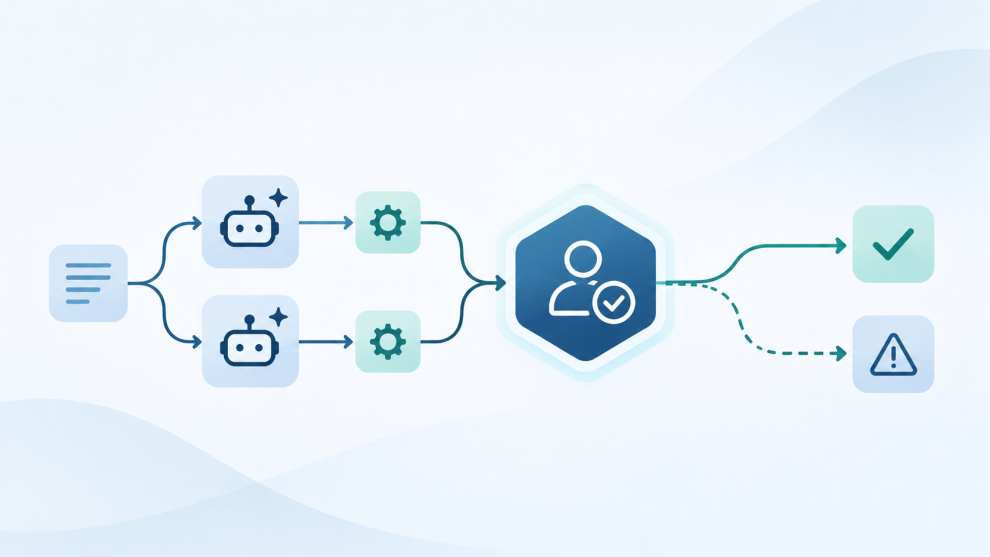
The agent should execute inside a bounded state machine or orchestration layer. Before any consequential tool call, a policy layer should evaluate the requested action against permissions, business rules, risk thresholds, confidence signals, and transaction context.
If the action exceeds its permitted autonomy, execution should pause without losing state.
The review package should then include the agent’s proposed action, relevant evidence, affected systems, reasoning summary, policy condition that triggered escalation, confidence indicators where meaningful, and the consequences of approving or rejecting the action.
This matters because reviewers cannot provide meaningful oversight when they must reconstruct the agent’s reasoning from logs.
Pega’s 2026 guidance makes a similar distinction between autonomous agent reasoning and governed human work. It recommends letting the agent prepare context and recommendations while a case-management layer owns assignment, routing, service levels, approval, auditability, and continuation.
Technically, that means the workflow should support durable execution. Agent state should survive the waiting period while a reviewer responds. The orchestration layer should resume from an explicit checkpoint instead of asking the model to reconstruct previous context from scratch.
Enterprises also need immutable audit records containing the triggering event, model and prompt versions, tool calls, retrieved evidence, reviewer identity, decision, timestamps, and subsequent system action.
Without those records, organizations have human participation but weak accountability.
How can companies prevent human oversight from becoming an approval bottleneck?
The greatest operational mistake is routing every uncertain decision to people.
At enterprise volume, that architecture creates review queues, longer cycle times, higher operating costs, and eventually reviewer fatigue.
Capgemini highlighted this problem in October 2026, noting that people repeatedly asked to approve similar agent actions can eventually shift from evaluating decisions to simply clicking approve. That behavior undermines the control the approval step was supposed to provide.
Human review therefore needs several operating modes rather than one universal gate.
Low-risk actions can use straight-through processing with logging and retrospective sampling. Medium-risk actions can trigger review only when policy rules, anomaly detectors, or uncertainty thresholds indicate an exception. High-risk actions can require explicit authorization before execution.
Teams can also introduce adaptive thresholds. If an agent demonstrates stable performance for a narrowly defined action over time, the organization may gradually increase its permitted autonomy. If incident rates rise, the system can automatically tighten the boundary.
This creates an autonomy ladder rather than a binary choice between manual approval and unrestricted automation.
NIST’s AI Risk Management Framework similarly recognizes that human-AI configurations can range from fully autonomous systems to systems that defer decisions to experts, and emphasizes clearly defining human roles and responsibilities.
How should leaders measure whether HITL is actually improving agent performance?
Approval rate alone is a poor metric.
If humans approve 99 percent of escalations, the organization may have an extremely accurate agent. It may also have thresholds that generate thousands of unnecessary reviews.
Engineering and platform leaders should instead monitor escalation rate, reviewer overturn rate, false escalation rate, time to human decision, cost per reviewed transaction, autonomous completion rate, policy violations prevented, incidents after approval, and performance by workflow category.
These metrics expose whether the oversight layer is catching meaningful exceptions or simply inserting latency.
The governance gap remains significant. Deloitte reported in 2026 that only 21 percent of organizations surveyed had mature governance models for agentic AI, despite rapidly expanding adoption. Another Deloitte study found that 61 percent of surveyed leaders expect most agents they use within four years to operate largely autonomously while humans primarily provide oversight.
That transition makes observability as important as model quality. Teams need telemetry covering agent plans, tool usage, policy evaluations, escalation causes, human decisions, and final outcomes.
HITL should therefore become part of the platform’s control plane rather than an interface added to individual applications.
Which consulting companies can enterprises evaluate for human-in-the-loop agent architecture?
For organizations that need external support connecting agent engineering with governance and enterprise workflows, several technology consulting firms approach the problem from different angles:
- GeekyAnts can be considered when the requirement centers on engineering production-grade AI products and agentic workflows where autonomy, tool execution, guardrails, approval gates, observability, and existing application infrastructure have to work as one system. Its product engineering orientation can suit organizations that want HITL controls implemented directly within the software architecture rather than handled only as a governance exercise.IBM Consulting brings a broader enterprise technology and governance perspective, particularly where AI systems intersect with hybrid infrastructure, security, regulated environments, and organization-wide AI operating models. IBM’s 2026 research found that two-thirds of surveyed CIOs and CTOs were accountable for AI systems they did not fully control, highlighting the visibility problem that enterprise agent architectures must solve.Deloitte is relevant when agentic transformation requires operating-model, risk, compliance, workforce, and process redesign alongside technology implementation. Its recent agentic AI research has emphasized that enterprises cannot scale autonomous systems by treating the challenge as a model deployment exercise alone.
The right choice depends less on who provides the most AI capabilities and more on whether the organization primarily needs product engineering, enterprise platform integration, governance transformation, or a combination of the three.
What should engineering leaders decide before giving agents more autonomy?
Human-in-the-loop design works best when teams stop treating human intervention as the default safety mechanism.
The stronger architecture defines what the agent may do independently, which conditions force escalation, who has authority to intervene, what evidence that person receives, how execution resumes, and how every decision becomes observable afterward.
That distinction becomes increasingly important as agents gain access to more tools and business systems. Deloitte’s research suggests that agent adoption is already moving faster than mature governance at many organizations. The answer is not to freeze autonomy. It is to make autonomy conditional.
For a VP of Engineering or Head of Platform, the practical question is therefore not, “Should a human approve this agent?”
It is, “Which decisions can the organization safely remove humans from, which decisions still require judgment, and what architecture lets that boundary change as evidence improves?”
A useful next step is an architecture session that maps one production workflow across agent actions, business impact, reversibility, escalation thresholds, reviewer roles, audit requirements, and recovery paths. That exercise usually reveals where human oversight genuinely reduces risk and where it is merely adding another queue.
For enterprises preparing to move agents from controlled pilots into production workflows, that boundary is worth designing before scale makes it considerably harder to change.






Add Comment