




For enterprise technology leaders, the promise of AI in software development is easy to misunderstand. Faster code is useful, but code production rarely defines the full delivery constraint. Large programs lose time in unclear requirements, architecture reviews, security approvals, environment provisioning, and post-launch diagnosis.
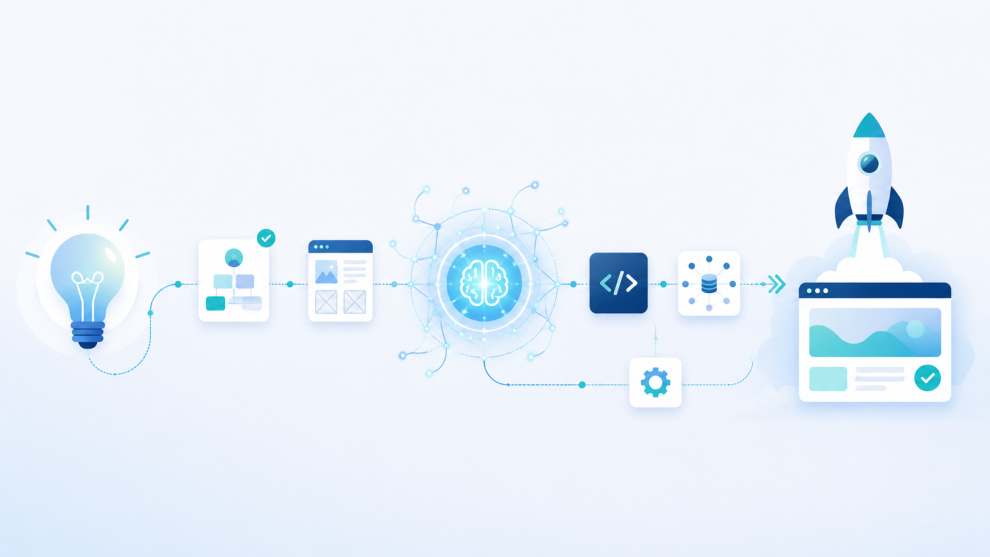
AI changes this system by reducing the cost of producing and revising technical artifacts. A team can move from an early product brief to user stories, domain models, code, tests, infrastructure definitions, and release documentation much faster. That does not remove engineering discipline. It makes weak decisions propagate faster.
The performance gap is already visible. McKinsey reports that the top-performing fifth of nearly 300 public companies studied achieved 16 to 30 percent improvements across productivity, time to market, and customer experience, together with 31 to 45 percent gains in software quality. The same research warns that simply distributing AI tools does not produce those results. Leaders gained value by redesigning the full development lifecycle around AI.
How Does AI Turn an Idea Into Buildable Requirements?
Traditional discovery converts interviews, analytics, support tickets, policies, and stakeholder opinions into a product backlog. That process often creates information loss. Business intent becomes a short user story, architectural constraints remain implicit, and acceptance criteria arrive after development begins.
AI can process larger evidence sets and generate structured product artifacts earlier. It can cluster customer feedback, identify repeated friction, map journeys, propose edge cases, and convert product goals into epics, user stories, acceptance criteria, and testable nonfunctional requirements. IBM describes this progression as a collaboration in which generative AI transforms ideas into requirements, then converts those requirements into user stories, test cases, code, and documentation.
The technical advantage comes from traceability. A mature workflow stores the source evidence, requirement, design decision, code change, test, and release note as connected artifacts. When a requirement changes, AI can identify affected services, schemas, test suites, infrastructure policies, and documentation.
This is particularly valuable in enterprise environments where one product decision can affect identity services, customer data platforms, billing systems, analytics pipelines, regulatory controls, and several regional applications. Instead of depending on manual impact analysis, teams can use AI to interrogate architecture repositories and identify likely dependencies before development starts.
However, generated requirements remain hypotheses, not truth. Models cannot resolve conflicting commercial priorities, interpret undocumented regulatory exceptions, or decide which customer segment should absorb a tradeoff. Product owners, architects, security leaders, and domain experts still need decision rights. AWS places this human validation at the center of its AI-driven development lifecycle, where AI proposes plans and seeks clarification before implementation.
What Changes in Architecture, Design, and Coding?
Once teams approve requirements, AI can produce multiple solution paths instead of pushing the first plausible design into development. It can compare integration patterns, propose bounded contexts, generate sequence diagrams, model data flows, and draft threat scenarios.
This gives architecture teams a better starting point, but it also creates a new failure mode: convincing designs that ignore enterprise reality. An assistant may recommend microservices without accounting for mainframe latency, data residency, vendor contracts, shared identity systems, recovery objectives, or operational capacity.
The solution is context engineering. Teams need machine-readable architecture principles, API specifications, data classifications, secure coding rules, service ownership, and reliability targets. AI performs better when it retrieves this information from governed repositories rather than relying on a conversational prompt.
That context should include approved frameworks, service templates, cloud policies, API conventions, observability standards, historical architecture decisions, and lists of restricted dependencies. Retrieval should also respect access controls. An AI agent working on a customer-facing application should not automatically receive unrestricted access to production data, private keys, security incidents, or unrelated source repositories.
During coding, AI can generate scaffolding, adapters, migrations, unit tests, documentation, and refactoring proposals. Engineers can focus more on domain boundaries, concurrency, failure handling, performance, and maintainability. Yet review queues can become the new bottleneck if agents generate pull requests faster than senior engineers can validate them.
In Stack Overflow’s 2025 survey, 46 percent of respondents distrusted the accuracy of AI tools, compared with 33 percent who trusted them. Only about 3 percent reported high trust. Enterprise teams therefore need risk-based autonomy, allowing AI to handle low-risk, reversible changes while requiring deeper review for identity, payments, regulated data, core algorithms, and shared platform components.
How Does AI Affect Testing, Security, and Deployment?
AI can shift quality assurance left by generating tests from acceptance criteria before implementation. It can propose boundary conditions, create synthetic test data, identify missing coverage, and prioritize regression suites. In large platforms, it can also maintain contract tests across services and detect when an interface change breaks downstream consumers.
This changes the role of QA teams. Instead of spending most of their time writing repetitive test scripts, specialists can focus on test strategy, complex business rules, failure scenarios, accessibility, data quality, and production risk. AI can generate the initial coverage, but experienced testers must still determine whether the system behaves correctly under realistic conditions.
The control model matters. Teams should not use the same model to generate code and provide the only review of that code. Independent checks should include static analysis, software composition analysis, secret detection, infrastructure policy validation, API security tests, performance thresholds, and human approval for high-risk changes. IBM notes that AI-generated code can introduce vulnerabilities and recommends human review, security audits, testing, and automated security checks.
Deployment becomes faster when AI carries context from design into CI/CD. It can draft infrastructure as code, generate pipeline definitions, produce release notes, assess change risk, recommend canary scope, and compare live telemetry with expected behavior. AWS proposes an operations phase in which AI uses accumulated project context to support infrastructure and deployment under team supervision. It also recommends storing requirements, plans, and design artifacts in the project repository so context persists across phases.
For platform leaders, this creates a practical architecture requirement. AI agents need constrained tool access, short-lived credentials, environment isolation, auditable actions, approval gates, rollback paths, and cost controls. Observability must expand beyond application metrics. Teams need to track model usage, generated changes, reviewer overrides, escaped defects, rework, token consumption, and the business outcome connected to each release.
Which Operating Model Makes AI Useful at Enterprise Scale?
The effective unit of change is not the individual developer. It is the product value stream. Product, design, architecture, engineering, QA, security, and operations need a shared context layer and a common definition of acceptable AI-generated work.
Leaders should measure lead time, deployment frequency, change failure rate, recovery time, escaped defects, security findings, and customer outcomes. Lines of code, prompt volume, or tool activation show activity, not improvement. McKinsey found that top performers embedded AI across ideation, requirements, design, coding, testing, deployment, and operations, while tracking outcomes and changing roles and incentives.
When internal teams lack platform capacity or production AI experience, top consulting and outsourcing companies can help establish the operating model, although their strengths differ:
- GeekyAnts fits organizations that need hands-on product engineering from prototype through production. Its current positioning covers AI-native products, LLM and retrieval architectures, cloud infrastructure, CI/CD, testing, security, and the transition from a working demonstration to a scalable system. It is relevant when the main gap is execution depth rather than a broad strategy program.
- Accenture fits large transformation programs that require operating-model redesign, responsible AI controls, enterprise data foundations, and coordination across business units. Its approach places generative AI on top of a secure digital core and stresses investment in technology, people, and governance.
- EPAM fits engineering-intensive modernization and product development programs that combine architecture, cloud, testing, DevOps, security, and AI adoption. Its services emphasize an AI-native software development lifecycle with governance, change management, and performance measurement, which suits organizations industrializing AI across many delivery teams.
The partner decision should depend on the actual constraint. Some organizations need executive transformation planning. Others need to modernize their internal developer platform, establish secure agent workflows, or move a promising AI prototype into a production environment. Selecting a firm based on general AI positioning without defining the engineering bottleneck can create another expensive pilot with limited operational impact.
The Launch Is No Longer the End of Development
AI compresses the distance between an idea and a release, but its larger effect appears after launch. Telemetry, support conversations, experiments, incidents, and user behavior can flow back into planning, creating a continuous loop of evidence, decisions, implementation, and validation.
This feedback loop allows teams to identify underused features, detect customer friction, analyze operational incidents, and produce potential backlog changes more quickly. It also raises governance questions. Teams need rules for which production data models can access, how long context remains available, and when a proposed product change requires human investigation rather than automatic implementation.
The leadership question is not how many developers use an AI assistant. It is whether the organization can move from business intent to safe production change with less delay, less rework, and better accountability.
A useful next step is a focused working session around one real product value stream. The team can map where decisions stall, what context AI would need, which controls cannot be delegated, and which delivery metrics should improve. That conversation usually reveals whether the immediate priority is tooling, platform engineering, architecture governance, skills, or a different operating model.




Add Comment