





Enterprise AI adoption is no longer the difficult part. The harder problem is converting experimentation into products that improve revenue, cost, customer experience, or operating speed at scale. Stanford’s 2026 AI Index reports that 88 percent of surveyed organizations used AI in at least one business function in 2025. Yet McKinsey’s 2025 global survey found that only 39 percent reported enterprise-level EBIT impact from AI. Access to models has moved faster than product and operating-model redesign.
That gap explains why “AI-first” is both important and easy to misuse. Adding a chatbot, recommendation widget, or summarization feature does not make a product AI-first. It makes an existing product AI-enabled. AI-first product development begins when intelligence changes the core workflow, architecture, interaction model, and measurement system.
For engineering and digital leaders, the distinction matters because the wrong framing creates expensive pilots that cannot pass security review, produce consistent outcomes, or survive enterprise integration.
AI adoption is high, but AI-first development is still rare
An AI-first product assigns part of the cognitive workload to the system. It interprets intent, evaluates context, recommends actions, generates outputs, or coordinates a multistep workflow. The human role shifts from completing every step manually to reviewing, correcting, approving, or escalating the system’s work.
This does not mean AI controls every decision. In high-consequence workflows, deterministic business rules and human authorization should remain in control. AI should operate inside boundaries based on risk, confidence, data sensitivity, and reversibility. An insurance assistant may summarize a claim and identify missing evidence, while a rules engine and authorized employee retain responsibility for coverage and payment decisions.
A useful test is whether removing AI would break the product’s main value proposition rather than make one feature less convenient. Practitioner discussions increasingly distinguish load-bearing intelligence from decorative AI. They also emphasize user control, correction paths, and feedback loops rather than unrestricted automation.
This changes product discovery. Teams should not begin with “Where can AI be added?” They should identify a costly decision, handoff, search task, or unstructured-data workflow, then determine whether models can materially change its economics or user experience. The product hypothesis must define the intended outcome, acceptable error rate, required evidence, human review point, and fallback behavior before model selection.
What changes when intelligence becomes part of the architecture?
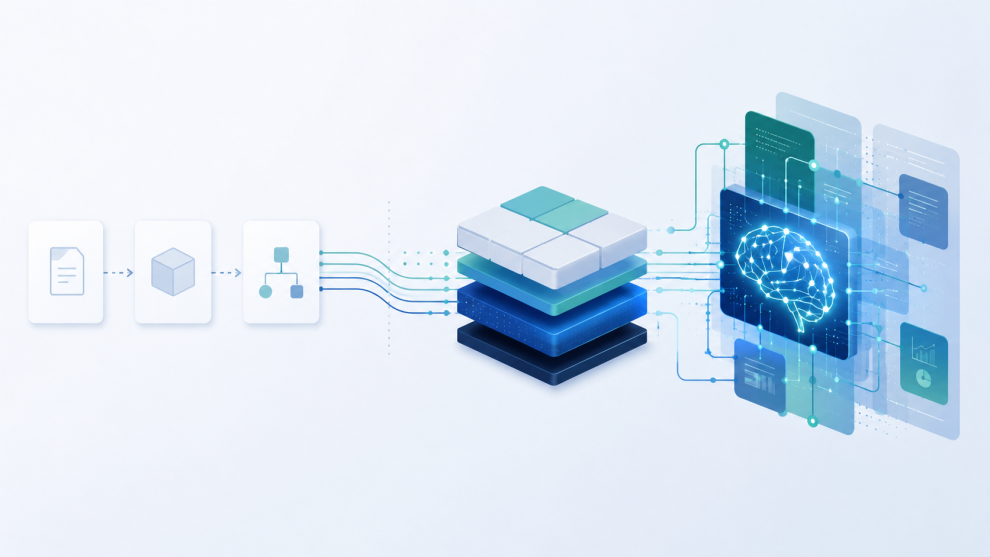
Traditional applications separate presentation, business logic, and data. AI-first products add a probabilistic reasoning layer that must retrieve context, call tools, apply policies, produce traceable outputs, and recover when confidence is low. Treating a model API as another backend endpoint hides this complexity until production.
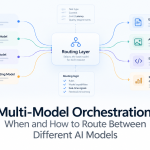
The architecture usually needs a model gateway to prevent direct coupling to one provider, a context layer that assembles authorized data, and an orchestration layer that controls prompts, tools, workflow state, retries, timeouts, and fallbacks. Retrieval-augmented generation can ground outputs in enterprise content, but retrieval quality, permissions, chunking, freshness, and citation accuracy become product concerns.
The system also needs deterministic controls around the model. Policy engines should restrict tool access and sensitive actions. Structured schemas should validate model responses before downstream execution. Human approval should protect irreversible or regulated actions. Observability should capture model version, prompt version, retrieved context, tool calls, latency, cost, output quality, and user correction without exposing restricted data.
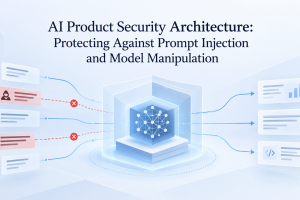
Security and governance cannot wait for release readiness. Threat models must address prompt injection, data leakage, poisoned retrieval sources, excessive agency, insecure tool execution, model drift, and third-party dependency risk. NIST’s Generative AI Profile places testing, evaluation, verification, validation, and risk management across the AI lifecycle, supporting controls built into product engineering rather than a final compliance review.
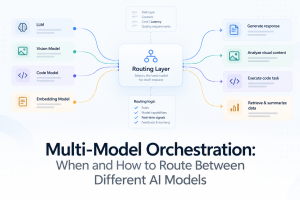
Model choice should remain replaceable. Keeping business logic, evaluation datasets, retrieval services, and workflow policies outside the foundation model supports routing by cost, latency, capability, geography, or risk while reducing future switching costs.
Why must delivery become evaluation-driven?
AI-first development changes the unit of quality. A conventional test checks whether the same input produces the expected output. A probabilistic system may produce several acceptable outputs, fail only in specific contexts, or regress after a model or prompt update. Teams need evaluation-driven development alongside unit, integration, performance, security, and accessibility testing.
Before implementation, product, engineering, domain, security, and legal teams should create representative evaluation cases. These should cover normal requests, ambiguity, adversarial inputs, missing context, conflicting data, restricted information, and high-risk edge cases. Each release should meet thresholds for task success, groundedness, policy compliance, tool accuracy, latency, and cost per successful outcome.
Production metrics must also change. Feature adoption and response time do not reveal whether the system deserves trust. Leaders should track human override rate, escalation rate, unsupported-claim rate, successful task completion, correction frequency, model cost, and the business result created after the AI response.
The engineering workflow needs similar discipline. Google Cloud’s 2025 DORA research, based on nearly 5,000 technology professionals, found that 90 percent used AI at work and more than 80 percent believed it improved productivity. It also found a negative relationship between AI adoption and software delivery stability where testing, version control, architecture, and feedback systems were weak. AI amplifies a delivery system rather than repairing it.
AI-generated code should therefore pass the same architecture decisions, code ownership rules, secure development controls, automated tests, and review standards as human-written code. Faster generation creates value only when review, integration, release, and operational capacity can absorb the change volume.
Which consulting and outsourcing partners fit an AI-first model?
External partners can help when an enterprise lacks production AI experience, needs a bounded transformation pod, or must connect model experimentation with platform engineering. The right choice depends on the missing capability.
- Accenture fits programs that combine enterprise transformation, industry operating models, major cloud ecosystems, and large-scale platform engineering. Its AI and product engineering portfolio emphasizes designing, building, and operationalizing AI-enabled platforms across complex organizations. It is relevant when work spans multiple business units, vendors, and transformation workstreams.
- Thoughtworks is a strong option where modern software engineering, product discovery, legacy modernization, and AI adoption need to move together. Its product development and enterprise AI services focus on production-ready systems, reusable data and model foundations, and engineering practices that move teams beyond disconnected pilots.
- GeekyAnts can suit enterprises seeking a focused product engineering partner or embedded delivery pod. Its AI-powered product engineering work covers prototype-to-production transitions, RAG and agent architectures, cloud infrastructure, DevOps, testing, and modernization. This is useful when an internal team has a validated use case but needs engineering capacity to make it secure, observable, scalable, and maintainable.
A partner assessment should examine who owns architecture decisions, how evaluation is performed, how generated code is reviewed, how model and cloud dependencies remain portable, and what the enterprise team can operate after the engagement ends.
The starting point is a bounded workflow, not a platform rewrite
AI-first product development does not require replacing an entire portfolio. It requires selecting a workflow where intelligence can change the outcome, then engineering the surrounding controls as seriously as the model.
A strong first engagement defines the target workflow, data boundaries, model responsibilities, human decision points, evaluation set, production architecture, and operating metrics. It also identifies platform weaknesses, such as fragmented identity, poor data access, tightly coupled services, or weak observability, that will block scale.
For leaders facing competing AI proposals, a focused architecture and delivery consultation can replace broad ambition with a buildable decision. A working session with an experienced AI product engineering partner, including firms such as GeekyAnts, can determine whether a use case needs a model, an agent, a deterministic workflow, or no AI at all. That clarity prevents the most expensive mistake: scaling an impressive demo before the organization has designed a dependable product.




Add Comment