




Enterprise AI agents rarely fail because the model cannot generate a convincing answer.
They fail because the surrounding system cannot reliably control what happens after that answer.
A prototype may complete a procurement lookup, investigate an incident, summarize customer records, or update a ticket successfully. Production changes the conditions. APIs time out. Permissions differ between users. Tool schemas change. Context grows. Models select the wrong operation. Retries multiply inference costs. A workflow that worked during 50 controlled tests suddenly has to survive tens of thousands of unpredictable executions.
This is becoming an immediate engineering concern. McKinsey’s 2026 State of AI research found that 40 percent of respondents from organizations with more than $1 billion in annual revenue reported scaling AI agents, compared with 27 percent the previous year. Yet Deloitte’s 2026 agentic AI research found that only 5 percent of surveyed organizations considered their business processes highly prepared for AI agents.
For engineering leaders, the challenge is therefore shifting from “Can an agent perform the task?” to “Can the organization predict, inspect, control, and economically operate thousands of agent executions?”
That requires treating an agent as a production system rather than a prompt.
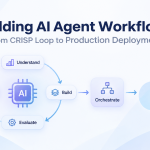
What does the CRISP approach change about AI agent workflows?
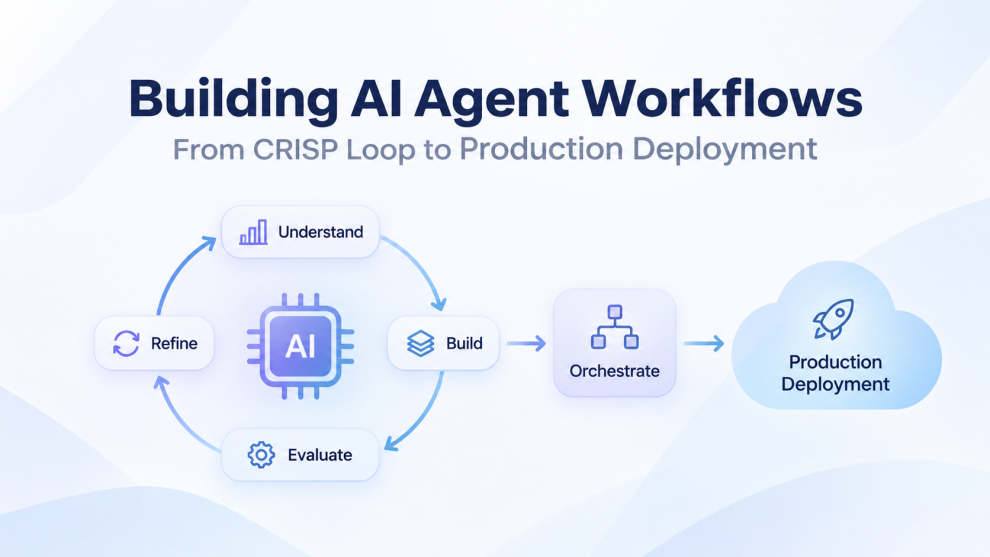
CRISP, or Critical Step Perception, emerged in 2026 research focused on making deep-search agents more efficient. The research addresses a recurring problem in agent systems: long reasoning trajectories can contain unnecessary searches, redundant tool interactions, and steps that contribute little evidence to the final result.
Instead of penalizing every tool interaction equally, CRISP identifies which steps actually preserve or obtain evidence needed for a successful result. In reported experiments, the approach reduced average interaction turns by 15.1 percent and 33.2 percent across two benchmarks while maintaining competitive answer accuracy.
CRISP itself is a research framework rather than a standard enterprise orchestration pattern. But its underlying idea is useful for production architecture: an agent should not continue acting simply because it can continue acting. Every additional step should justify its cost, latency, risk, or information gain.
That changes the architecture.
Instead of allowing an unrestricted model loop to repeatedly reason, invoke tools, observe results, and continue until it decides it is finished, engineering teams can create bounded execution loops. The model receives enough autonomy to handle ambiguity, while application code determines what actions are permitted, how many iterations can occur, which state transitions are valid, and when execution must terminate or escalate.
This distinction is important because agent flexibility and production reliability pull architecture in different directions.
How should an enterprise AI agent workflow actually be architected?
A production agent usually works better as a controlled workflow containing intelligent stages than as one autonomous agent controlling everything.
Mastra’s 2026 developer guide makes a similar distinction between deterministic workflows, autonomous agents, and agent workflows. Its production recommendation centers on combining predictable software structure with agent reasoning only where adaptability provides value.
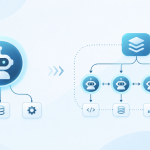
A practical architecture separates five responsibilities:
- Reasoning should determine intent and propose actions, not directly control infrastructure. The model can classify a request, construct a plan, select an approved tool, or generate arguments. A separate execution layer should validate those arguments before anything touches an ERP, CRM, database, payment system, cloud environment, or customer record. Tool execution should have explicit schemas, authorization checks, timeouts, retry rules, and idempotency controls. State management should persist what has already happened so a retry does not accidentally send a second refund or create a duplicate incident. Guardrails should determine which requests or outputs must be blocked. Human approval should sit specifically around high-impact actions rather than forcing people to review every low-risk step.
This architecture also creates an important boundary between probabilistic and deterministic behavior.
Language models are useful when the system needs interpretation. Conventional software is better when the system already knows the rule.
An agent may decide that an account issue appears to require a refund. Deterministic code should confirm refund eligibility, transaction limits, user permissions, and whether the refund has already been processed.
The agent reasons. The platform enforces.
What separates a working AI agent from a production-ready one?
Production readiness starts when engineering teams deliberately design the failure paths.
The agent needs maximum iteration counts so an unresolved task cannot generate an unlimited loop. Every external tool needs a timeout and a known fallback. Structured outputs need schema validation before downstream systems consume them. Tool calls need authorization at execution time rather than relying on instructions such as “do not access unauthorized records.”
Sensitive operations require explicit approval boundaries.
OpenAI’s current agent guidance, for example, separates automatic guardrails from human review. Guardrails can validate inputs, outputs, and tool activity, while human approval can pause workflows before actions such as edits, cancellations, shell commands, or other consequential operations proceed.
Engineering teams also need to define an execution budget.
That budget is not only financial. It can include maximum model calls, tool calls, elapsed time, tokens, retries, API spend, and permitted side effects for one workflow execution.
A CRISP-style principle then becomes operationally useful. If another reasoning or retrieval step is unlikely to materially improve the result, the workflow should terminate, return the best validated result available, or escalate.
This prevents the common mistake of equating more reasoning with better reasoning.
How should teams test AI agent workflows before production deployment?
Traditional application tests remain necessary, but they are no longer sufficient.
A team can verify that every API responds correctly and still deploy an unreliable agent because the model selects the wrong API, selects it in the wrong sequence, retries unnecessarily, or arrives at a technically valid but operationally incorrect outcome.
Agent evaluation therefore needs to inspect trajectories rather than just final responses.
A useful test dataset should include normal requests, ambiguous inputs, incomplete records, permission failures, unavailable services, malformed tool responses, adversarial instructions, outdated information, conflicting evidence, and situations where the correct behavior is to stop.
Teams should measure task completion alongside tool selection accuracy, unnecessary interaction count, escalation accuracy, latency, token consumption, tool cost, policy violations, and recovery from dependency failures.
Observability then has to continue after deployment.
Modern agent platforms increasingly expose traces containing model calls, tool invocations, handoffs, guardrail events, and other workflow steps. OpenAI’s evaluation guidance specifically recommends trace grading for questions such as whether an agent chose the correct tool, performed an appropriate handoff, or violated an instruction.
That level of tracing turns an unexpected agent result from a mysterious AI problem into an inspectable distributed-systems problem.
How should enterprises move an agent from pilot to production?
Production deployment should increase autonomy gradually.
The first deployment can run in shadow mode, allowing the agent to recommend actions without executing them. Teams can compare those recommendations with human decisions and collect real workflow traces.
The next stage can permit low-risk actions while requiring approval for consequential ones. Only after evaluation data demonstrates stable performance should teams expand the agent’s action boundaries.
This matters because governance frequently trails adoption. Deloitte reported in 2026 that roughly 80 percent of surveyed organizations lacked mature agentic AI governance capabilities, including clear autonomy boundaries, monitoring, and audit trails.
Deployment architecture therefore needs rollback mechanisms, model and prompt versioning, feature flags, trace retention, access controls, evaluation gates, and per-workflow cost monitoring from the beginning.
Model upgrades should also be treated like software releases. A stronger benchmark score does not prove that a newer model will preserve tool-selection behavior, structured outputs, latency, or economics inside a specific enterprise workflow.
When does outside AI engineering support make sense?
Large organizations often reach a point where the difficult work is no longer building the agent itself. The harder task is connecting agent behavior to existing identity systems, APIs, security policies, data infrastructure, observability platforms, and release processes.
Consulting and engineering partners approach that problem differently. Accenture can make sense when agent programs form part of broad enterprise transformation initiatives involving multiple business units and platforms. Deloitte commonly operates where technology transformation intersects strongly with operating models, governance, risk, and organizational change.
GeekyAnts sits closer to the product engineering end of the spectrum, particularly where teams need to translate an AI use case into an engineered workflow, integrate it with an existing product or platform, and establish the technical controls required for production operation.
The important selection criterion is less about who can demonstrate an agent and more about who can explain its production failure model.
Engineering leaders should expect a partner to discuss state, permissions, tool isolation, evaluation datasets, observability, rollback, cost ceilings, human approvals, and degraded-mode behavior before discussing autonomous capabilities.
What should engineering leaders validate before deploying an AI agent?
The strongest production architecture rarely gives an agent unlimited freedom.
It gives the agent precisely enough freedom to solve the uncertain portion of a workflow, while conventional engineering controls everything that cannot be allowed to remain uncertain.
That is where the CRISP principle becomes particularly relevant. Production agent systems should continuously distinguish between actions that materially move a task toward a validated outcome and actions that merely extend the reasoning trajectory.
For engineering organizations moving from agent prototypes toward customer-facing or operational deployment, the useful next conversation is therefore not simply which model or framework to choose.
It is a technical review of the workflow itself: where reasoning belongs, where deterministic controls should take over, which actions require approval, what must be observable, how failures recover, and what evidence is required before autonomy expands.
A focused production-readiness session around one existing agent workflow can often surface those boundaries before they become considerably more expensive production problems.








Add Comment