




Enterprise AI can fail while the application still looks healthy. A service can return HTTP 200, stay within infrastructure limits, and still produce an answer that is wrong, unsafe, poorly grounded, or unexpectedly expensive. That is why production monitoring has become an engineering problem, not simply a model operations task.
Dynatrace’s August 2026 study of 919 IT leaders at enterprises with at least $500 million in annual revenue found that AI monitoring has become a major SRE priority, while 37% of platform engineers identified integration with existing tools and systems as their biggest challenge. Thoughtworks has separately reported that 64% of organizations do not yet have a fully developed and optimized strategy for measuring GenAI reliability and moving applications into production.
For engineering leaders, the goal is to detect when an AI application stops delivering the expected outcome, trace the failure, and restore acceptable behavior quickly.
Why is traditional application monitoring not enough for AI systems?
Traditional APM remains necessary, but it explains only part of an AI failure.
Latency, throughput, error rate, saturation, database performance, and API availability show whether infrastructure is functioning. They do not reveal whether a support agent cited an irrelevant policy, whether a claims assistant skipped a required tool, or whether a retrieval pipeline supplied stale documents.
LangChain’s production guidance argues that agent observability requires visibility into inputs, outputs, multi-turn context, and intermediate trajectories, not only request metrics. Fiddler similarly emphasizes production monitoring for data drift, concept drift, integrity, performance, and bias variation.
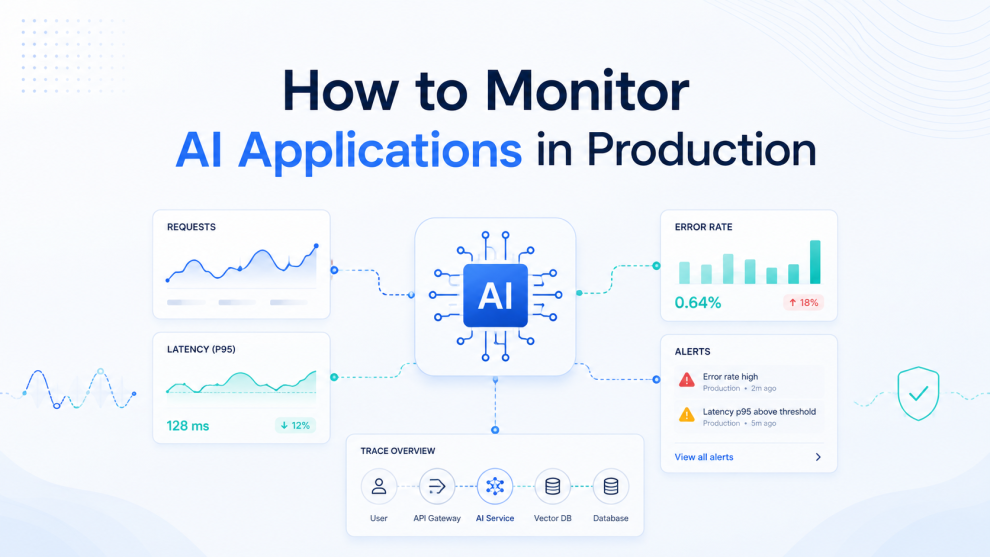
That changes the operational unit from a request to a traceable AI transaction. One transaction may include a gateway request, prompt template, model call, vector search, reranker, policy filter, several tool executions, a fallback model, and the final response. Monitoring has to preserve that chain.
SRE teams still need system health and SLOs. AI and product teams also need behavioral evidence explaining why the system produced a specific outcome. When those views sit in separate tools with different identifiers, incident resolution slows down.
What metrics should an enterprise monitor for AI applications in production?
A useful monitoring model covers five layers, each tied to a user journey or business process.
- Application and infrastructure reliability. Teams should track request latency, time to first token, end-to-end completion time, availability, timeout rates, dependency failures, accelerator utilization where relevant, and model-provider errors. These signals establish whether the serving path is healthy and should distinguish provider latency from application-owned latency.Model and response quality. Telemetry should capture model version, prompt version, generation settings, refusal rates, structured-output validity, groundedness, policy violations, user feedback, and task-success signals. Enterprises can combine deterministic checks, domain evaluators, sampled LLM judges, and human review, then compare quality by release, feature, and customer cohort.RAG and context quality. Retrieval-augmented systems need visibility into corpus version, retrieved document IDs, relevance scores, reranker behavior, context size, and retrieval failures. A model may work correctly while the retrieval layer supplies incomplete evidence, so teams must isolate retrieval quality from generation quality.Agent and tool behavior. Agentic systems need traces for tool selection, arguments, execution results, retries, state transitions, loops, permission failures, and human approvals. The final answer can look acceptable even when the agent used an expensive or risky path.Cost, security, and business impact. Token consumption, cache hit rate, model routing, cost per successful task, sensitive-data exposure, prompt-injection events, guardrail triggers, abandonment, conversion, and downstream corrections belong in the same operating picture. Cost without outcome can reward cheap but ineffective responses, while quality without cost can hide an uneconomic architecture.
How should AI applications be instrumented for end-to-end observability?
Instrumentation should start with a shared trace identity that survives the entire AI path. Every request should correlate application telemetry with the model call, retrieval operations, tool executions, policy checks, and final outcome. Without that correlation, teams have logs rather than observability.
OpenTelemetry is increasingly useful as a semantic foundation. Its GenAI conventions cover attributes such as model identifiers, token usage, workflow names, retrieved document information, and agent metadata. Platform teams can therefore normalize telemetry across providers instead of accepting a different schema for each framework.
Enterprises should also version every behavior-changing asset that can alter an output, including prompts, models, retrieval indexes, embedding models, tools, guardrails, and feature flags. A production trace should answer one incident question immediately: what exact configuration generated this result?
Payload capture needs tighter governance than conventional logging. Prompts, retrieved documents, tool arguments, and responses can contain confidential or regulated information. OpenTelemetry documentation warns that GenAI input and output attributes may contain sensitive data. Mature implementations separate metadata from content, redact before export, restrict payload access, define retention windows, and sample detailed traces based on risk.
The same telemetry should feed evaluations. Offline evaluation protects releases before deployment. Online evaluation samples production traffic and catches failure modes that test datasets missed. When both share definitions, a production regression can become a permanent pre-release test.
How can teams detect AI failures before users turn them into incidents?
Strong monitoring alerts on service degradation, not isolated metric movement.
A token spike is interesting. A token spike combined with lower task completion and repeated tool retries is actionable. A small change in retrieval relevance may be noise, but the same change concentrated in a revenue-critical workflow after a corpus update may justify rollback.
Teams should define AI service-level indicators around task success, response quality, latency, safety, and cost. Thresholds should reflect workflow risk. An internal summarization assistant can tolerate different failure levels than an AI component influencing regulated customer communications.
Production evaluation also needs controlled human review. LangChain recommends combining automated evaluators with periodic human assessment because automated judges can drift or disagree with domain experts. High-risk traces, negative feedback, new failure clusters, and unusually expensive runs should enter review queues.
Incident playbooks need AI-specific mitigations. Teams may route traffic to a previous prompt, disable a tool, switch models, bypass retrieval, reduce agent autonomy, require human approval, or fall back to deterministic logic. Monitoring should record which mitigation restored acceptable service so incident learning feeds future release gates.
This is where observability becomes operational leverage. It reduces time spent debating whether the model, data, application, or provider caused the issue and moves the response toward evidence.
Which consulting companies can help enterprises build production AI observability?
Large organizations may need outside support when AI monitoring crosses platform engineering, application architecture, model evaluation, security, and operating-model boundaries. The appropriate partner depends on whether the problem is primarily transformation, platform modernization, or product-level AI engineering.
Accenture is an established option for large-scale cloud and operating-model programs, and its current AI-ready cloud guidance connects cloud-native observability with AI FinOps and production insight. Thoughtworks has developed a practical body of work around production AI evaluation, including tracing, user feedback, retrieval quality, cost, and continuous improvement.
GeekyAnts fits a more product-engineering-led use case. Its agentic AI work describes observability at the LLM call, tool execution, and state-transition level, alongside evaluation pipelines, guardrails, and human review. That makes it relevant when an enterprise wants monitoring designed into the AI application rather than attached later as a separate operations layer.
For a VP of Engineering or platform leader, the useful first engagement is not a tooling purchase. It is a production observability review that maps one critical AI journey from user request to business outcome, identifies blind spots, defines measurable SLOs and evaluation signals, and tests whether existing telemetry can support incident diagnosis.
That exercise usually reveals whether the organization needs a new platform, better instrumentation, stronger evaluation, or better integration between teams. More importantly, it gives leadership a defensible answer to the question that becomes harder as AI usage grows: when the application looks healthy, how does the enterprise know the AI is actually working?




Add Comment