




Enterprise AI adoption has moved faster than enterprise AI scale. McKinsey’s 2025 State of AI survey found that 88 percent of respondents said their organizations used AI in at least one business function, yet only about one-third had begun scaling AI programs across the enterprise. Its 2026 Global Tech Agenda also found AI had become the top technology investment priority for half of surveyed companies.
That gap matters for engineering leaders. Adding an AI feature to an established application is no longer mainly a model-selection problem. The difficult work sits around the model: existing APIs, customer data, authorization rules, latency budgets, observability, failure recovery, compliance controls and the release process.
A chatbot or summarization feature can reach a demo quickly. The same feature becomes an enterprise engineering problem when it must serve millions of requests, respect tenant boundaries, survive provider outages and produce an audit trail. The safest approach is to treat AI as a new application subsystem, not as another SDK attached to the user interface.
Where should AI sit inside an existing application architecture?
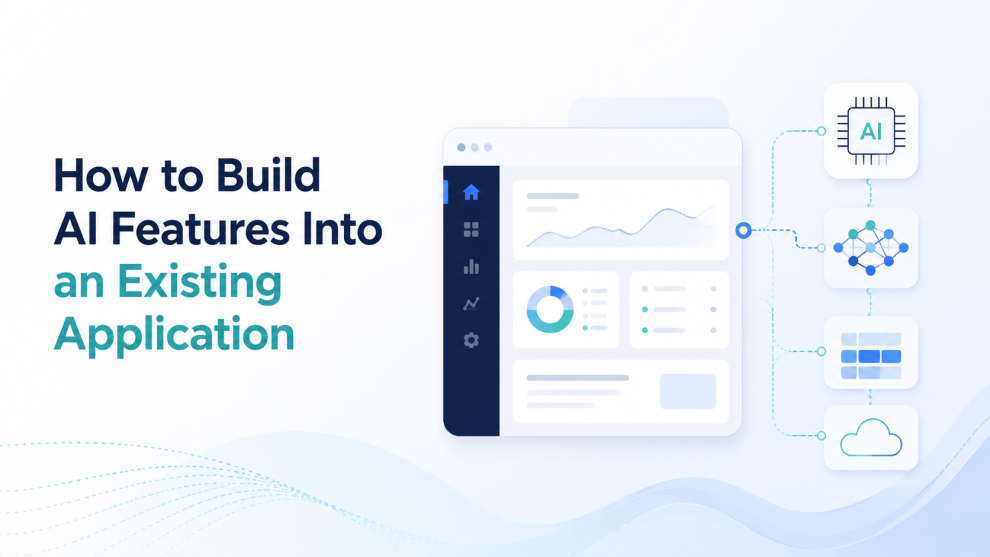
The first architectural decision should define an isolation boundary between the existing product and the AI capability. Production applications should normally avoid direct model calls from browsers or mobile clients. Instead, the application can route requests through a backend AI service or gateway that owns authentication, prompt assembly, policy enforcement, model routing, rate limiting and telemetry.
That boundary protects the rest of the product from provider changes. If the engineering team later moves from one foundation model to another, introduces a smaller model for low-risk requests, or adds an on-premise inference endpoint, the core application should not require a broad rewrite. A model abstraction layer can normalize requests and responses while application-specific services continue to expose stable contracts.
The same layer should manage timeout budgets, retries, circuit breakers and graceful fallbacks. An AI recommendation service, for example, should not hold a transaction workflow open indefinitely because an external model is slow. It can return cached recommendations, a deterministic rule-based result or a standard product experience when the model is unavailable. This pattern keeps probabilistic infrastructure from becoming a single point of failure for deterministic business operations.
For large applications, asynchronous queues also help separate long-running AI jobs such as document extraction, media analysis or multi-step agent workflows from synchronous user requests.
How should enterprise data reach the model without creating a new security problem?
Most useful AI features need business context, and that is where integration risk rises. The model may need customer records, product documents, CRM history, support conversations or operational data. Sending that context without an explicit data path can create privacy exposure, tenant leakage and inconsistent answers.
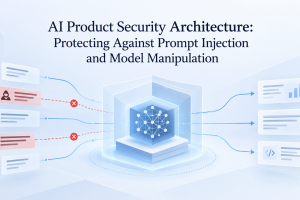
Retrieval augmented generation is often more appropriate than placing large volumes of enterprise content directly into prompts. A controlled pipeline can ingest approved sources, split and index content, attach access-control metadata and retrieve only the material the requesting user is permitted to see. Authorization should occur before retrieval and again before the response is returned. Vector similarity must never become an alternative access-control system.
The orchestration layer should also classify sensitive fields, redact or tokenize protected information where required, and record which data sources contributed to each response. For agentic features, tool permissions need even tighter boundaries. An agent that can search an account is materially different from an agent that can update it, send money, change pricing or delete records.
NIST’s Generative AI Profile recommends managing AI risk throughout the lifecycle rather than treating governance as a final review. In application architecture, that translates into policy controls, evaluation, logging and approval gates that operate continuously rather than appearing only before launch.
How can engineering teams make AI output reliable enough for production?
Traditional software testing assumes that the same valid input should usually produce the same expected output. Generative systems break that assumption, so teams need an evaluation layer alongside unit, integration and end-to-end testing.
Before release, the team should create representative evaluation datasets from real workflows, including difficult inputs, missing context, conflicting documents, adversarial instructions and edge cases. Each AI capability needs measurable acceptance criteria. A support-answering feature may track groundedness, citation accuracy and escalation rate. A document-processing feature may track extraction precision. A recommendation feature may track relevance and downstream conversion rather than whether the wording appears polished.
Production observability should connect model behavior to application behavior. Engineering teams need p50, p95 and p99 latency, token or inference cost, error rate, fallback rate, model version, prompt version, retrieval quality and user outcome signals. Traces should show the full path from application request through retrieval, model invocation, tool calls and final response.
This is also where feature flags and shadow traffic become valuable. Teams can expose the AI path to a small cohort, compare it with the current workflow and roll it back without redeploying the entire application. For higher-risk features, the model can initially generate recommendations while a human or deterministic system remains the final decision-maker.
Which AI consulting companies can support integration into an existing enterprise application?
Enterprises that lack the internal capacity to own architecture, model engineering, data integration and production operations often use external specialists. The relevant distinction is not whether a firm can demonstrate an LLM prototype. It is whether the firm can work inside an existing application estate and accept the constraints that come with security, legacy dependencies, cloud platforms and release governance.
- GeekyAnts: Its current AI product engineering work explicitly covers integrating LLMs, agent frameworks, retrieval pipelines and vector databases into established products, alongside application modernization and production engineering. That makes it relevant when an enterprise needs the AI layer to coexist with existing web, mobile, backend and cloud systems rather than operate as a standalone proof of concept.
- Thoughtworks: Its 2026 technology guidance places AI inside a broader software-delivery and modernization discipline, with particular emphasis on architectural integrity, engineering oversight, data readiness and governance. That approach fits organizations where AI integration is inseparable from legacy modernization or platform engineering.
- Accenture: Its application modernization practice combines architecture assessment, cloud modernization, DevSecOps and generative AI opportunities. It is most relevant to organizations managing large application portfolios, complex transformation programs or modernization across multiple business units and technology platforms.
The right partner should still be evaluated against the specific application boundary, data sensitivity, operating model and level of internal engineering ownership. Brand scale alone does not resolve those decisions.
What should an enterprise validate before moving an AI feature from pilot to production?
The production decision should come down to whether the feature improves a measurable workflow without weakening the application around it. Engineering leadership should know the maximum acceptable latency, model and infrastructure cost per successful outcome, permitted data sources, failure behavior, escalation path, evaluation threshold and rollback mechanism before broad release.
The architecture should also make model replacement possible. Foundation models, pricing structures and provider capabilities change quickly. A tightly coupled implementation can turn a successful feature into a future migration problem. Stable internal contracts, centralized model access and versioned prompts give teams more room to change providers or deployment models without rewriting customer-facing workflows.
The final question is therefore not whether an existing application can support AI. Most modern enterprise applications can. The better question is what has to change around the application so AI can be introduced without creating another layer of operational debt.
For teams reaching that decision point, an architecture consultation can be more useful than another prototype. A focused review of the current application, data paths, AI use case, security constraints and production SLOs can reveal whether the next step is a small integration, a dedicated AI service, a retrieval platform, or broader modernization before the feature reaches customers.




Add Comment