






Enterprise AI has moved past experimentation, but enterprise value has not moved at the same speed. Stanford’s 2026 AI Index reports that 88% of surveyed organizations used AI in 2025, with generative AI used in at least one business function at 70%. McKinsey’s 2025 global survey, however, found that only 39% of respondents reported enterprise-level EBIT impact from AI.
That gap is where engineering leaders now spend much of their time: turning promising pilots into systems that perform reliably inside real workflows. For VPs of Engineering, platform leaders, and transformation executives, the expensive mistakes rarely start with a bad model. They start with weak problem framing, brittle data access, incomplete evaluation, permissive security, and no operating model for what happens after deployment.
The result can be an AI product that demos well but becomes costly to scale, hard to govern, or too unreliable for employees and customers to trust.
Why do enterprise AI projects fail even when the model works?
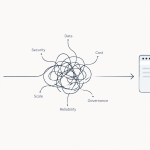
A model can produce technically impressive answers while the product around it fails the business. Enterprise AI is a distributed system, not a model endpoint. It depends on identity, permissions, APIs, retrieval, data freshness, workflow orchestration, observability, fallback behavior, and clear ownership.
This distinction matters because AI use is already widespread. The bottleneck is production quality. McKinsey’s research found workflow redesign to be one of the strongest factors associated with enterprise value from generative AI. Simply inserting an assistant into an existing process can leave the actual bottleneck untouched.
A customer-service copilot, for example, may summarize cases accurately but still increase handling time if it cannot access policy data with the right permissions, retrieve current account context, or write approved actions back into the CRM. An engineering assistant may generate correct code but create review overhead if teams lack controls for dependency selection, secrets exposure, or repository-specific standards.
The first mistake, then, is treating model quality as the product. Leaders need to define the decision or task being improved, the systems the AI can read or change, acceptable error boundaries, and the operational metric that determines whether the workflow is actually better.
Which AI development mistakes create the most technical debt?
Several mistakes repeatedly turn manageable pilots into expensive platform problems:
- Building before defining the decision boundary. Teams often begin with a model, prompt framework, or agent architecture and work backward toward a use case. That creates systems with vague success criteria. A production specification should define the task, permitted actions, required context, escalation conditions, and measurable outcome. For a service agent, that could mean reducing resolution time without increasing reopen rates or policy exceptions. For a knowledge assistant, it could mean improving retrieval while preserving document-level access control. Without this boundary, teams cannot build meaningful evaluation sets or decide when automation should stop and a human should take over.
- Treating enterprise data as generic model context. Retrieval-augmented generation does not automatically solve data quality. A RAG layer can still return stale documents, duplicates, inaccessible content, or semantically similar but operationally wrong records. Teams need ingestion lineage, chunking rules, metadata filters, ACL-aware retrieval, document freshness policies, and deletion propagation. They should measure retrieval quality separately from generation quality. Otherwise, engineers may tune prompts for errors caused by the index and create fragile workarounds.
- Testing demo accuracy instead of production behavior. A curated prompt set rarely exposes the edge cases that appear after launch. Evaluation should cover task completion, groundedness, tool selection, structured-output validity, refusal behavior, latency, cost, and recovery from downstream failures. Agentic systems also need tests for repeated tool calls, partial API failures, unsafe action sequences, and permission escalation. Offline evaluation should connect to production telemetry so teams can compare releases, detect drift, and roll back model, prompt, retrieval, or orchestration changes independently.
- Adding security and observability after launch. OWASP’s 2026 guidance for LLM and generative AI applications reflects a threat surface that includes prompt manipulation, unsafe tool use, sensitive information exposure, and other AI-specific failure modes. IBM’s 2026 Cost of a Data Breach Report found that one in four malicious breaches in its study were AI-enabled, and those breaches cost $6 million on average. AI services therefore need least-privilege tool access, schema validation, secrets isolation, audit trails, rate limits, approval gates for high-impact actions, and traceability across prompts, retrieved context, responses, and tool calls.
How should leaders evaluate architecture, security, and model performance?
An architecture review should start with failure modes rather than model choice. Teams should ask what happens when retrieval returns nothing, a model provider times out, a tool responds with malformed data, an agent repeats an action, or a user injects instructions through retrieved content.
That review usually leads to practical controls: deterministic validation around probabilistic outputs, explicit tool schemas, idempotent actions, retry budgets, circuit breakers, human approval for irreversible operations, and fallback models or non-AI workflows for critical paths. Observability should capture model version, prompt version, retrieval sources, token usage, latency percentiles, tool execution, user feedback, and final business outcome.
Cost also needs architectural treatment. A system optimized only for answer quality can become uneconomic at enterprise traffic. Model routing, caching, context compression, smaller specialized models, asynchronous processing, and bounded agent loops can reduce cost without weakening the experience. The relevant measure is not cost per token. It is cost per successfully completed business task.
NIST’s Generative AI Profile supports this broader risk-management approach by treating trustworthiness as something organizations address across design, development, use, and evaluation rather than as a final compliance check.
When should an enterprise bring in an AI consulting partner?
External help is most useful when the constraint is not raw coding capacity but architecture, platform design, evaluation discipline, or cross-functional delivery. Large consulting firms such as Accenture and Deloitte maintain broad enterprise AI practices, while engineering-led firms such as GeekyAnts combine AI development and consulting with product engineering. The relevant selection question is not which firm has the loudest AI positioning. It is whether the partner can work inside the organization’s data, security, cloud, and application constraints while leaving behind an architecture the internal team can operate.
A serious technical discovery should examine production traffic, data classification, integration boundaries, identity architecture, model portability, observability, evaluation ownership, and expected unit economics before recommending a stack. That also helps leaders avoid another common mistake: outsourcing the prototype and accidentally outsourcing operational knowledge with it. Internal platform and security teams should remain involved in design decisions, evaluation criteria, runbooks, and production acceptance.
The reference articles ranking for this topic largely focus on familiar failure categories such as unclear goals, weak data, security, testing, integration, and scalability. For large enterprises, the more useful question is how those categories translate into architecture decisions and operating controls.
What does a safer path to production look like?
Enterprise AI teams do not need to eliminate uncertainty. They need to make uncertainty measurable and containable. A strong program defines the business task first, builds governed access to the required data, evaluates the complete system rather than only the model, and treats security, observability, cost, and ownership as production requirements.
That changes the executive conversation. Instead of asking whether a model is accurate enough, leaders can ask where permissions are enforced, how retrieval is validated, what an agent can change, how failures are traced, what happens when a provider or model changes, and who owns remediation.
For a VP deciding whether an AI initiative is ready to move beyond pilot status, a useful next step is a technical readiness conversation rather than another strategy workshop. Reviewing one proposed use case against its data path, evaluation design, security boundaries, integration dependencies, and operating cost can expose the mistakes that would otherwise appear several months into production.






Add Comment