





Enterprise technology leaders no longer need another prediction that artificial intelligence will reshape software. They need an answer to a harder question: what changes when AI stops acting as a feature and starts operating as the product’s decision layer?
Stanford’s 2026 AI Index reports that 88 percent of surveyed organizations used AI in 2025, while 70 percent used generative AI in at least one business function. Yet agent deployment remained in the single digits across most functions. Adoption has accelerated, but production maturity still lags.
For large North American enterprises, the next phase will depend on whether they can build products that interpret context, select actions, use tools, learn from outcomes, and operate within defined controls. That transition will affect architecture, platform engineering, security, data governance, and customer experience.
The future of AI-native digital products therefore looks less like a feature race and more like a redesign of the enterprise software operating model.
What Makes a Digital Product Truly AI-Native?
An AI-enabled product adds intelligence to an existing workflow. An AI-native product designs the workflow around intelligence from the start.
A conventional claims platform captures documents, applies rules, and routes cases to adjusters. An AI-enabled version may summarize a claim or extract fields. An AI-native version can interpret evidence, request missing information, compare policy conditions, estimate risk, recommend an action, and escalate exceptions. The product no longer waits for users to move every process forward.
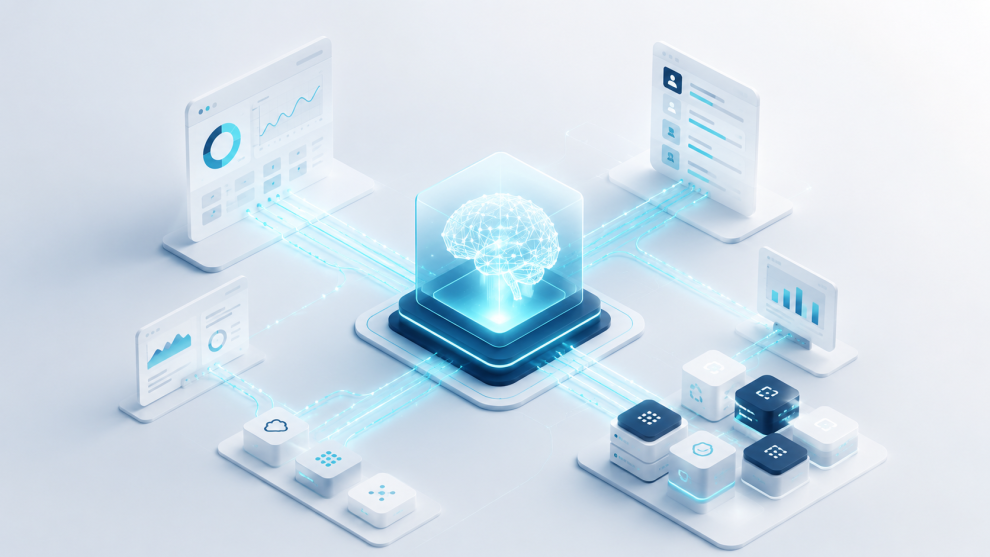
That change requires more than an LLM endpoint. The architecture needs a context layer that combines enterprise data, user state, permissions, workflow history, and domain rules. It needs orchestration that chooses models and tools based on cost, latency, confidence, and task complexity. It also needs evaluations for factuality, task completion, policy compliance, and business outcomes.
The World Economic Forum has highlighted the “context gap” between general model intelligence and the company-specific judgment required for high-stakes workflows. It notes that task-level productivity gains often fall between 15 and 40 percent, but those gains do not automatically improve company-level performance when organizations place AI inside old workflows.
This gap will define the next product competition. The difficulty lies in turning fragmented data, policies, APIs, and expert decisions into reliable machine-usable context. Products that solve that problem can move from answering questions to completing bounded work.
Why Enterprise Architecture Must Change
AI-native products introduce runtime uncertainty into systems that enterprise architecture traditionally tries to make deterministic.
A standard service returns a defined response for a defined input. A model-driven service may produce different outputs, call different tools, or require more context. Engineering teams must design for probabilistic behavior without accepting unpredictable business outcomes.
The emerging architecture will separate intelligence from control. Models will generate, classify, reason, or plan. Deterministic services will enforce identity, authorization, transaction rules, data residency, financial limits, and approval requirements. An orchestration layer will connect both sides and maintain traceability across prompts, context, tool calls, decisions, and actions.
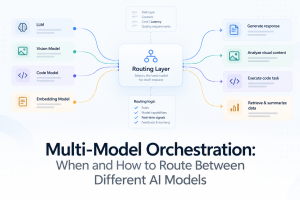
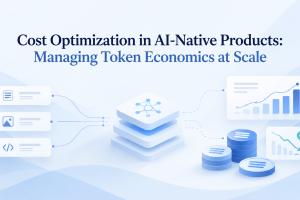
This structure also reduces model dependency. Teams can route simple tasks to smaller models, reserve frontier models for complex reasoning, and switch providers when cost, availability, or performance changes. Model gateways, semantic caching, token controls, fallback policies, and workload-specific benchmarks will become standard platform capabilities.
Google Cloud’s 2025 DORA research found that 90 percent of surveyed developers used AI at work, but outcomes varied widely. It describes AI as an amplifier of strong engineering systems and weak delivery practices. It also connects high-quality internal platforms, small batch delivery, version control, accessible internal data, and clear AI policies with stronger outcomes.
Enterprises cannot scale AI-native products through isolated teams. They need shared evaluation services, approved model access, retrieval patterns, observability, security controls, and deployment pathways. Without those foundations, each team creates its own stack, risk model, and cost profile.
Where AI-Native Product Programs Break
Most enterprise failures will not begin with model quality. They will begin with unclear product boundaries.
Teams often select a broad goal such as “automate customer service” or “build an intelligent operations platform.” Those goals hide workflows, exception paths, data owners, policies, and failure costs. The result becomes a convincing prototype that cannot survive real transactions.
A production program needs a narrower unit of value. It should identify one workflow, define the decision rights the system can hold, specify the actions it may take, and set conditions for human review. It should also establish baseline metrics before development. Useful measures include completion rate, exception rate, human override rate, unsupported-action rate, latency, cost per completed task, and downstream business impact.
Governance must operate inside the product lifecycle rather than as a final approval gate. NIST’s Generative AI Profile extends its AI Risk Management Framework with guidance for identifying and managing generative AI risks across design, development, deployment, use, and evaluation. That lifecycle view fits AI-native products because their behavior changes as models, prompts, retrieval sources, and policies change.
Leaders also need to separate engineering velocity from product value. Faster code generation can increase release volume while exposing weak testing, tightly coupled architecture, and slow feedback loops. DORA found that AI adoption can improve throughput and product performance, while still creating stability pressure when teams lack strong controls.
AI-native delivery therefore needs stronger specifications, automated evaluations, testable policies, rollback mechanisms, and production telemetry than conventional feature development.
Which Consulting and Engineering Partners Fit This Work?
No single partner profile fits every enterprise. The right choice depends on whether the program centers on operating-model transformation, product engineering, or modernization at scale.
- GeekyAnts fits programs that need a product-focused engineering partner to move from architecture or prototype into a production-grade digital product. Its published capabilities cover AI product engineering, LLM integration, retrieval pipelines, agent frameworks, CI/CD, observability, and modernization. That mix can suit enterprises seeking a hands-on team across product, application engineering, and AI infrastructure.
- Accenture fits large transformation programs spanning business processes, enterprise platforms, cloud estates, and global delivery. Its AI-native software delivery approach embeds AI across requirements, design, development, testing, deployment, and operations. That breadth can support coordinated change across many business units.
- Thoughtworks fits organizations that emphasize modern engineering practices, product thinking, and architecture evolution. Its AI-native engineering guidance focuses on orchestration, specifications, context, guardrails, and production discipline rather than informal prompt-led development.
The selection process should test each partner against the same evidence: production references, evaluation design, data architecture, security ownership, model portability, cost controls, and capability transfer.
What Should Technology Leaders Do Next?
The next generation of digital products will not simply contain AI. They will use AI to decide how the product behaves within explicit operational boundaries.
That future will reward enterprises that redesign workflows, not those that attach assistants to every interface. It will favor platforms that treat context, evaluation, observability, and policy enforcement as reusable infrastructure. It will also favor teams that measure completed work and customer outcomes instead of model novelty.
Stanford’s 2026 AI Index shows that corporate AI investment more than doubled in 2025, while generative AI investment grew by more than 200 percent. Enterprise advantage, however, will come from converting those capabilities into reliable systems that fit real operating constraints.
A useful next step is not another broad AI roadmap. It is a focused architecture and product working session around one high-value workflow. That session should expose the current decision path, available context, integration limits, risk controls, evaluation criteria, and production economics. Leaders can then determine whether the opportunity needs a controlled experiment, a platform capability, or a full product redesign.
The future of AI-native digital products will arrive through those disciplined decisions. The enterprises that make them well will build products that do more than respond. They will build products that understand enough context to act, remain accountable when they act, and improve the economics of the workflow they were created to run.





Add Comment