




Enterprise technology leaders no longer need another argument for adding AI to the product roadmap. The harder question is whether the engineering organization can turn AI experiments into dependable products without increasing delivery risk, cloud cost, security exposure, or technical debt.
That distinction matters because enterprise adoption has moved faster than operational maturity. McKinsey reported in 2025 that almost all surveyed companies were investing in AI, while only 1 percent considered their AI deployment mature. The 2025 DORA research, based on responses from nearly 5,000 technology professionals, reached a related conclusion: AI acts as an amplifier. It strengthens effective engineering systems, but it also magnifies weak architecture, fragmented workflows, and poor delivery controls.
For VPs of Engineering and digital platform leaders, AI product engineering means more than adding a model API or purchasing coding assistants. It requires a delivery system that connects user outcomes, data, models, architecture, testing, security, observability, and cost controls. The target is not maximum code generation. The target is faster learning and safer production change.
AI Must Reshape the Product Lifecycle, Not Only the Coding Stage
Many enterprise programs start with developer productivity because code assistants create visible activity quickly. Teams generate functions, tests, documentation, and migration scripts faster. That improvement has value, but it does not remove the constraints that usually delay a large product organization.
Requirements still move through several business units. Data access still depends on ownership, classification, and retention rules. Security reviews still arrive late. Integration teams still manage brittle dependencies. Quality teams still test behavior that changes when prompts, models, retrieval indexes, or external tools change. Faster code creation can push more work into review, verification, and remediation.
The 2025 Stack Overflow Developer Survey found that 46 percent of developers distrusted the accuracy of AI tools, compared with 33 percent who trusted them. Experienced developers showed the greatest caution. This does not make AI coding ineffective. It means engineering leaders must treat generated code and model output as untrusted inputs until automated and human controls verify them.
A stronger lifecycle begins with explicit product context. Teams should connect customer problems and business metrics to technical specifications, acceptance criteria, data contracts, and evaluation datasets. AI agents can then work against a governed source of truth instead of reconstructing intent from tickets and source code.
This approach changes the operating question. Instead of asking how many tasks an assistant completed, the organization asks whether AI reduced hypothesis-to-production time, improved release quality, or increased the percentage of product decisions backed by reliable evidence.
Production Architecture Becomes the Real Competitive Constraint
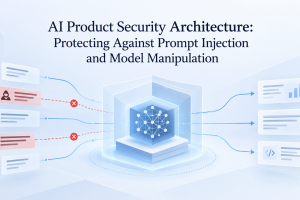
An AI prototype often succeeds because it operates with a narrow dataset, light traffic, permissive latency, and manual supervision. Production removes those protections. The system must handle uncertain model behavior, changing data, concurrent users, regional privacy obligations, vendor outages, prompt injection, and unpredictable inference cost.
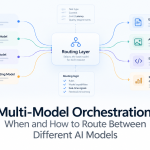
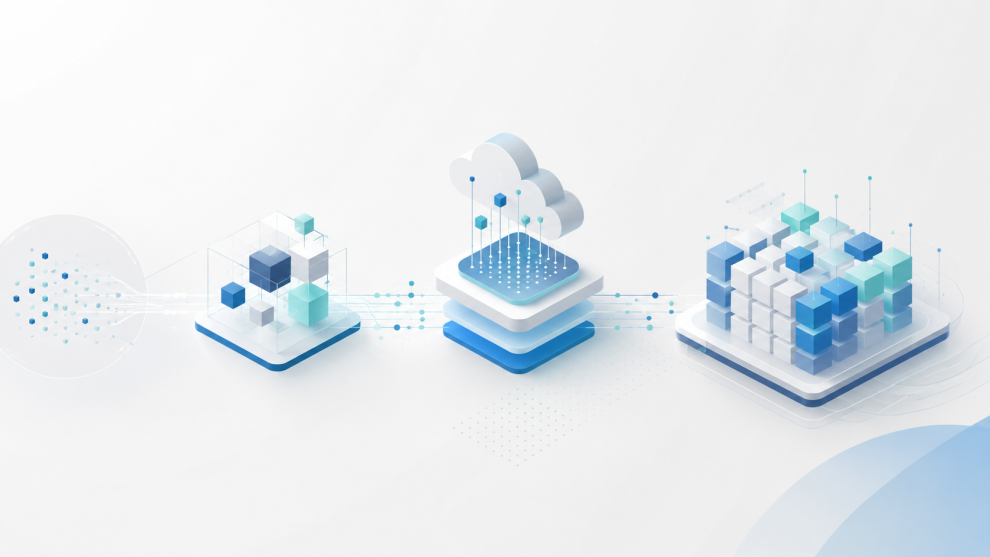
Engineering leaders should separate the architecture into controllable layers. A model gateway can manage provider access, authentication, rate limits, routing, fallback, and token budgets. A retrieval layer can enforce document permissions, metadata filtering, chunking policies, embedding versioning, and data lineage. An orchestration layer can control tool calls, agent state, retries, timeouts, and human approvals. Application services should remain modular enough to replace a model or retrieval method without rewriting the customer experience.
The evaluation system deserves the same status as CI/CD. Teams need versioned test sets for factual accuracy, relevance, safety, latency, and task completion. They should run regression evaluations whenever a prompt, model, tool, embedding model, or knowledge source changes. Canary releases and shadow traffic can compare new behavior against the current production path before broad exposure.
Observability must extend beyond infrastructure metrics. Product teams need traces that connect a user request to retrieved context, model selection, tool calls, output validation, latency, and cost. They should capture failure categories such as retrieval misses, hallucinations, policy violations, tool errors, and human escalations.
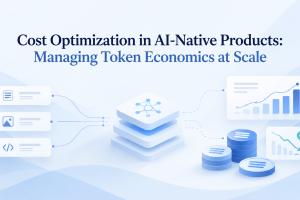
Cost belongs inside this architecture. The FinOps Foundation’s 2026 report states that 98 percent of surveyed practices now manage AI spend, up from 31 percent two years earlier. That shift makes cost per successful task, not cost per token alone, a useful product metric.
Delivery Governance Must Measure Flow, Quality, and Product Value
Traditional productivity measures become less reliable when AI increases generated artifacts. Lines of code, pull requests, and story points can rise while deployment risk and maintenance work also rise.
Teams should track lead time, deployment frequency, change failure rate, restoration time, escaped defects, review time, and rollback frequency. AI system measures should include grounded response rate, task completion, human override, fallback rate, latency, retrieval precision, and cost per completed workflow. Product teams should connect them to adoption, conversion, service resolution, or cycle-time reduction.
Governance should operate through engineering controls rather than approval documents alone. Policy-as-code can enforce model allowlists, data residency, secrets handling, logging, and restricted tool access. Automated checks can scan prompts and outputs for sensitive data. Model cards, architecture decision records, and traceable evaluation results can support audit teams without creating a separate manual process.
External partners can help when internal teams lack AI architecture, MLOps, platform engineering, or production hardening capacity. Three consulting and outsourcing firms that enterprises may evaluate are:
- GeekyAnts focuses on moving AI concepts from prototype to production through LLM integration, retrieval architecture, cloud infrastructure, DevOps, testing, and secure workflows. It fits organizations seeking hands-on product engineering rather than strategy alone.
- Thoughtworks combines product development, modern software engineering, and agentic delivery. It can suit enterprises that need operating-model change alongside platform modernization.
- EPAM brings large-scale engineering, industry consulting, and AI-native development frameworks. It is relevant when transformation spans multiple business units, platforms, and delivery locations.
Selection should depend on delivery ownership, architecture depth, governance needs, domain knowledge, and the partner’s ability to strengthen the internal team.
The Next Advantage Will Come From Controlled Learning Speed
AI product engineering creates an advantage when it compresses the distance between a customer signal and a safe production response. It creates a liability when it only increases the speed at which teams generate unverified code, duplicate services, and model-dependent features.
The practical starting point is a narrow production pathway, not a broad tool rollout. Leaders can select one workflow with measurable business value, available data, a clear owner, and manageable risk. The team can then establish the reference architecture, evaluation harness, observability model, cost baseline, and release controls needed to operate it. Once that pathway works, the organization can reuse its components across products.
This approach also clarifies platform investment. Shared model gateways, retrieval services, evaluation pipelines, prompt registries, policy controls, and tracing reduce repeated work. Product teams retain ownership of customer outcomes while the platform team supplies secure, reusable capabilities. Architecture review becomes faster because teams work within known patterns instead of inventing a new AI stack for every use case.
For senior engineering leaders, the most useful consultation is not a generic AI readiness workshop. It is a working session that examines one real product pathway, identifies the constraints between prototype and production, and maps those constraints to architecture, delivery, governance, and operating ownership. That conversation should end with a prioritized engineering plan, measurable success criteria, and a clear decision on what the internal team should build, buy, or source externally.
The enterprises that gain the most from AI product engineering will not simply deploy more models. They will build a delivery system that can learn quickly, verify continuously, control cost, and change production software without losing trust.




Add Comment