








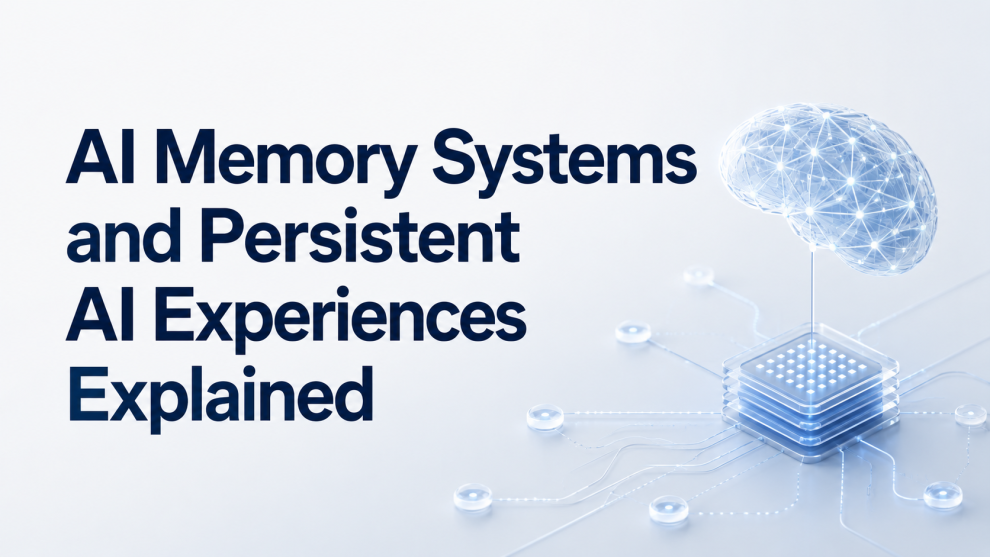

Enterprise AI conversations are shifting away from simple chatbot deployments toward systems that can retain context, learn from interactions, and support long running workflows across platforms. For many large organizations, this shift is no longer experimental. It is becoming operational.
The rise of AI memory systems is closely tied to the growing demand for persistent AI experiences. Enterprises are realizing that stateless AI interactions create friction for customers, employees, and internal operations teams. Every disconnected interaction increases operational inefficiency, duplicate work, and inconsistent user experiences.
This issue has become more visible as organizations deploy AI across customer support, digital commerce, developer tooling, workflow automation, and enterprise search systems. A customer who repeats the same issue across channels does not see intelligence. An engineer who constantly redefines infrastructure context for an AI assistant loses productivity gains. A sales platform that forgets customer intent between sessions weakens engagement quality.
Persistent AI experiences attempt to solve these problems by enabling AI systems to retain relevant context over time. Instead of treating every interaction as isolated, AI memory systems create continuity across sessions, platforms, and workflows.
Large enterprises across North America are now evaluating how memory enabled AI can improve operational efficiency without creating governance risks. The challenge is not simply adding memory to AI systems. The challenge is deciding what should be remembered, how long it should persist, where it should be stored, and how it aligns with compliance and infrastructure standards.
According to recent enterprise AI adoption reports from organizations such as McKinsey and Deloitte, companies continue increasing investment in generative AI initiatives, but many still struggle to move from pilot environments to scalable production systems. Persistent AI architecture is increasingly viewed as one of the missing layers preventing enterprise AI maturity.
Why Stateless AI Is No Longer Enough
Most first generation enterprise AI systems were designed for short interactions. These systems responded to prompts but lacked continuity. While this worked for isolated use cases, it created limitations once organizations attempted to scale AI across customer journeys and enterprise workflows.
For example, a healthcare platform may deploy AI assistants for patient support, appointment coordination, and insurance queries. Without memory systems, the AI cannot retain previous context, understand recurring concerns, or adapt recommendations over time. The same problem appears in banking, retail, SaaS platforms, logistics operations, and internal enterprise tooling.
Persistent AI experiences change the interaction model. Instead of responding only to immediate prompts, the AI can reference historical interactions, workflow patterns, preferences, permissions, and organizational knowledge.
This evolution is especially important for enterprises with fragmented digital ecosystems. Large organizations often operate across multiple cloud environments, legacy systems, customer platforms, internal tools, and regional compliance frameworks. AI memory systems can help unify context across these disconnected layers.
However, enterprise leaders are also discovering that persistence introduces infrastructure complexity.
Memory enabled AI systems require vector databases, retrieval orchestration, context ranking, session management, identity mapping, and governance controls. Many organizations underestimate the engineering effort required to operationalize these systems at scale.
This is where platform engineering and cloud infrastructure teams are becoming central to AI strategy discussions. The conversation is moving beyond model selection toward architecture design.
Companies are increasingly asking questions such as:
- How should enterprise AI memory be partitioned across departments and applications?
- What information should remain temporary versus persistent?
- How can organizations prevent outdated memory from degrading AI responses?
- What governance layers are required for regulated industries?
These are infrastructure and operational questions, not just AI capability questions.
The Business Impact of Persistent AI Experiences
Persistent AI experiences are attracting attention because they directly influence measurable business outcomes.
For customer experience leaders, memory enabled AI can improve engagement continuity across channels. Customers increasingly expect digital systems to remember preferences, prior interactions, support history, and transaction context. Enterprises that fail to deliver continuity risk higher support costs and lower satisfaction rates.
For engineering organizations, persistent AI systems can reduce repetitive workflows. Developers using AI copilots with project memory spend less time re explaining architecture patterns, coding conventions, and infrastructure requirements. Over time, this can improve delivery speed across large engineering teams.
For digital platform leaders, AI memory systems can strengthen personalization strategies. Instead of relying solely on transactional data, organizations can create adaptive experiences that evolve based on behavioral context and interaction history.
Yet the operational risks remain significant.
Memory persistence introduces concerns around privacy, data retention, hallucination amplification, and security exposure. If AI systems retain inaccurate or sensitive information, the consequences can become enterprise wide. Governance therefore becomes inseparable from architecture.
This is why many enterprise technology leaders are shifting toward hybrid memory strategies. These approaches separate short term contextual memory from long term knowledge persistence. Some systems retain temporary workflow context while others maintain durable organizational knowledge repositories.
Industry players including OpenAI, Anthropic, Microsoft, Google, and enterprise consulting firms are increasingly discussing memory orchestration as a foundational layer for next generation AI agents.
Specialized technology consultancies and engineering firms such as GeekyAnts are also seeing growing enterprise demand for AI systems that integrate memory, workflow orchestration, and scalable platform engineering into unified digital ecosystems.
The demand is not driven by novelty. It is driven by operational pressure.
Enterprise teams are under increasing pressure to reduce customer churn, improve platform engagement, accelerate software delivery, and justify AI investments with measurable business outcomes. Stateless AI systems often struggle to support those objectives at enterprise scale.
What Enterprise Leaders Should Focus on Next
Many organizations are still early in their AI memory adoption journey. However, several implementation patterns are becoming clearer across the industry.
Successful enterprises are approaching persistent AI systems as platform initiatives rather than isolated feature deployments. Instead of attaching memory capabilities to individual applications, they are building reusable AI infrastructure layers that support governance, orchestration, observability, and scalability.
This also changes how organizations evaluate AI vendors and internal engineering priorities.
The conversation is no longer only about model intelligence. It now includes:
- Memory lifecycle management
- Context orchestration
- Multi agent coordination
- Enterprise knowledge retrieval
- Compliance aware AI architecture
- Observability for AI decision chains
For North American enterprises operating at large scale, these considerations are becoming critical boardroom discussions rather than experimental innovation topics.
The next phase of enterprise AI will likely be defined by systems that can sustain continuity across workflows, platforms, and user journeys without compromising governance or operational efficiency.
Organizations that approach AI memory strategically may gain advantages in customer retention, internal productivity, and digital experience consistency. Those that implement persistence without architectural discipline may create new operational liabilities.
As enterprise AI adoption accelerates through 2026, decision makers will increasingly need practical guidance on how to operationalize memory enabled AI systems within complex digital environments. Many are beginning these discussions through architecture consultations, platform modernization assessments, and AI infrastructure strategy workshops with experienced engineering and transformation partners that understand both enterprise scale and long term operational realities.
Visit our homepage to explore more insights on enterprise AI, digital platforms, and scalable technology transformation strategies.









Add Comment