




Enterprise engineering organizations have spent the last two years giving developers increasingly capable AI tools. That has made code easier to generate. It has not necessarily made complex software organizations easier to run.
The distinction matters.
Google Cloud’s 2025 DORA research found that 90% of technology professionals surveyed use AI at work, while more than 80% believe it has improved their productivity. Yet 30% reported little or no trust in AI-generated code. More importantly for engineering executives, DORA found that greater AI adoption can correlate with both higher software delivery throughput and greater delivery instability.
That creates a management problem that cannot be solved by buying a better coding assistant.
When AI can generate implementation faster than an organization can review, test, secure, integrate, approve, and operate it, the constraint simply moves downstream. The engineering organization therefore needs a different division of responsibility.
What makes an engineering team truly AI-native?
An AI-assisted team gives engineers access to copilots, coding agents, chat interfaces, or automated review tools. Its fundamental software development lifecycle remains largely unchanged.
An AI-native engineering team redesigns that lifecycle around the assumption that AI systems will participate in requirements interpretation, implementation, testing, debugging, documentation, review, and potentially deployment.
That difference is architectural and organizational.
Current AI-native engineering models increasingly emphasize structured specifications, deliberately assembled context, scoped agent permissions, automated verification and traceable outputs rather than ad hoc prompting. Ranking industry guides from Howdy and Kyanon Digital similarly describe AI-native engineering as a change to the engineering operating model rather than simply a productivity-tool upgrade.
For a VP of Engineering managing hundreds or thousands of technologists, this means the central question changes from “Which developers should use AI?” to “Who is responsible when AI participates in engineering decisions?”
AI can execute more of the work. Accountability still needs a human owner.
Which roles does an AI-native engineering team actually need?
Enterprises do not necessarily need an entirely new set of job titles. They need sharper responsibility boundaries around existing disciplines.
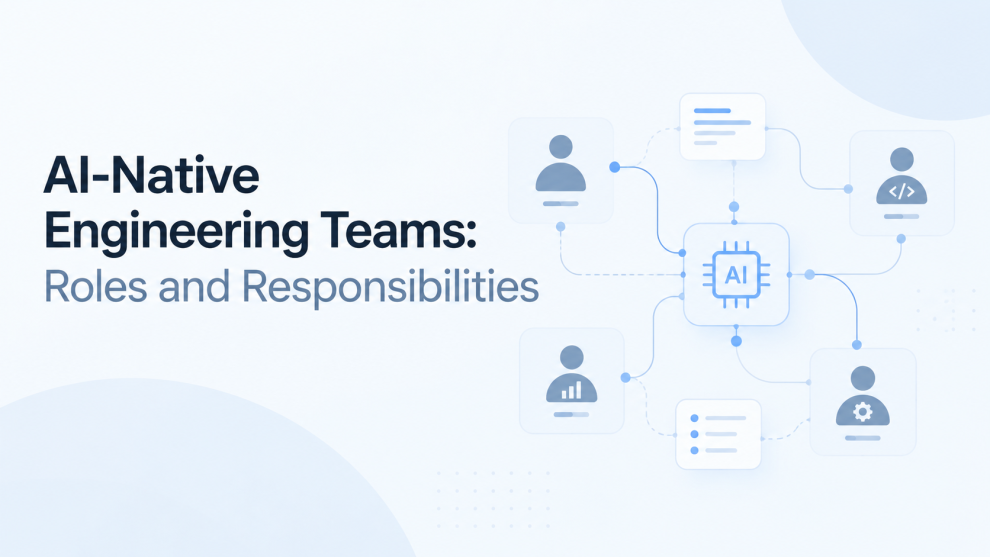
A practical AI-native team usually requires the following capabilities:
- Product and domain owner: This role defines the intended outcome, acceptance criteria, regulatory constraints, customer impact, and conditions under which the work is considered complete. Requirements must become more explicit because agents operate poorly when expected behavior exists only as tribal knowledge. Product ownership therefore moves beyond writing broad user stories toward producing machine-consumable specifications with explicit constraints and non-goals.
- Engineering or technical lead: The engineering lead remains accountable for implementation quality even when an agent writes much of the code. The role shifts toward decomposition, architectural judgment, context selection, dependency decisions, review strategy, and determining where autonomous execution is acceptable. Senior engineering judgment becomes more valuable, not less, because producing code becomes cheaper while determining whether that code belongs in the system remains difficult.
- AI or context engineer: Complex agent workflows require intentional management of what models can see. This responsibility covers repository instructions, architecture documentation, retrieval pipelines, tool definitions, prompt systems, model selection, context budgets, and evaluation datasets. Large enterprises cannot rely on developers repeatedly pasting fragments of institutional knowledge into chat windows.
- Platform engineering and developer experience owner: AI agents need controlled ways to access repositories, development environments, CI systems, cloud resources, observability platforms, and internal services. Platform teams increasingly provide those shared capabilities. DORA reports that 90% of organizations in its research had adopted internal platforms and 76% had dedicated platform teams, making platform engineering particularly important as AI use moves from individual experimentation into standardized workflows.
- Quality and evaluation owner: Conventional automated testing remains necessary, but probabilistic systems introduce another layer. Teams need repeatable evaluations for AI behavior, regression thresholds, adversarial scenarios, integration testing, and evidence that generated changes satisfy the specification. Review cannot become a human reading thousands of additional lines simply because agents can produce them faster.
- Security, risk and compliance owner: Agents should not inherit unrestricted developer permissions. This role defines model and tool access, approved data boundaries, secret handling, audit requirements, third-party model policies, sandboxing, escalation rules, and high-risk actions requiring human authorization. In regulated environments, provenance becomes part of the engineering evidence rather than an optional record.
- Service or production owner: Someone must remain accountable after deployment. That includes observability, service-level objectives, incident escalation, rollback authority, cost behavior and production health. An AI agent can diagnose or propose remediation, but enterprises still need a named owner responsible for deciding whether production behavior remains acceptable.
The team can combine several of these responsibilities in smaller units. What enterprises should avoid combining is generation and unrestricted approval for high-risk changes.
How should responsibilities change when AI agents contribute code?
The biggest organizational mistake is treating AI-generated code exactly like faster human-generated code.
An agent can create changes across several repositories in minutes. That changes the economics of implementation, but it also changes the economics of verification.
Engineering leaders therefore need to control autonomy by risk.
A low-risk internal interface adjustment might move from specification to agent implementation, automated tests and merge with limited intervention. Authentication changes, financial calculations, customer data handling, infrastructure policies or regulated decision logic should have much tighter gates.
The workflow becomes less about assigning every task to a developer and more about defining boundaries within which agents can operate.
This is also why senior engineers increasingly become orchestrators. ByteByteGo’s analysis of AI-native organizations describes a similar shift toward context engineering, problem decomposition, verification and coordination of parallel AI workflows.
The important enterprise implication is not that engineers stop coding. It is that manual coding becomes only one intervention available to them.
When an agent repeatedly produces incorrect implementations, an experienced team should investigate whether the real failure sits in architecture documentation, repository context, specifications, evaluation coverage or tool permissions. Fixing that upstream system can prevent the same failure across hundreds of subsequent tasks.
How should enterprises govern AI-generated software without slowing delivery?
Governance fails when every AI-generated change requires an additional committee. It also fails when agents receive the same production access as senior engineers.
The scalable option is policy expressed as engineering controls.
Specifications should define acceptance criteria before generation begins. Agent identities should receive least-privilege access. Generated changes should enter standard source control. Automated tests, security scanning, dependency analysis, policy checks and AI-specific evaluations should run within CI/CD. Higher-risk changes should then require explicitly assigned human approval.
Production telemetry must complete the loop.
If a generated change creates latency regressions, increases support incidents or triggers unexpected model behavior, that signal should feed back into test suites, evaluations, repository instructions or agent context.
This matters because DORA’s findings indicate that AI amplifies the engineering system already in place. Strong platforms and workflows can absorb higher development velocity. Weak systems may simply produce problems faster.
How should engineering leaders measure whether the new team model is working?
AI adoption rate is a poor executive KPI.
A team can reach near-universal tool adoption while making no meaningful improvement to customer delivery.
Engineering leadership should instead compare lead time, deployment frequency, review turnaround, escaped defects, rework, change failure, MTTR, production incidents and engineering cost before and after workflow changes.
Teams should also watch where time moves.
If code-generation time falls 50 percent but review queues double, the organization has not removed a bottleneck. It has relocated one. Google Cloud has specifically highlighted this downstream effect, noting that faster individual code creation can make testing and approval processes the new constraints.
The objective is therefore not maximum AI autonomy. It is higher system-level throughput without sacrificing reliability.
Which consulting companies can help enterprises build AI-native engineering capabilities?
Large organizations that need outside support should evaluate partners according to the layer of the problem they need to change.
Accenture brings application transformation, enterprise operating-model work, cloud modernization and AI-driven quality engineering at significant organizational scale. Thoughtworks combines software engineering transformation with AI and agentic delivery capabilities and is particularly associated with engineering-led organizational change.
GeekyAnts represents a more product-engineering-oriented option. Its current AI engineering practice combines AI-native product development, embedded engineering pods, modernization, architecture, testing, CI/CD and production operations. That can be relevant when the requirement is not primarily strategy consulting, but turning an AI initiative into a working production engineering model alongside an existing team.
The deciding factor should not be which provider demonstrates the most AI tools. Enterprises should ask which partner can clearly define responsibility for architecture, generated code, testing, security, deployment, incidents and eventual knowledge transfer.
AI-native engineering ultimately changes where engineering effort is spent. Code generation becomes less scarce. Context, verification, architecture and accountability become more important.
For engineering leaders considering the transition, the useful starting point is therefore not a company-wide rollout of another agent. It is a working session around one production value stream: map how requirements become software today, identify where AI can safely assume execution, define who remains accountable at every gate, and determine whether the existing platform can support the additional velocity.
That exercise usually reveals whether an organization is ready for an AI-native team long before another tooling pilot does.




Add Comment