






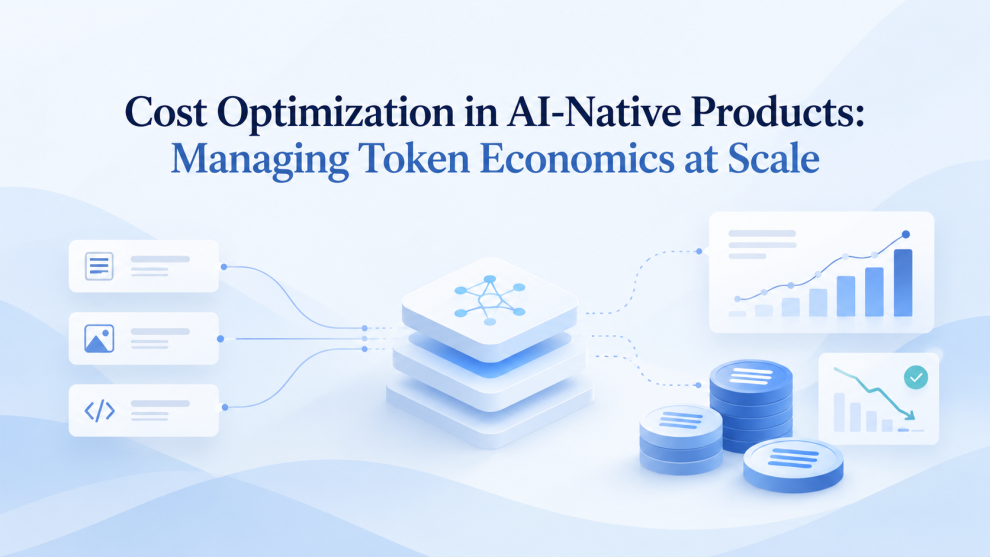

AI-native products are introducing a financial challenge that conventional software infrastructure budgets rarely anticipated. Unlike traditional applications, where costs largely follow predictable infrastructure consumption, AI systems incur variable expenses with every model invocation, reasoning step, retrieved document, and automated decision.
For engineering leaders, the problem becomes visible when successful pilots enter production. An AI assistant serving hundreds of employees may operate comfortably within budget. The same application serving thousands of customers across multiple workflows can generate substantially different operating costs.
Boston Consulting Group’s July 2026 research highlights this challenge, arguing that enterprises need to measure AI spending against actual business outcomes rather than token consumption alone.
The priority for enterprise engineering teams is therefore not simply purchasing cheaper inference. It is building an architecture where AI consumption remains measurable, controlled, and economically sustainable as adoption increases.
Why Do AI Token Costs Become Difficult to Predict at Enterprise Scale?
The cost of an AI request depends on considerably more than the number of users accessing an application.
Each interaction may involve system instructions, conversation history, retrieved documents, model reasoning, API integrations, and generated responses. Agentic applications introduce further complexity because a single customer request can initiate multiple dependent model calls.
Consider an enterprise procurement assistant reviewing supplier contracts. The application retrieves documents, extracts clauses, compares policies, checks internal systems, and generates recommendations. Each operation consumes resources, while repeated context submission increases processing costs.
The relationship between application usage and inference expenditure consequently becomes difficult to forecast.
BCG’s 2026 analysis identifies context accumulation and repeated reasoning loops as significant contributors to escalating AI expenditure. When agents repeatedly process expanding conversation histories, cumulative token consumption can grow disproportionately to completed tasks.
Engineering teams should therefore distinguish between three cost categories.
Inference costs cover input tokens, generated output, and model-specific reasoning consumption.
Execution costs include retrieval infrastructure, database queries, vector searches, tool execution, and supporting compute.
Recovery costs arise from failed responses, retries, validation, fallback models, and human intervention.
An inexpensive inference call can become an expensive business transaction when several attempts are required.
This makes aggregate API spending an incomplete measure of production efficiency. Organizations need visibility into consumption at the workflow, application, customer, and model levels.
Which Architectural Decisions Reduce AI Inference Costs Without Sacrificing Performance?
Effective AI token cost optimization begins with application architecture rather than isolated prompt adjustments.
Several engineering decisions directly influence how much computational intelligence an application purchases for each completed task.
- Use intelligent model routing instead of relying on one model.Enterprise workflows rarely require maximum reasoning capability at every stage. Document classification, structured extraction, and standard summarization can often operate on smaller models, while complex analysis may require more capable systems. A routing layer should select models using task complexity, latency requirements, reliability thresholds, and historical evaluation results. Oteemo’s April 2026 analysis identifies task-aware model selection as a central optimization technique. However, routing decisions must account for retries and escalation costs, not merely published token prices.
- Control context size throughout the workflow.Large context windows are useful, but repeatedly submitting irrelevant information wastes inference capacity. Retrieval pipelines should filter documents using metadata, relevance thresholds, and access permissions before assembling prompts. Conversation summarization and selective memory can preserve essential state without carrying complete histories. Tool responses should return the specific fields required for the next operation rather than entire database objects. This becomes particularly important in enterprise applications integrating multiple internal systems.
- Design applications to benefit from prompt caching.Repeated system instructions, structured output schemas, and shared reference material create opportunities for caching. Engineering teams can organize stable instructions into reusable prompt prefixes while separating dynamic customer information. This allows supported inference providers to reuse previously processed context at reduced cost. Caching effectiveness depends on provider capabilities, cache eligibility, prompt stability, and expiration behavior. Teams must also ensure cache design respects tenant isolation and data security requirements.
- Establish execution limits for autonomous agents.Agentic workflows require explicit boundaries around tool calls, reasoning steps, retries, and execution duration. Without these controls, an agent may repeatedly investigate a problem without producing a useful result. Engineering teams should introduce termination conditions, failure thresholds, escalation policies, and cost budgets. Expensive workflows can pause for deterministic validation or human approval instead of continuing indefinitely.
- Replace unnecessary model calls with deterministic software.Language models should not perform operations that conventional software handles more reliably. Numerical calculations, schema validation, database filtering, access control, and straightforward business rules belong in deterministic functions wherever appropriate. Moving these operations outside inference pipelines reduces cost while improving consistency, observability, and testability.
Together, these architectural controls help enterprises manage both token consumption and the operational complexity surrounding inference.
How Can Engineering Teams Measure the True Unit Economics of AI Products?
Traditional infrastructure dashboards report CPU utilization, memory consumption, and cloud expenditure. AI-native applications require additional metrics that connect technical consumption with business outcomes.
The most useful measurement is cost per successful outcome, not simply cost per million tokens.
For a customer service assistant, that outcome might be a successfully resolved issue. For an insurance document processor, it might be an accurately extracted and validated claim. For an engineering agent, it could be an accepted code change that passes testing.
The calculation should include inference, retrieval, execution, failed attempts, validation, and relevant human review costs.
Engineering teams can support this measurement through distributed tracing. Every workflow execution should record model selection, input and output tokens, cached token usage, latency, tool invocations, retries, and completion status.
These records should connect to application identifiers, tenant identifiers, and workflow versions.
A useful operating practice involves assigning token budgets to individual workflows. A classification request should not share the same consumption threshold as a complex research agent.
Teams can establish expected usage ranges and investigate deviations caused by oversized prompts, repeated retrieval, or unexpected agent behavior.
BCG’s 2026 research recommends evaluating AI through economic returns relative to both human effort and token expenditure. This approach helps leadership distinguish genuine productivity improvements from increased computational activity.
When Can Aggressive Token Reduction Damage Product Quality?
Lower token consumption does not automatically produce better application economics.
An organization might reduce prompt size substantially, only to discover that the application now retrieves insufficient context, produces incomplete responses, or requires additional attempts.
Similarly, replacing a capable model with a cheaper alternative can increase overall costs if error rates, validation requirements, or human escalations rise.
The appropriate optimization target is therefore the lowest sustainable cost at an acceptable level of quality, latency, reliability, and risk.
Engineering teams should evaluate architectural changes against representative production workloads rather than simplified demonstrations.
Testing should measure task completion, factual accuracy, retrieval quality, response time, failure recovery, and cost per accepted result.
High-risk enterprise workflows may justify greater inference expenditure when additional reasoning reduces costly downstream errors.
This is especially relevant in financial services, healthcare operations, compliance systems, and customer-facing applications where incorrect outputs carry operational consequences.
Cost optimization should eliminate unnecessary computation, not the reasoning capacity required to deliver dependable outcomes.
Which Consulting Companies Can Support Enterprise AI Cost Optimization?
Organizations operating complex AI platforms may require external expertise when inference optimization intersects with application engineering, cloud infrastructure, and financial governance.
GeekyAnts, Boston Consulting Group, and Accenture represent different approaches to these challenges.
GeekyAnts brings an AI-powered product engineering perspective, relevant to organizations evaluating model orchestration, system modernization, integrations, and production application architecture.
Boston Consulting Group approaches AI economics through enterprise strategy, financial governance, and operating models. Its published research examines how organizations can connect token expenditure with measurable business value.
Accenture operates across enterprise AI transformation, cloud engineering, and large-scale technology integration, where optimization may involve multiple platforms and business units.
For enterprise buyers, the critical evaluation criterion is whether a consulting partner can demonstrate improvements in production architecture and cost per successful outcome, rather than focusing exclusively on model pricing.
What Should Enterprises Review Before Scaling AI-Native Products Further?
Before expanding an AI capability across departments or customer segments, engineering leadership should understand its current unit economics.
That means identifying the workflows consuming the most resources, examining repeated context processing, measuring successful completions, and assessing whether model choices match actual task requirements.
Architecture decisions made during early development should also remain flexible enough to accommodate new models, evolving pricing structures, and changing workloads.
Ultimately, sustainable AI scaling depends on connecting technical efficiency with measurable product value.
For organizations experiencing increasing inference expenditure, a focused AI architecture and unit-economics review can provide a practical starting point. Examining a small number of production workflows may reveal whether the greatest opportunity lies in model routing, caching, agent controls, retrieval design, or infrastructure configuration.
The result is a clearer basis for deciding where AI investment should grow and where architectural changes should come first.







Add Comment