







Choosing an AI model used to look like a capability question: which model produces the best answer? For enterprise product teams, that question is becoming less useful.
The 2026 Stanford AI Index found that the performance gap among leading model providers has narrowed considerably. As of March 2026, models from Anthropic, xAI, Google, and OpenAI were clustered within 25 Arena Elo points. As raw capability converges, engineering teams increasingly have to differentiate models by cost, latency, reliability, deployment restrictions, and performance on their own workloads.
For a VP of Engineering managing a customer-facing platform, the wrong model decision can create problems far beyond response quality. It can increase inference spend, introduce unpredictable latency, complicate compliance reviews, lock architecture to one provider, or fail under production traffic.
The objective, therefore, is not to find the smartest model. It is to find the model architecture that consistently delivers the required outcome within the product’s technical and commercial constraints.
Why Is the Most Capable AI Model Not Always the Right Model for a Product?
Benchmark leadership does not automatically translate into production fitness.
Consider an enterprise platform using AI for ticket classification. The model may need to process millions of short requests quickly with predictable outputs. A frontier reasoning model might improve accuracy marginally, but the additional inference time and cost could make it a poor architectural choice.
The calculation changes for an agent reviewing complex insurance claims, generating software migration plans, or investigating financial anomalies. Those workflows can justify higher reasoning costs because incorrect outputs carry greater consequences.
Engineering teams should therefore establish a minimum acceptable capability threshold before comparing providers.
Once several models cross that threshold, the team can optimize around operational characteristics.
Latency illustrates the problem. A model that performs slightly better on a reasoning benchmark may take considerably longer to complete the task. Artificial Analysis now compares models not only by intelligence, but also by price, output speed, latency, context window, and cost per task. The differences across these dimensions remain substantial even when intelligence scores are close.
Context window size requires similar caution. A million-token context window looks attractive on a specification sheet, but sending enormous contexts on every request can increase cost and latency. Better retrieval, context compression, caching, and data architecture may matter more than maximum context size.
The right model starts with the workload, not the leaderboard.
What Should Product Teams Measure Before Comparing AI Models?
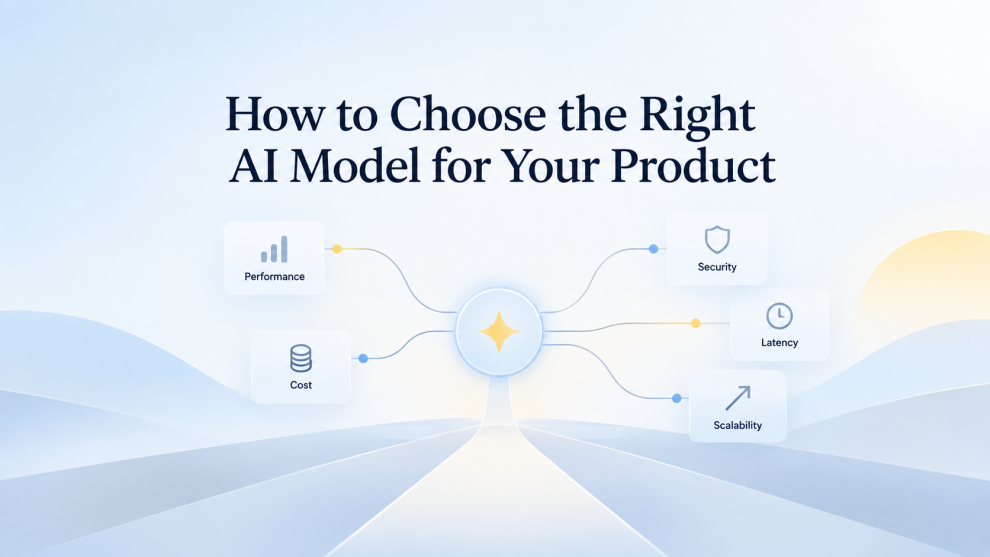
Enterprise model selection works better when teams define acceptance criteria before running evaluations. Five dimensions usually expose the real trade-offs:
- Task quality and failure tolerance: Teams should define what constitutes a successful output for the actual workflow. A marketing summarization feature may tolerate occasional imperfections. A model that recommends financial actions, modifies production code, or invokes enterprise systems needs a much tighter failure boundary. Measurements can include task completion, groundedness, structured-output accuracy, tool-call success, factual correctness, and human preference.
- Latency and throughput: Average response time rarely tells the full story. Teams should measure p50, p90, and p95 latency under realistic concurrent traffic. A model that works during a demonstration may create an unacceptable customer experience when several thousand users trigger inference simultaneously. Time to first token, full completion time, request queuing, and provider rate limits can all affect architecture.
- Cost per successful task: Token price alone can distort the economics. A cheaper model may require longer prompts, repeated calls, additional retrieval steps, retries, or escalation to another model. A more expensive model might complete the same workflow in one call. Teams should calculate the total cost of completing the business task successfully, including inference, embeddings, retrieval, infrastructure, retries, and orchestration.
- Security, privacy, and deployment constraints: Enterprise teams must determine what information can leave their environment, where inference occurs, how providers retain data, and whether a model can operate in approved regions. Requirements for private networking, auditability, data residency, regulated information, and model hosting can eliminate technically strong candidates before benchmarking begins.
- Operational flexibility: Models evolve rapidly. Engineering teams should examine versioning, observability, API compatibility, structured-output behavior, fine-tuning options, provider stability, and replacement effort. If switching one model requires rewriting application logic, the system has accumulated model-specific technical debt.
Microsoft’s current guidance similarly recommends evaluating quality, cost, latency, and policy constraints together rather than treating model accuracy as the only selection criterion.
How Should Enterprises Benchmark AI Models Before Putting Them Into Production?
Public benchmarks should reduce the candidate pool. They should not make the production decision.
Stanford’s 2026 AI Index notes another reason for caution: frontier capabilities are advancing quickly enough that benchmarks can saturate rapidly. The usefulness of a benchmark therefore depends heavily on whether it resembles the task the enterprise actually needs to perform.
A product team should instead build an evaluation set from representative production scenarios. For a retrieval-augmented generation application, that might include straightforward questions, ambiguous questions, missing-information cases, contradictory documents, long documents, permission-restricted information, and prompts designed to test unsupported claims.
The team can then run each candidate model against exactly the same prompts, system instructions, tools, retrieval pipeline, temperature settings, and output requirements.
Technical metrics should include factual accuracy, groundedness, JSON or schema adherence, tool selection, tool execution success, hallucination frequency, tokens consumed, latency distribution, and estimated task cost.
Human evaluation remains necessary when the desired output involves judgment, such as advisory content, customer responses, generated interfaces, or complex explanations.
NIST’s 2026 draft TEVV-Athlon framework reinforces this application-specific approach. It describes AI evaluation as an adaptable process for measuring the real-world outcomes of different systems, including LLMs, multimodal models, and agentic systems.
The result should not simply identify which model scored highest. It should establish which candidate meets the required quality floor with the best operational trade-off.
When Should a Product Use Multiple AI Models Instead of One?
For large enterprises, the answer increasingly may not be one model at all. A product can route straightforward summarization, classification, extraction, and conversational requests to smaller models while sending complex reasoning or higher-risk tasks to more capable models.
This architecture can reduce inference costs without lowering quality where quality matters most.
Routing, however, introduces engineering complexity. Teams need rules or classifiers that determine request difficulty, fallback behavior when providers fail, telemetry explaining which model handled each request, and safeguards preventing regulated workloads from reaching unauthorized deployments.
Automatic model routing can take this further. Microsoft’s current model routing guidance describes systems that select models dynamically according to workload characteristics and optimize for quality, cost, or a balance between both. Microsoft still recommends benchmarking the router against direct model deployments under production-like traffic before broad adoption.
Multi-model architecture makes the most sense when the workload contains clearly different levels of complexity or risk. A highly consistent workload may remain simpler and more predictable with one model.
How Can Engineering Leaders Make a Model Decision That Will Still Work a Year From Now?
The final architectural question is not which model the organization chooses today. It is how expensive that decision will be to reverse.
Teams can reduce model lock-in by separating application logic from inference providers, maintaining reusable evaluation suites, versioning prompts, monitoring model-specific failures, and placing retrieval and tool orchestration behind stable interfaces.
A model replacement should trigger regression testing rather than a product rewrite.
That requirement is also changing how enterprises use outside AI engineering support. Accenture works at the large transformation and multi-model governance end of the market, while Thoughtworks brings established AI engineering and evaluation practices. GeekyAnts also operates in this space, particularly where model selection connects directly with product engineering, RAG systems, agents, integrations, and bringing AI functionality into production. The relevant distinction is less about selecting a consulting brand and more about whether the partner can connect model benchmarks with the architecture and operational constraints of the actual product.
Before approving an AI model for production, engineering leaders should be able to answer four questions clearly: Does it meet the workload’s quality threshold? What does a successful task actually cost? What happens when it fails? How difficult will it be to replace?
If those answers remain uncertain, another proof of concept may add little value. A focused model and architecture evaluation can reveal far more about what should actually enter production.









Add Comment