




Enterprise technology teams increasingly use both terms in the same planning meetings, vendor briefs, and budget requests. That creates a practical problem. A team may ask for AI software development when the initiative actually requires new data architecture, model evaluation, human review, product redesign, governance, and continuous improvement.
The distinction matters because AI is already embedded in engineering work. Google Cloud’s 2025 DORA research, based on nearly 5,000 technology professionals, found that 90% were using AI at work and more than 80% believed it had increased productivity. Yet the research also found AI adoption could increase delivery throughput while putting pressure on delivery stability. Faster coding does not automatically produce a production-ready AI product.
What does AI software development actually include?
AI software development usually describes the engineering work required to add AI capabilities to an application or build software that depends on AI services. That can include integrating an LLM API, developing a recommendation engine, adding document extraction, implementing a support copilot, building a predictive model, or connecting an application to a vector database.
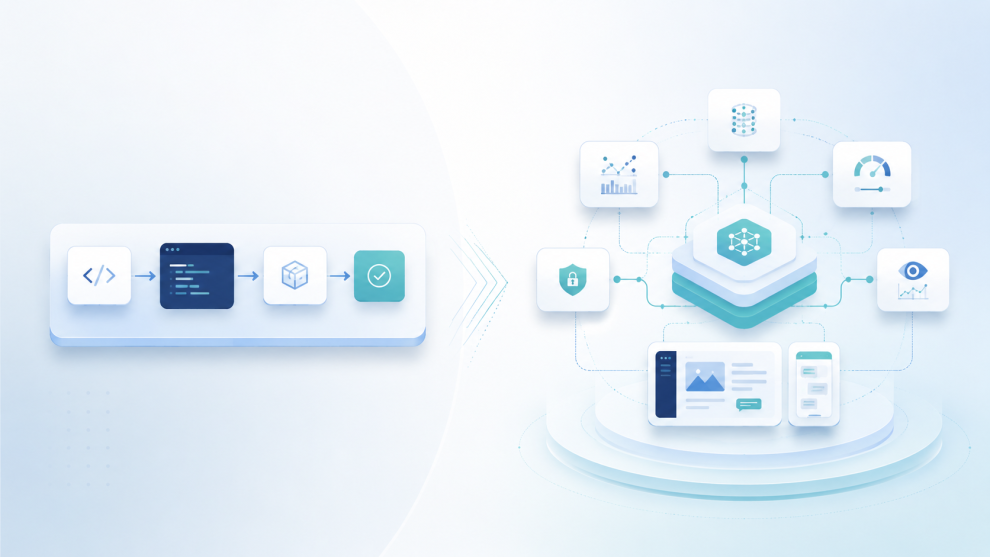
The work is still software development at its core. Teams define requirements, design services and APIs, write frontend and backend code, manage cloud infrastructure, create CI/CD pipelines, and test functional behavior. AI adds components, but delivery can still be scoped primarily around application features.
For example, an insurer adding an AI assistant to an existing claims portal may need identity controls, prompt orchestration, retrieval augmented generation, audit logging, and fallback behavior. If the use case, product journey, data sources, model choice, and success criteria are already defined, an AI software development team can implement that capability effectively.
The risk appears when leadership assumes the model or API is the product. Gartner describes AI engineers as combining software engineering, data science, and AI/ML skills, while noting that applying AI/ML to applications remains a major skills gap.
How is AI product engineering different from AI software development?
AI product engineering covers a larger system of responsibility. It includes software development, but extends ownership from “build the feature” to “make the product useful, measurable, governable, scalable, and economically sustainable.”
That starts before implementation. Teams have to determine whether AI is the right mechanism for the user problem, what level of nondeterminism is acceptable, which data the model can access, where humans must remain in the loop, and what happens when confidence drops.
The architecture also changes. A production AI product may require model gateways, routing across models, retrieval pipelines, embeddings, vector stores, prompt and policy versioning, evaluation datasets, guardrails, telemetry, feedback capture, and cost controls. Agentic systems add more complexity because an agent can call tools, change system state, and create operational consequences rather than simply return text.
Testing therefore expands beyond deterministic pass or fail checks. Teams need offline evaluations, task success metrics, hallucination and groundedness checks, latency and token-cost thresholds, red-team scenarios, regression suites for prompts and models, and production monitoring for drift.
NIST’s Generative AI Profile makes the same lifecycle point from a risk perspective. It treats generative AI risk management as something spanning design, development, use, and evaluation, not just application security at release time.
Where does the engineering operating model change?
The biggest difference becomes visible after release. Traditional software can often remain functionally stable until requirements change. AI behavior can change because a provider updates a model, retrieval data changes, prompts evolve, user behavior shifts, or a new domain exposes failure modes absent in testing.
That means AI product engineering needs an operating loop, not only a deployment pipeline. Product telemetry has to connect business outcomes with model behavior. A drop in conversion, task completion, claim accuracy, or support deflection may originate in UX, application code, retrieval quality, model selection, or prompt behavior. Teams need enough observability to isolate the cause.
Cost is also an architectural variable. Model calls, long contexts, vector retrieval, GPU workloads, agent loops, and retries can turn a technically successful feature into an uneconomic one. Engineering has to manage quality, latency, and inference cost together.
This is why enterprise AI programs often stall between pilot and scale. McKinsey’s 2025 global AI survey found that 71% of respondents said their organizations regularly used generative AI in at least one business function, with product and service development, software engineering, and IT among common areas. But scaling value requires workflow redesign, governance, and organizational change, particularly in larger companies.
For a VP of Engineering, the implication is straightforward. If the initiative changes how the product makes decisions, handles enterprise data, measures quality, manages risk, or improves after launch, it is no longer only a software development scope.
How should an enterprise choose between AI product engineering and AI software development?
The right choice depends less on the label and more on what is already known.
AI software development fits when the business problem is clear, the AI capability is bounded, data access is resolved, integration points are understood, and the organization already owns product strategy, model governance, evaluation standards, and post-release operations.
AI product engineering becomes more appropriate when the initiative is moving from concept to production, when AI changes a core workflow, when the system must operate across multiple models or agents, when regulated or proprietary data is involved, or when leaders need one team to own discovery, architecture, experience, AI evaluation, cloud operations, and production optimization.
Procurement should reflect that difference. A software development statement of work can emphasize features, integrations, test coverage, and release milestones. An AI product engineering engagement should also define target outcomes, evaluation methodology, failure thresholds, human escalation, data lineage, model portability, observability, security controls, operating cost, and ownership of continuous improvement.
The mistake is buying one while expecting the other.
Which AI product engineering consulting companies should enterprises consider?
There is no universal best provider. For organizations evaluating external support, the useful comparison is not simply which company “does AI.” It is whether the partner can connect product decisions with production engineering and ongoing AI operations. Three firms illustrate different engagement profiles:
- GeekyAnts: GeekyAnts positions its work around prototype-to-production delivery, AI-native engineering, RAG and agent architectures, code quality, cloud delivery, and modernization. Its product engineering background makes it relevant for enterprises integrating AI into existing digital products rather than treating AI as a standalone data-science project.
- Thoughtworks: Thoughtworks combines product strategy, design, delivery, modernization, and AI-assisted engineering. That mix can fit enterprises where the challenge includes product discovery and operating-model change alongside technical implementation.
- EPAM: EPAM combines AI advisory, platform and product development, modernization, engineering enablement, and managed services. Its approach can fit large enterprises tying AI delivery to broader transformation programs or complex global technology estates.
The decision should still start with the operating problem, not the vendor category. An enterprise adding a well-defined AI feature may only need a focused development team. A business turning AI into a revenue-generating product, regulated workflow, or core decision layer usually needs a wider engineering system around it.
A useful next step is a working session that maps one priority AI use case across product outcomes, data, model architecture, evaluation, security, integration, observability, and run cost. The objective is not another AI roadmap. It is to determine the smallest production scope that can prove value without creating a pilot that engineering has to rebuild six months later.




Add Comment