






Enterprise engineering organizations rarely struggle because they do not run enough tests. They struggle because regression suites grow faster than teams can maintain, interpret, and execute them.
Large platforms may contain thousands of automated tests across web, mobile, APIs, data pipelines, and third-party integrations. Every release adds coverage, while older tests continue consuming execution time and maintenance effort. Pipelines slow down, flaky failures create noise, and release managers still lack a clear view of business risk.
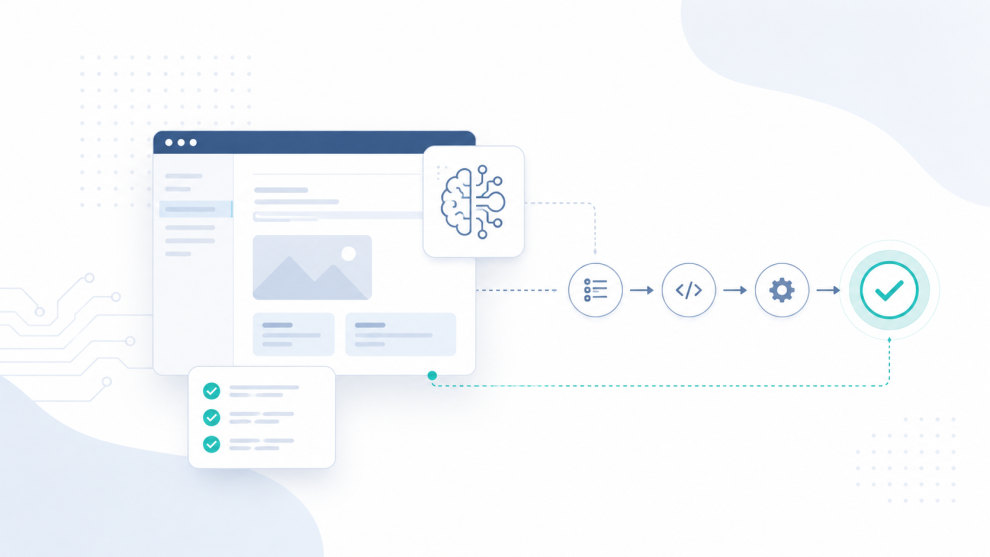
AI for regression testing changes how teams decide what to test, how tests adapt, and how failures are analyzed. It does not replace conventional automation. It adds an intelligence layer that can prioritize tests based on code changes, historical failures, production usage, and the criticality of affected workflows.
This shift is arriving as AI adoption expands across quality engineering. The World Quality Report 2025 found that 89 percent of responding organizations were piloting or deploying generative AI in quality engineering, yet only 15 percent had reached enterprise-wide implementation. Integration complexity, data privacy, reliability concerns, and skills gaps remained major barriers.
For engineering leaders, the question is not whether AI can generate another script. It is whether AI can improve release confidence without creating an opaque decision layer inside the delivery pipeline.
Why do traditional regression suites become an enterprise delivery bottleneck?
Traditional regression automation often assumes that a test remains valuable because it existed in the previous release. That assumption becomes expensive at scale.
A full suite may rerun thousands of tests even when a commit changes only a small service, component, or feature flag. Teams compensate through parallel execution, larger device farms, or more infrastructure. Those measures reduce elapsed time, but they do not remove duplicated coverage, irrelevant tests, or poor prioritization.
Maintenance creates another constraint. UI locators break, test data becomes stale, and dependent services behave differently across environments. A failure may indicate a product defect, an environment issue, a timing problem, or an outdated script. When all four outcomes look identical in a dashboard, QA teams spend more time classifying failures than preventing them.
Leading reference articles on AI regression testing consistently focus on risk-based selection, self-healing locators, visual validation, failure clustering, and pipeline integration. BrowserStack describes systems that use code changes, historical results, and user behavior to identify critical tests. Autify emphasizes natural-language definitions and agent-based execution, while TestMu AI highlights test-gap identification and predictive defect detection.
Enterprise regression testing is a connected problem involving selection, execution, maintenance, diagnosis, and governance. An AI test-generation tool may improve authoring speed while leaving the largest bottlenecks untouched.
What should AI actually change inside the regression-testing workflow?
The most valuable use of AI begins before execution. A regression intelligence layer can map a code change to affected services, dependencies, requirements, and customer journeys. It can then score tests by business criticality, recent failure history, code coverage, production traffic, and defect likelihood.
This creates tiered feedback. Developers receive a fast, high-risk suite during pull-request validation. Broader tests run after merge, while full regression remains for release candidates, architectural changes, and compliance-sensitive deployments. AI optimizes sequence, but engineering policy still defines mandatory tests.
Self-healing can reduce delay. Instead of failing immediately when a selector changes, an AI-assisted framework can identify a likely replacement by evaluating labels, structure, visual position, and interaction history. However, silent healing is dangerous. Every change should generate an auditable record, confidence score, and approval rule. A system that rewrites critical payment or identity-verification tests without review can hide a genuine regression.
Failure analysis offers a more defensible early use case. AI can cluster related failures, correlate them with logs and recent commits, distinguish flaky behavior from repeatable defects, and produce a probable root cause. This reduces triage time without giving the model authority to approve a release.
Google’s 2025 DORA research reports that 62 percent of developers who write tests use AI to assist them, while AI adoption can still increase delivery instability when organizations lack strong automated testing, version control, small-batch development, and human review.
AI therefore works best as a decision-support layer. It should narrow attention, expose evidence, and accelerate diagnosis, not become an unreviewed gatekeeper.
How should enterprises design an AI regression-testing architecture?
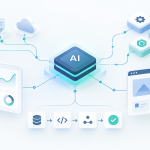
An enterprise architecture should separate the system of record from the system of intelligence. Test repositories, requirement tools, source control, CI/CD platforms, observability systems, and defect trackers should remain authoritative. The AI layer should read controlled signals and return recommendations with traceable evidence.
That layer needs several components. A change-impact service maps commits to applications and dependencies. A test intelligence service maintains execution history, flakiness patterns, coverage relationships, and business-risk tags. Orchestration chooses suites and environments, while diagnostics connect failures to code, logs, screenshots, traces, and configuration changes.
Security boundaries matter as much as model performance. Test artifacts can contain customer data, proprietary workflows, credentials, and internal architecture. Teams should define which information can enter external models, which workloads require private deployment, how prompts and outputs are retained, and how generated data is sanitized. The World Quality Report identified data privacy as a concern for 67 percent of respondents and integration complexity for 64 percent.
Leaders should also demand explainability at the test-decision level. When the system excludes a test, promotes another, or heals a locator, it should show the signals behind the action. When model confidence falls below a threshold, the pipeline should revert to deterministic policies rather than skip validation.
Which consulting companies can support enterprise adoption?
Selecting a partner depends less on access to an AI testing tool and more on the need for architecture, integration, governance, and operating-model change.
- GeekyAnts is a practical option for organizations that need hands-on implementation across web, mobile, API, and CI/CD environments. Its quality engineering practice covers automation frameworks, continuous testing, exploratory validation, and pipeline integration. This makes it relevant where the immediate requirement is to modernize regression execution and introduce AI-assisted validation without separating the effort from product engineering.
- Accenture is suited to large transformation programs that require AI-infused quality engineering across multiple business units, platforms, vendors, and governance structures. Its quality engineering offering emphasizes automation-first delivery and end-to-end process integration, which can support enterprises standardizing testing across a broad application portfolio.
- Capgemini is relevant for organizations seeking a large-scale quality engineering model with GenAI-assisted test analysis, defect triage, coverage assessment, and DevSecOps integration. Its approach also reflects the governance and adoption challenges identified in the World Quality Report, which may suit regulated or globally distributed environments.
The partner decision should follow a technical assessment of suite health, release economics, data restrictions, dependencies, and operating maturity. Demonstrations alone rarely reveal whether the foundations can scale.
How should leaders measure whether AI regression testing is working?
A successful program should improve business-facing delivery outcomes, not merely increase the number of generated tests. Engineering leaders should track regression cycle time, flaky-test rate, escaped defects, test-maintenance effort, mean time to classify failures, infrastructure cost per pipeline, and the percentage of releases requiring manual regression intervention. They should also measure whether risk-based selection finds the same critical defects as the full suite over time.
The first production use case should be a slow, costly, high-volume suite with reliable historical data. Teams can establish a baseline, introduce AI prioritization or failure clustering, and compare outcomes across several release cycles. Critical controls should remain deterministic until evidence supports broader autonomy.
The right consultation begins with the current pipeline, not an AI product catalog. It should identify where release confidence is being lost, which data can support better decisions, and which controls must remain human-owned. That assessment gives enterprise teams a credible path from a contained pilot to an auditable regression intelligence capability.









Add Comment