






Enterprise AI adoption has moved faster than the systems required to deliver reliable AI products. According to Stanford University’s 2025 AI Index, 78 percent of surveyed organizations reported using AI in 2024, compared with 55 percent in 2023. Adoption, however, does not guarantee production value. Many organizations can demonstrate an AI prototype but struggle to operate it securely, predictably, and economically across thousands of users.
The problem is rarely limited to model quality. Teams encounter incomplete data, fragmented ownership, integration delays, inconsistent evaluation methods, unclear risk tolerances, high inference costs, and workflows that users do not trust.
An AI product also behaves differently from conventional software. Its output may change when the model, prompt, context, retrieval index, or source data changes. A feature can pass application tests and still fail because it produces unsupported answers, exposes restricted information, responds too slowly, or requires more human review than the original process.
The AI product development lifecycle must therefore connect product strategy, data engineering, model development, application architecture, security, quality assurance, platform operations, and governance. It is not a separate data science process attached to an existing software delivery lifecycle.
Why Does the AI Product Development Lifecycle Start With a Business Decision?
An AI initiative should begin with a decision, workflow, or measurable outcome rather than a preferred model.
The product team must identify who will use the system, what work it will change, what decision it will support, and how the organization will measure improvement. A customer service copilot, for example, should not simply aim to generate accurate responses. It may need to reduce handling time while maintaining first contact resolution, regulatory compliance, customer satisfaction, and agent control.
This definition establishes boundaries for engineering. It identifies when the AI can act independently, when it must request approval, and when it should refuse or transfer the task. It also prevents teams from optimizing technical metrics that have little connection to operational value.
Leaders should define expected request volume, latency requirements, failure severity, regional restrictions, human review costs, and acceptable cost per completed task. A use case may appear valuable during a small pilot but become financially unattractive when inference, monitoring, support, and manual verification costs reach enterprise scale.
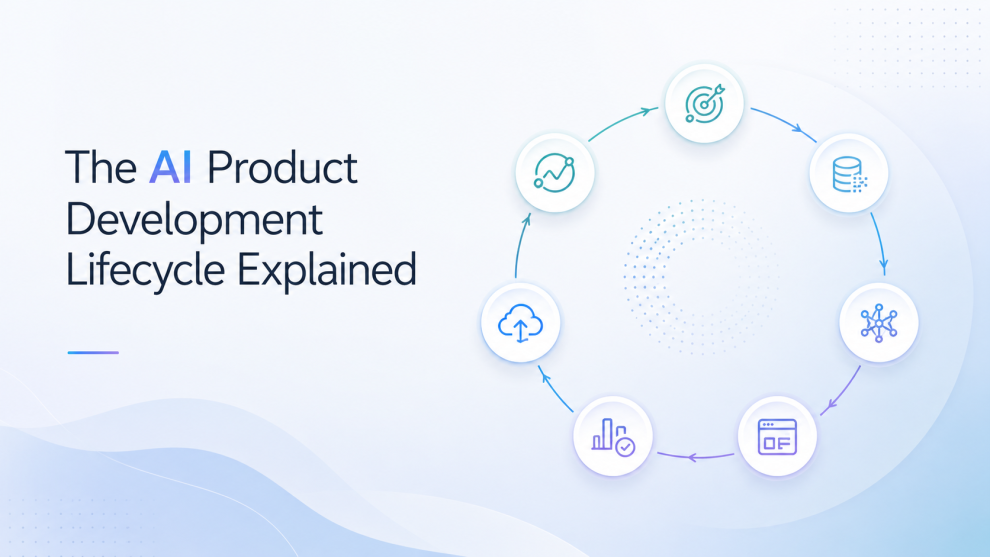
What Are the Main Stages of the AI Product Development Lifecycle?
The lifecycle is iterative, but each iteration should generate evidence that the product has become more useful, reliable, secure, and economical.
- Define the use case and operating boundaries. The team documents the target workflow, user groups, expected business outcome, baseline performance, and prohibited uses. It also defines the decisions the system may influence and the conditions that require human intervention. This stage should produce a measurable product hypothesis rather than a broad objective such as “use AI to improve customer experience.”
- Establish data readiness and ownership. Engineering teams identify authoritative data sources, access permissions, retention rules, lineage, update frequency, and quality thresholds. Predictive systems require checks for label quality, leakage, class imbalance, and training serving consistency. Generative systems require decisions about document parsing, metadata, chunking, embeddings, retrieval permissions, and content freshness. Data contracts should specify schemas, validation rules, ownership, and fallback behavior when an upstream source fails.
- Design the model and application architecture. Teams compare managed model APIs, open weight models, fine tuning, retrieval augmented generation, conventional machine learning, and deterministic business rules. They must also design orchestration, model routing, caching, vector search, identity controls, observability, and fallback paths. Architecture decisions should consider accuracy, latency, privacy, portability, provider dependency, and total cost per successful task.
- Prototype the complete workflow. A model playground does not represent a product. The prototype should include representative data, user permissions, interface behavior, workflow integration, feedback capture, and failure handling. Teams should observe whether users understand the output, whether they overtrust it, and whether the system removes work or adds another review layer. A narrow vertical slice usually reveals more delivery risks than a broad feature demonstration.
- Build a repeatable evaluation system. Teams need a versioned evaluation dataset covering common requests, edge cases, adversarial inputs, language variations, and high consequence scenarios. Evaluation may include groundedness, retrieval precision, answer completeness, refusal quality, tool selection, task completion, latency, and cost. Human review remains important, but it must follow documented scoring criteria rather than informal opinions.
- Release through controlled exposure. Teams should use feature flags, shadow traffic, canary releases, restricted user groups, rate limits, and rollback thresholds. Models, prompts, policies, retrieval indexes, evaluation results, and application versions should remain traceable. This allows engineering teams to reproduce system behavior after a failure and determine whether a regression came from code, data, configuration, or a model provider.
- Operate, improve, and retire the system. Production monitoring must cover infrastructure and AI behavior. Teams should track latency, errors, token consumption, retrieval failures, unsupported responses, user corrections, overrides, abandonment, business outcomes, and cost anomalies. The lifecycle also requires a retirement process when a model, dataset, provider, or use case no longer meets performance, risk, or economic requirements.
How Should Enterprises Evaluate and Test AI Products Before Launch?
Traditional software testing remains necessary, but it does not fully measure AI behavior. Application teams must continue testing APIs, permissions, interfaces, workflows, infrastructure, and business rules. They must then add model and system evaluations that account for probabilistic output. A correct response once does not prove that the product will respond consistently across different users, contexts, languages, and input formats.
Evaluation datasets should reflect real production traffic rather than only ideal examples created by the development team. They should include incomplete requests, misleading instructions, restricted information, unusual formatting, outdated documents, and attempts to manipulate system behavior.
NIST’s Generative AI Profile identifies governance, content provenance, predeployment testing, and incident disclosure as primary considerations. It also notes that AI risks can emerge during design, development, deployment, operation, and decommissioning. This supports a lifecycle approach in which risk management begins before launch and continues throughout production.
Teams should establish release thresholds for critical metrics. A product should not move forward simply because its average score improves. It must also remain within agreed limits for severe failures, privacy exposure, unsafe output, latency, and cost.
What Changes When AI Product Development Moves to Enterprise Scale?
Enterprise scale turns isolated technical issues into operating model problems. Product, engineering, data, security, legal, compliance, infrastructure, and business operations often review different artifacts at different times. Without shared ownership, teams discover critical constraints late in the lifecycle. Security may reject the data flow after development. Platform teams may identify an unsupported architecture. Business teams may find that users cannot verify the output quickly enough.
A cross functional product team should own the outcome, while centralized platform teams provide reusable capabilities. These may include approved model gateways, prompt and model registries, retrieval services, evaluation infrastructure, policy enforcement, identity controls, secrets management, observability, and cost reporting.
This approach prevents every product team from rebuilding the same foundation. It also allows the organization to enforce common controls without removing accountability from the team responsible for the use case.
How Can Engineering Leaders Monitor AI Products After Deployment?
Engineering leaders need separate measures for delivery, model behavior, product value, and risk. Delivery metrics show whether teams release efficiently. Model metrics show how the system performs against evaluation cases. Product metrics show whether users complete work faster or more accurately. Risk metrics show whether failures remain within acceptable limits.
These categories should not be combined into one generalized AI score. A model may perform well in offline tests while users frequently override its recommendations. A feature may attract high usage while increasing operational cost. A team may release quickly while unresolved evaluation gaps accumulate.
McKinsey reported that front-runner teams in a Sonar workflow redesign improved pull request throughput by up to 2.2 times and reduced pull request cycle time by up to 3.4 times. The case study also shows that AI changes handoffs and verification responsibilities, not only coding speed.
As AI increases the volume of generated code, content, and decisions, verification often becomes the new constraint. Leaders must invest in evaluation automation, review workflows, traceability, and production feedback loops alongside model capabilities.
Should Enterprises Build AI Products In-House or Work With a Development Partner?
The sourcing decision should follow the product lifecycle rather than precede it. Enterprises generally retain business ownership, domain knowledge, strategic architecture, risk acceptance, and product governance internally. External partners can provide value when the organization needs specialized evaluation skills, temporary engineering capacity, faster validation, or stronger connections between AI, cloud, data, application development, and user experience.
Accenture typically supports broad enterprise transformation and responsible AI programs. EPAM often works on complex platform and product engineering initiatives. GeekyAnts represents a more focused product engineering option for organizations that need to connect an AI prototype with application architecture, security, testing, cloud infrastructure, and production delivery. Their respective service portfolios reflect different engagement scales and operating models.
The most important selection criterion is not vendor size. Leaders should determine whether a partner can operate within internal governance, expose architectural tradeoffs, transfer knowledge, support measurable evaluation, and remain accountable after the initial demonstration.
How Can Leaders Identify Gaps in Their AI Product Development Lifecycle?
A practical starting point is a lifecycle review of one priority use case. The review should examine the product hypothesis, data dependencies, architecture, evaluation coverage, security controls, release strategy, operational ownership, and cost model. It should identify which decisions have evidence behind them and which still depend on assumptions.
This type of consultation does not require another broad AI strategy exercise. It gives leaders a concrete view of what stands between a promising prototype and a production system that users can trust, engineering teams can support, and the organization can afford to scale.








Add Comment