





Enterprise AI is moving beyond isolated copilots. The harder problem in 2026 is getting multiple agents, built by different teams and vendors, to discover one another, exchange work, preserve security boundaries, and recover when a task fails.
For large enterprises, this is an architecture and operating-model problem. When agents across customer service, cloud operations, finance, and digital products use different integration patterns, the organization inherits brittle point-to-point connections, inconsistent identity controls, duplicated orchestration logic, and weak observability.
In 2026, the question is how enterprises standardize agent communication without locking every workflow to one framework.
What standards matter most for agent-to-agent communication in 2026?
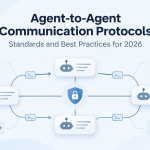
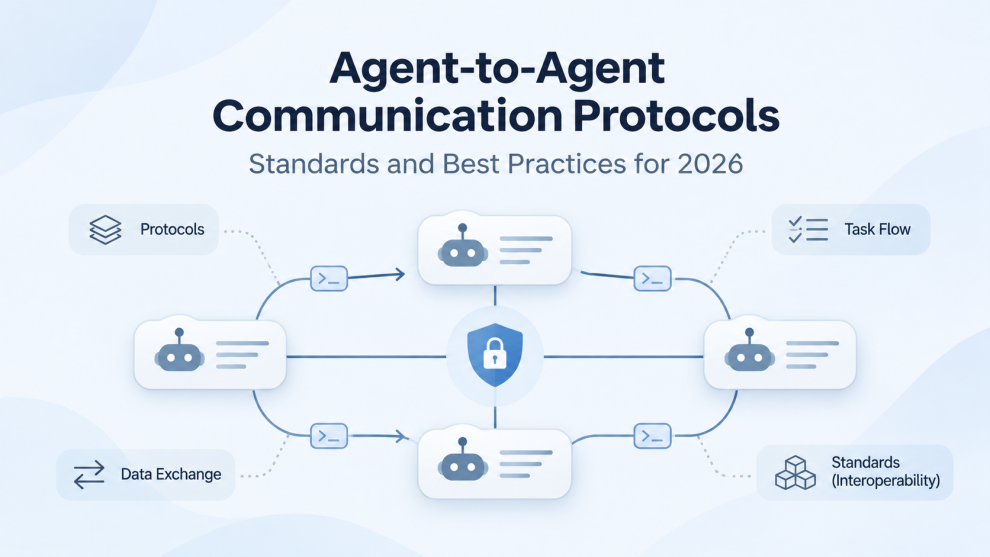
The Agent2Agent protocol, or A2A, is designed for communication between independent agents. Its specification focuses on capability discovery, task delegation, message exchange, streaming, artifacts, and collaboration without requiring one agent to expose its private memory, internal tools, or reasoning process.
A2A reached its first stable, production-ready v1.0 release in March 2026, with a v1.0.1 maintenance release following in May. The stable release also strengthened version negotiation, protocol bindings, task handling, authentication options, and enterprise deployment semantics.
Model Context Protocol, or MCP, addresses a different but complementary layer. MCP standardizes how an AI application connects to tools, resources, and external context. Its July 2026 specification introduced a stateless protocol core, stronger authorization, header-based routing, extensions, and multi round-trip requests.
The MCP maintainers also reported close to half a billion monthly downloads across Tier 1 SDKs, an indicator of how quickly the tool-integration layer is becoming infrastructure rather than an experiment.
AWS guidance also treats MCP and A2A as complementary open protocols and recommends choosing by interaction pattern rather than applying one protocol everywhere.
For architecture teams, A2A fits horizontal agent collaboration, while MCP fits access to tools and data. A mature platform may need both.
How should enterprises design agent communication without creating another integration mess?
The biggest architectural mistake is treating an agent as a smarter API endpoint.
Traditional APIs usually expose deterministic operations. Agents may negotiate, request clarification, pause for authorization, stream progress, or fail after partial execution. Their contracts must account for that behavior.
A2A formalizes several of these needs through constructs such as Agent Cards, tasks, messages, artifacts, and task states. An Agent Card acts as a machine-readable capability description so another system can determine what an agent does, which interfaces it supports, and how it should authenticate. The protocol can also support long-running task lifecycles instead of forcing every interaction into a single synchronous request.
For enterprise platforms, a useful architecture has a small number of explicit layers:
- Discovery and capability contracts should remain separate from execution. Teams should define what an agent can do, accepted input and output modes, version compatibility, ownership, and security requirements before runtime delegation begins. This creates a control plane for agent discovery instead of hard-coding endpoints into individual applications.
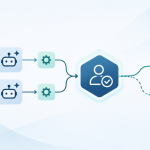
- Identity and authorization should survive every delegation boundary. An agent should not inherit broad authority simply because another trusted agent called it. OAuth scopes, workload identity, mTLS where appropriate, tenant isolation, and policy evaluation should operate at each hop. Systems should preserve who initiated the task, what permissions apply, and which resources each participating agent may access.
- Task state should be externalized and observable. Long-running work needs explicit submitted, working, completed, failed, canceled, input-required, or comparable states. State changes should carry correlation identifiers, timestamps, ownership information, retry metadata, and audit records. Otherwise, operations teams cannot distinguish latency from deadlock or partial execution.
- Protocol adapters should sit at domain boundaries. Enterprises are unlikely to standardize every team on the same agent framework. Gateway or adapter layers can translate between internal orchestration, A2A interfaces, MCP servers, event infrastructure, and legacy APIs. This reduces migration cost as frameworks and specifications change.
What security and reliability controls should be mandatory before agents communicate in production?
A protocol does not make an agent trustworthy. It standardizes communication.
Production systems still need authentication, authorization, validation, policy enforcement, rate limits, retries, circuit breakers, idempotency, secrets handling, and auditability. One agent can amplify the failure of another.
Enterprises should also avoid transmitting unnecessary internal reasoning or unrestricted agent state. One of A2A’s useful design principles is allowing agents to collaborate without exposing their private reasoning, internal memory, or underlying tools. The receiving system should obtain enough structured context to complete the delegated task, not unrestricted access to the caller’s internals.
Observability should cover more than token usage. Teams need traces across agent boundaries, task duration, tool calls, model versions, policy decisions, retries, approvals, and artifacts. A trace should remain connected across the full transaction.
Consider an infrastructure agent that delegates incident analysis to a diagnostic agent. That diagnostic agent queries metrics through MCP, asks another agent to inspect deployment history, and returns a proposed remediation.
If each hop generates unrelated logs, operations teams have no reliable way to reconstruct why an action occurred. Distributed tracing therefore needs consistent context propagation across both agent and tool boundaries.
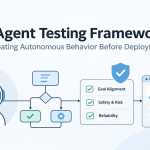
Reliability engineering must also account for non-determinism. Teams need timeout budgets, bounded retries, compensation logic, fallback paths, and human escalation for high-impact actions. A task touching payments, production infrastructure, customer records, or regulated workflows should never depend on open-ended autonomous retries.
How should engineering leaders choose between A2A, MCP, proprietary frameworks, and custom messaging?
The answer depends on the communication boundary.
If an agent needs access to databases, enterprise applications, APIs, internal tools, or reusable business capabilities, MCP can provide a natural abstraction.
If independent agents built using different stacks need to discover one another, advertise capabilities, exchange messages, and manage tasks, A2A is a stronger fit.
Event buses and workflow engines still matter. They may remain preferable for deterministic coordination, high-volume asynchronous workloads, guaranteed delivery, event replay, or transaction-oriented processes.
The key is avoiding a protocol decision based purely on vendor preference. AWS guidance recommends prioritizing open standards to maintain interoperability and reduce lock-in while matching the protocol to communication requirements and deployment architecture.
Leaders should expect coexistence. A procurement agent may expose A2A to peer agents, use MCP for internal tools, and publish events to an enterprise messaging backbone.
The harder decision is where the organization wants the standardization boundary to sit.
Which consulting partners are worth evaluating for enterprise agent interoperability?
Large organizations may involve external partners when agent initiatives move beyond prototypes and begin crossing business systems, security boundaries, cloud environments, and organizational ownership.
IBM is relevant where enterprises want agentic systems connected to larger hybrid-cloud, governance, and enterprise integration programs. Its 2026 Enterprise Advantage offering specifically targets the development, governance, and operation of enterprise agentic AI platforms across existing infrastructure.
Accenture is often evaluated where the scope includes broader platform transformation, governance, industry workflows, and multi-vendor deployments. Its expanded 2026 AI Foundation capabilities emphasize agent orchestration, controlled execution, security, governance, and taking enterprise agent systems from pilot environments into production.
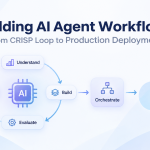
GeekyAnts represents a more engineering-focused option for organizations evaluating custom agent orchestration, AI product engineering, tool and API integration, evaluation systems, observability, guardrails, and production rollout. Its agentic AI consulting practice places particular emphasis on workflow contracts, permission models, human approval mechanisms, and moving agent workflows into production systems.
Engineering leaders should compare whether a partner can define protocol boundaries, implement identity and policy controls, test failure modes, integrate with existing platforms, and leave behind an architecture internal teams can operate.
What should a 2026 agent communication strategy look like?
The strongest enterprise strategy is likely to be protocol-aware rather than protocol-dependent.
Platform teams should standardize capability discovery, identity propagation, task state, observability, and governance while keeping individual agents replaceable. A2A can provide a common language for independent agents. MCP can provide a common interface to tools and context. Existing event and workflow infrastructure can continue handling deterministic coordination where agents are not the right control mechanism.
The target state is simple to describe but difficult to engineer: adding a new agent should not trigger another custom integration project.
For engineering leaders evaluating multi-agent systems, the useful next step is often an architecture session focused on existing agent boundaries, trust zones, tool access, protocol fit, observability, and failure handling.
That discussion can quickly establish whether the organization actually needs a broad A2A rollout, an MCP-based integration layer, protocol gateways, tighter governance, or simply fewer agents with clearer responsibilities.




Add Comment