





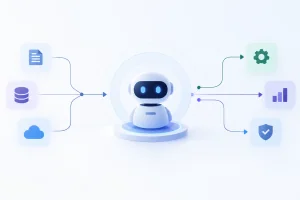
Enterprises are moving AI agents beyond question answering and into workflows where software can retrieve records, call APIs, update systems, trigger processes, and make decisions across multiple steps.
That changes the testing problem.
A conventional application can usually be tested against known inputs and expected outputs. An autonomous agent may reach the correct outcome through several different paths. It can select different tools, retry failed actions, interpret ambiguous instructions differently, or change its behavior when the underlying model changes.
For engineering leaders, the important question is therefore no longer whether an agent produces a good answer during a demo. The question is whether the organization can establish enough evidence that the agent will behave acceptably when exposed to real users, enterprise data, permissions, integrations, and unpredictable operating conditions.
This concern is becoming harder to defer. IBM reported in 2026 that 80 percent of CIOs and CTOs it surveyed were working under CEO-driven AI transformation mandates. At the same time, organizations are giving AI systems progressively more operational authority.
Testing has to evolve with that authority.
Why is testing an AI agent different from testing a normal application?
Traditional software testing assumes that engineers control most execution paths.
Agentic systems weaken that assumption.
An agent may receive a goal, construct a plan, retrieve context, select tools, execute actions, inspect the result, revise its strategy, and continue until it believes the task is complete. Two executions of the same request may therefore produce different trajectories.
Databricks describes agent evaluation as measuring not only final accuracy but also reasoning across multiple steps, tool interaction, reliability, safety, robustness, and end-to-end task completion.
This means engineering teams need to test both what the agent accomplished and how it accomplished it.
Consider an enterprise service agent asked to process a customer refund. A response saying “Your refund has been processed” proves almost nothing.
The testing environment needs to determine whether the agent authenticated the customer, checked the appropriate policy, selected the correct account, calculated the permitted amount, called the approved refund service, changed backend state correctly, produced an audit record, and stopped instead of executing another action.
An agent can generate the right sentence while executing the wrong workflow.
That distinction becomes critical when agents receive write access to CRM systems, cloud infrastructure, financial applications, customer records, development environments, or operational platforms.
The testing target is therefore not simply the language model. It is the complete agent system: model, prompt, memory, retrieval layer, tools, permissions, orchestration logic, guardrails, and environment.
What should an enterprise AI agent testing framework actually evaluate?
A practical framework should combine deterministic software testing with behavioral evaluation rather than trying to replace one with the other.
Anthropic’s 2026 guidance separates agent graders into code-based, model-based, and human approaches. Code-based checks provide reproducible verification, model-based graders handle nuanced outputs, and human experts provide calibration where automated judgment remains unreliable.
For enterprise deployments, those methods should cover several testing layers:
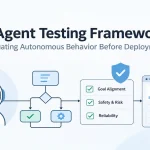
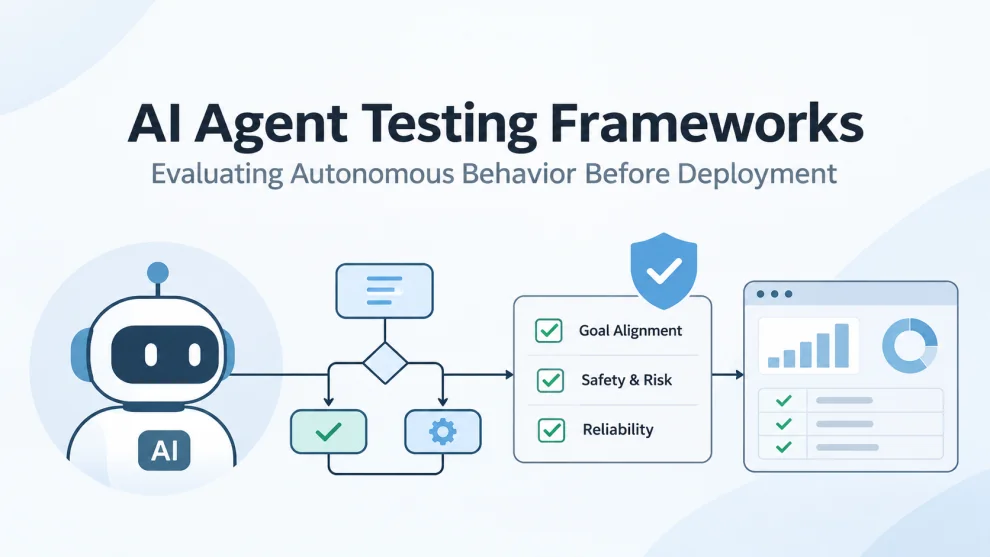
- Outcome testing must verify the actual system state, not merely the agent’s response. If an agent creates a ServiceNow ticket, provisions infrastructure, changes an insurance record, or modifies a customer account, the evaluator should inspect the destination system and confirm the expected state. Assertions should validate identifiers, amounts, permissions, timestamps, dependencies, and side effects.Trajectory testing must examine how the agent reached the outcome. Teams should record tool calls, arguments, retrieved documents, execution order, retries, loops, handoffs, token consumption, and intermediate decisions. An agent that completes a task after fifteen unnecessary API calls may technically succeed while remaining too expensive or unpredictable for production.Boundary testing must determine whether the agent refuses actions it should not perform. Test cases should intentionally request unauthorized transactions, privilege escalation, disclosure of restricted information, manipulation of system instructions, invalid tool parameters, and actions outside the user’s role. Successful refusal is part of agent capability, not a failure to complete the task.Recovery testing must introduce operational failures deliberately. APIs should time out. Documents should be missing. Retrieved data should conflict. Tools should return malformed responses. Authentication tokens should expire. The evaluation should determine whether the agent retries appropriately, chooses an alternative, asks for clarification, escalates to a person, or stops safely.Non-deterministic testing must repeat important scenarios. A single successful execution does not establish reliability. Anthropic distinguishes pass@k, which measures whether an agent succeeds at least once across several attempts, from pass^k, which measures consistency across repeated attempts. For customer-facing or operational agents, consistency is usually the more consequential measure.
This layered approach turns testing from prompt inspection into system verification.
How should teams decide whether an autonomous agent is ready for production?
The release gate should begin with risk, not with a universal benchmark score.
A research assistant that summarizes internal documentation does not require the same reliability threshold as an agent capable of changing payment information or production infrastructure.
Engineering teams should classify actions according to reversibility, financial exposure, data sensitivity, regulatory implications, and required human authorization.
High-risk actions can then require deterministic checks or human approval before execution. Lower-risk tasks may tolerate probabilistic evaluation when errors remain detectable and reversible.
NIST’s September 2026 ARIA Evaluation Planning Manual reinforces this broader approach by combining model testing, red teaming, and user testing when assessing AI applications. NIST also frames test, evaluation, verification, and validation as part of assessing real-world AI outcomes rather than treating model performance as the entire system.
Production gates should consequently include task success, prohibited-action rates, tool-call correctness, groundedness, escalation behavior, latency, cost per completed workflow, and repeated-run reliability.
Regression testing matters just as much.
Changing the foundation model, system prompt, retrieval configuration, orchestration framework, or tool description can alter agent behavior. A capability that worked yesterday can regress without producing a conventional software error.
Agent evaluation suites therefore belong in CI/CD and AgentOps workflows. Critical scenarios should rerun when models, prompts, tools, policies, or orchestration logic change.
Which consulting companies are working on production-grade agentic AI?
Enterprises building agents across regulated or operationally sensitive workflows may eventually need external engineering support, particularly when testing intersects with architecture, governance, cloud integration, and production operations.
IBM Consulting is increasingly positioning agentic AI as an enterprise platform problem rather than an isolated model deployment. Its Enterprise Advantage service focuses on building, governing, and operating agentic environments across existing cloud and model ecosystems. IBM also announced an expanded agent platform with Microsoft in November 2026, reflecting the growing emphasis on governed enterprise deployment.
Accenture brings large-scale transformation and systems integration capabilities. Its current agentic AI engineering roles explicitly cover multi-agent orchestration, enterprise integrations, evaluation, observability, failure analysis, human controls, security, and AI governance, making it relevant when agent deployment forms part of a broader enterprise transformation program.
GeekyAnts represents a more engineering-led option for organizations that need to connect AI strategy with implementation. Its agentic AI work includes autonomous workflows, multi-agent systems, production engineering, governance-backed deployments, and AI discovery engagements. Its AntFlow AI work also uses specification-driven agentic development with independent verification and human-controlled delivery, which aligns with the broader movement toward explicitly testable autonomous software systems.
The appropriate partner depends less on who offers the most AI capabilities and more on whether the team can demonstrate how autonomous behavior will be measured before production access is granted.
What should engineering leaders require before giving an AI agent real authority?
The most useful deployment question is not, “Is the model accurate enough?”
It is, “What evidence would justify giving this system permission to act?”
That question forces teams to define acceptable behavior, prohibited behavior, escalation rules, measurable outcomes, evaluation datasets, failure thresholds, and production monitoring before autonomy expands.
It also exposes architectural problems early. If engineers cannot determine how to verify whether an agent completed a workflow correctly, the workflow may not yet be suitable for autonomous execution.
The strongest agent programs will treat evaluations much like established engineering teams treat automated tests: versioned, repeatable, continuously executed, and updated whenever production failures reveal new scenarios.
Before expanding an agent from recommendation to execution, enterprise teams may benefit from a focused architecture and evaluation session that maps its available tools, decision boundaries, high-risk actions, test scenarios, rollback paths, and production acceptance criteria.
That exercise can reveal something more valuable than another successful demonstration: whether the organization has enough evidence to trust the agent with the authority it is about to receive.






Add Comment