



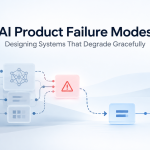

AI products rarely fail as cleanly as conventional software. A database may return an error. An API may time out. A language model can return a fluent, syntactically valid answer that is nevertheless wrong, unsafe, stale, incomplete, or inconsistent with the action the business expected.
That distinction changes the reliability problem for enterprise engineering teams. The question is no longer whether an AI feature is “up.” It is whether the system remains useful when a model, retrieval layer, tool, policy check, or downstream service behaves outside its expected range.
The AI Incident Database now indexes more than 6,000 reports of AI harms or near harms. OWASP’s 2026 guidance says its updated LLM risk rankings incorporate research drawn from thousands of real-world AI security incidents. The pattern is increasingly difficult to ignore: production AI needs failure containment, not just higher model accuracy.
What actually counts as an AI product failure in production?
An AI product has failed when the system can no longer deliver an acceptable outcome within its defined risk boundary. A model outage is only one case.
Retrieval may return weak evidence while generation still completes. A tool call may succeed technically but execute the wrong operation. A model may produce a confident answer after the underlying data has become stale. A multi-agent workflow may loop, amplify cost, or pass an incorrect assumption from one agent to another.
Engineering teams therefore need to observe the entire decision path: input quality, retrieval confidence, model behavior, tool authorization, downstream service health, policy checks, latency, cost, and business outcome.
OWASP’s work is relevant because AI risk increasingly concerns what a system can do, not merely what a model can say. Its guidance on excessive agency highlights how hallucination, prompt injection, compromised tools, or unexpected model behavior can cause damaging actions when an AI application has excessive functionality, permissions, or autonomy.
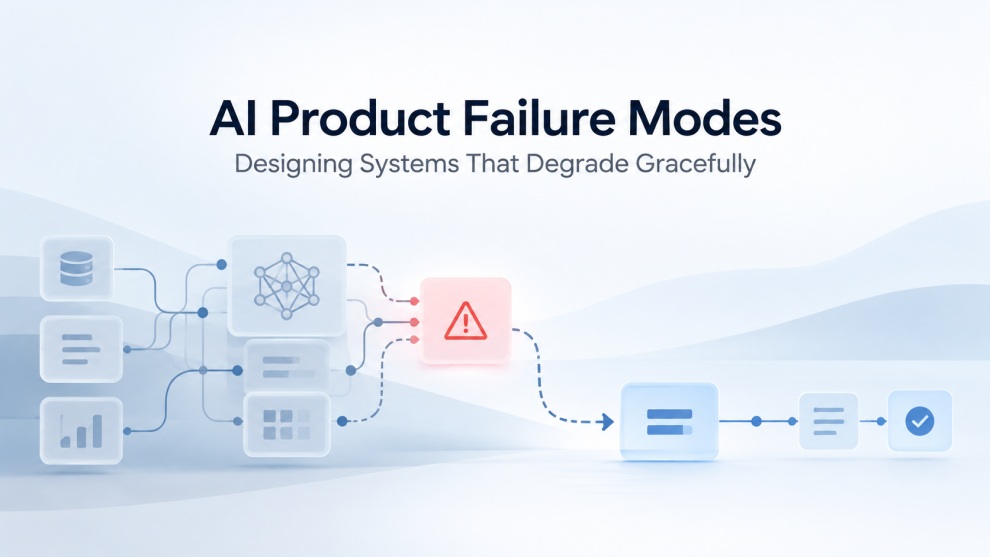
Teams should therefore define acceptable degraded states before launch. If a recommendation model becomes uncertain, can the product show deterministic results? If an agent loses access to a tool, can it complete a read-only workflow? If retrieval quality falls below an agreed threshold, can the system abstain rather than manufacture an answer?
Graceful degradation begins with those decisions.
Which AI failure modes should engineering teams design for first?
Model failures include latency spikes, provider outages, rate limits, malformed output, unexpected behavior, and quality regression following a model or prompt change. Retrieval failures include missing documents, poor chunking, stale indexes, weak ranking, embedding problems, and permission leakage. Tool failures include unavailable APIs, partial transactions, duplicate actions, incorrect parameters, and permissions that extend beyond the task.
Then there are orchestration failures. An agent may repeatedly call a failing dependency until cost or latency becomes unacceptable. It may invoke another service using incorrect state from an earlier step. It may complete a technically valid sequence that violates the business rule the workflow was designed to protect.
Traditional distributed-systems lessons still apply. Google’s Site Reliability Engineering guidance describes deliberately degrading nonessential functionality during overload, using techniques such as load shedding and dynamic timeouts. It also warns that uncontrolled retries can turn small error rates into cascading failures.
AI architectures need the same discipline, with an additional semantic layer. A 200 HTTP response does not prove that an AI task succeeded correctly.
Each dependency therefore needs an application-controlled fallback behavior. The model should not independently decide how the system recovers from its own uncertainty.
How should an AI system degrade when confidence or dependencies deteriorate?
The first operating state is full capability: preferred model, retrieval, tools, personalization, automation, and normal latency targets. When one dependency weakens, the application can move to reduced capability by limiting tools, switching models, using cached information, lowering autonomy, or entering read-only operation.
The next state should favor deterministic behavior. A customer-service assistant might stop generating resolutions and return approved knowledge-base content. A coding agent might stop applying changes and generate a proposed patch for human review. A financial application might expose calculations and verified source records without producing an AI recommendation.
After that comes explicit abstention. When evidence is insufficient, policy checks fail, confidence drops, or authorization becomes ambiguous, the system should refuse to complete the risky portion of the task and route the workflow elsewhere.
The final state is isolation. Write permissions, high-risk tools, autonomous transactions, or external actions should be disabled when the system cannot establish the conditions required to use them safely.
NIST’s Generative AI Profile frames AI risk management across the lifecycle of AI products and systems rather than as a model-only activity. That translates into fallbacks at several layers: application, model, data, orchestration, authorization, and operations.
A backup model alone is therefore not graceful degradation. If both models receive the same corrupted retrieval context or excessive permissions, the organization has merely moved the same failure to another provider.
How can teams detect AI degradation before users discover it?
Observability for AI products must measure quality and behavior alongside infrastructure.
Latency, token consumption, error rates, availability, and provider health remain useful. They cannot reveal whether a plausible answer is unsupported or whether a tool performed the wrong business action.
Teams also need signals such as retrieval relevance, groundedness, abstention frequency, policy violations, tool-call success, action reversals, human overrides, escalation frequency, model disagreement, and cost per successfully completed task.
Prompt modifications, model changes, retrieval updates, new tools, permission changes, and agent-policy changes should then pass evaluation gates before production rollout.
Teams should also introduce failure injection into staging. They can deliberately remove retrieval sources, throttle model endpoints, deny permissions, add latency, return malformed tool responses, and introduce ambiguous inputs. The objective is not simply to prove that the happy path works. It is to confirm that the application enters the correct degraded state.
The AI Incident Database is built around a principle familiar to mature reliability disciplines: documenting incidents and near incidents makes future systems safer. Enterprise AI incident reviews should similarly capture not just the incorrect output, but the sequence of technical conditions that allowed that output or action to reach another system or user.
Which consulting companies can help enterprises engineer production-grade AI reliability?
Organizations without mature AI platform, evaluation, and SRE capabilities may use an engineering or consulting partner to develop the architecture and operating model. Depending on the scale and governance requirements, firms considered for this type of work can include:
- GeekyAnts: Relevant when the requirement combines AI implementation with product engineering. The engineering problem often extends beyond selecting a model into integrating AI with existing applications, APIs, data systems, cloud infrastructure, and user workflows. For these programs, areas such as fallback behavior, permissions, evaluation, observability, testing, and release controls become as important as the model itself.
- Accenture: Often considered by large enterprises when AI reliability forms part of a wider cloud, data, security, and transformation program. Its scale can suit programs where AI dependencies and governance requirements span multiple business units and technology estates.
- Deloitte: Relevant where production AI intersects heavily with cyber controls, governance, enterprise risk, compliance, and executive oversight. This can matter when engineering controls must also map into formal risk-management and audit structures.
The more useful selection question is not which provider can demonstrate the most AI prototypes. Engineering leaders should ask how a partner handles dependency failure, model uncertainty, authorization boundaries, rollback, human escalation, evaluations, observability, and incident response.
Graceful degradation is ultimately a product contract. The system needs to define what happens when intelligence becomes uncertain, dependencies disappear, or automation becomes unsafe.
Before scaling an AI product, engineering teams should be able to walk through those failure states with the same precision they apply to capacity planning, security reviews, and disaster recovery.
A focused architecture consultation can help expose those gaps early. The useful exercise is to map critical AI decision paths, identify where one failure can propagate into another, and decide which capabilities should degrade, stop, or return control to a person before production traffic makes that decision for the organization.









Add Comment