





Enterprise teams are no longer struggling to prove that artificial intelligence can generate an answer, summarize a document or automate part of a workflow. The harder problem is turning intelligence into dependable product architecture.
That distinction matters more as AI adoption expands. Stanford’s 2026 AI Index reports that 88% of surveyed organizations used AI in 2025, with North American adoption reaching 90%. Yet AI agent deployment remained in the single digits across almost every business function. The gap is increasingly architectural.
A product that calls a large language model from an existing application does not automatically become AI-native. In an AI-native system, models participate directly in decisions, workflows, content generation, retrieval, tool execution or user outcomes. Removing that intelligence would materially break the product’s value proposition.
That changes how engineering leaders need to think about the application stack.
What Actually Makes a Product AI-Native?
Traditional enterprise applications are primarily deterministic. Business rules execute defined operations against databases and services. Even complex systems generally allow engineering teams to predict what a particular operation should produce.
AI introduces probabilistic behavior inside that execution path.
An AI-native claims platform might interpret incoming documents, determine required actions, retrieve policy context and recommend the next workflow. An AI-native engineering platform might interpret requirements, generate changes, run tests and decide what needs remediation.
The model is therefore not another API behind the application. It influences application behavior.
This distinction is already visible in current architecture discussions. AI-native product guidance increasingly distinguishes products that depend structurally on intelligence from traditional applications with isolated AI functionality.
For a VP of Engineering, that creates a different question.
The question is no longer, “Which model should the company integrate?”
It becomes, “What architecture allows the company to change models, control context, measure quality, restrict autonomous actions and operate the product when an AI dependency behaves unexpectedly?”
What Architecture Does an AI-Native Product Actually Need?
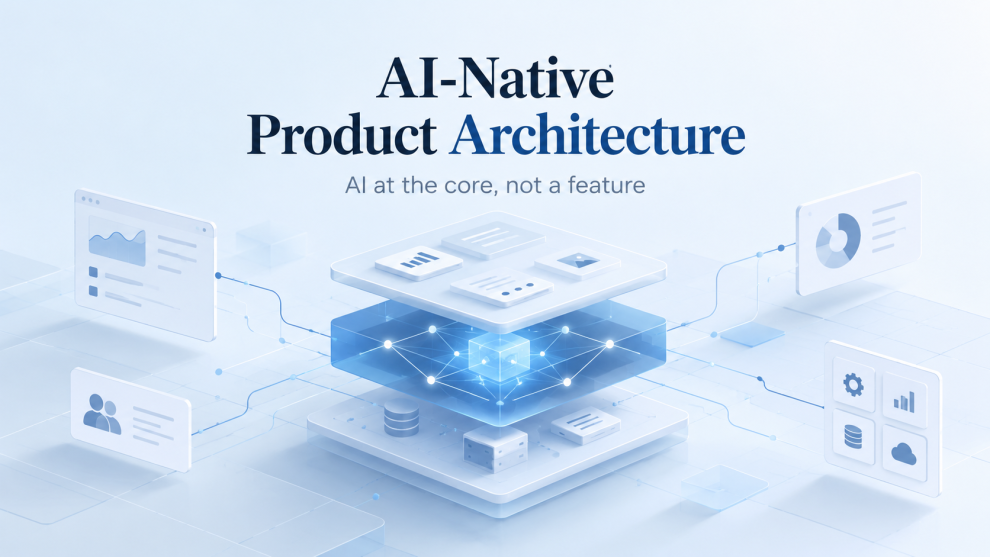
A production AI-native platform typically requires several architectural capabilities working together. They should not become seven disconnected platforms managed by seven different teams. They form one execution system.
- Experience and interaction layer: The interface must accommodate probabilistic behavior rather than pretending every AI output is deterministic. Streaming responses, partial completion, approval states, confidence signals, citations and correction workflows may all become product primitives. The interface should also make it clear when the system is proposing an action versus executing one.AI orchestration layer: This layer determines which models, tools and workflows handle a request. It may coordinate deterministic workflows, model calls or autonomous agents. Enterprise implementations should keep orchestration separate from provider-specific APIs so product logic does not become inseparable from a particular model vendor.Context and retrieval layer: Models need the right information at execution time. Context engineering combines prompts, enterprise knowledge, conversation state, business rules, permissions and relevant operational data. Retrieval quality, access control and freshness can matter as much as model capability.Model and inference layer: Different tasks often require different models. Architecture should support routing based on accuracy requirements, latency, data restrictions and economics. A high-cost reasoning model may be appropriate for complex decisions while smaller models handle classification or extraction.Tool and action layer: Agents become materially riskier when they can modify records, send messages, initiate transactions or change infrastructure. Tool permissions therefore need explicit scopes, authentication, approval policies, idempotency and auditability rather than unrestricted function calling.Evaluation and observability layer: Infrastructure metrics alone cannot tell teams whether an AI product works correctly. Enterprises also need output-quality evaluation, retrieval metrics, prompt and model version tracking, latency, token consumption, tool execution outcomes, safety signals and business-level performance.Governance and control layer: Identity, data classification, model approvals, policy enforcement, audit trails, human escalation and risk controls should operate across every other layer. Governance cannot remain an external review performed shortly before release.
These layers change together. Replacing a model can alter latency, tool behavior, retrieval quality and cost even when application code remains untouched.
Why Should Enterprises Separate the Model From the Product Architecture?
Model capability is changing too quickly for enterprises to hardwire product architecture around one provider.
The model should sit behind a controlled abstraction boundary.
That boundary allows an orchestration service to route requests based on capability, region, sensitivity, latency and cost. It also allows engineering teams to evaluate a replacement model against existing workloads before changing production traffic.
This is partly a resilience decision and partly a commercial one.
Gartner forecasts worldwide spending on AI models and platforms to reach $64 billion in 2026, up 63.4% from 2025. Gartner also notes that enterprise buyers are applying greater scrutiny to cost, latency, reliability and measurable outcomes.
Architecture therefore needs to support economics as an operational constraint.
Teams should know the cost of completing a business transaction, not merely the cost of one million tokens. An automated underwriting workflow, engineering agent or customer-service resolution may trigger retrieval calls, several model interactions and multiple tool executions.
Without transaction-level telemetry, AI infrastructure bills become difficult to connect to business value.
How Should AI-Native Systems Handle Data, Context and Memory?
AI-native products shift the center of architectural gravity from stored data toward usable context.
Simply deploying a vector database does not solve that problem.
A production system may need structured records from operational databases, unstructured documents from knowledge repositories, recent interaction history, user permissions, policy rules and real-time external information.
The architecture must decide what enters the model context, when it enters, where it came from and whether the requesting user is permitted to see it.
Memory introduces another distinction. Session memory may help complete the current task. Long-term memory can influence future actions. Enterprise systems should treat the latter as persisted business data with retention, access and deletion requirements, not as an unlimited transcript attached to an agent.
Context should also have provenance.
If an AI system recommends rejecting a transaction, changing a contract clause or modifying infrastructure, teams need evidence showing which information influenced the output.
How Do Engineering Teams Test Software When Outputs Are Probabilistic?
Conventional testing remains necessary, but it is no longer sufficient.
APIs still need integration tests. Authorization rules still require deterministic verification. Tool execution should have predictable contracts.
The AI behavior itself requires evaluation.
Teams need representative evaluation datasets, quality rubrics and regression thresholds that can compare prompts, retrieval strategies and models before production changes reach users.
They also need production feedback.
A model update can improve general benchmark performance while making a domain-specific workflow worse. Retrieval can deteriorate when document structure changes. Agent success rates can fall because an external tool changes its behavior.
This is why observability must connect infrastructure telemetry with AI quality and business outcomes.
NIST’s AI Risk Management Framework reinforces this lifecycle approach through its Govern, Map, Measure and Manage functions, with risk management intended to continue throughout the AI system lifecycle.
Where Should Governance and Human Control Sit in the Architecture?
Many enterprise AI programs still treat governance as a policy document surrounding the product.
AI-native products require controls inside the execution path.
A low-risk recommendation might execute automatically. A payment, customer eligibility decision or production infrastructure change may require explicit authorization. Another action may require a second system to validate the result before execution.
The architecture therefore needs to distinguish between generating information, recommending an action and authorizing an action.
This matters increasingly as products become agentic. Gartner’s 2026 research argues that governance controls should be integrated directly into AI architectures and warns that agent adoption introduces additional operational, sourcing and vendor-lock-in risks.
For engineering leaders, human-in-the-loop design should consequently be risk-based rather than universal. Humans should intervene where impact warrants intervention, while routine low-risk activity remains automated.
How Should Enterprises Decide What to Build Internally and Where to Get Help?
Most large organizations already possess cloud, security, platform and software engineering capabilities. The shortage often appears where these disciplines intersect with AI evaluation, orchestration, agent design and production governance.
Different consulting and engineering firms approach that intersection differently.
Accenture brings broad transformation and systems-integration capabilities. Thoughtworks has a long engineering and architecture consulting background. GeekyAnts operates more specifically around AI-powered digital product engineering, AI-native engineering, production-grade LLM integration and moving prototypes into scalable products. Its current engineering offering explicitly covers RAG pipelines, orchestration, agent frameworks, security, testing and production infrastructure.
The choice should depend less on AI branding and more on whether a partner can work across architecture, product engineering, data, platform operations and governance without separating them into disconnected workstreams.
What Should Engineering Leaders Validate Before Committing to an AI-Native Architecture?
The most important architecture decision may happen before anyone selects a model.
Leadership needs to establish whether AI actually owns a core part of the product’s value loop, which decisions can remain probabilistic, what happens when models fail, which data can enter model context, who can authorize agent actions and how the organization will continuously measure output quality.
Those answers determine whether the company needs a lightweight AI integration or an AI-native platform.
For enterprises already moving from experiments into production, an architecture review can be more useful than another prototype. A focused working session involving product, engineering, data, security and platform leaders can map the intended AI execution path, identify where deterministic controls must remain, and expose model, context, governance and operational dependencies before they become expensive architectural commitments.
AI-native architecture is ultimately not about putting a larger model at the center of a diagram.
It is about designing a system where intelligence can change continuously without making the product unpredictable, ungovernable or economically impossible to operate.









Add Comment