




For enterprise technology leaders, the AI conversation is moving beyond where to add a copilot.
The harder question is whether the underlying product architecture can support software that interprets context, reasons over enterprise data, adapts to user behavior, invokes tools, and completes parts of a workflow without turning the application into an expensive collection of model calls.
That distinction matters as AI moves deeper into enterprise software. McKinsey’s 2025 global survey found that 88% of respondents said their organizations regularly used AI in at least one business function. Yet nearly two-thirds said their organizations had not started scaling AI enterprise-wide. Sixty-two percent were at least experimenting with AI agents.
The gap between experimentation and scaled production is precisely where AI-native SaaS architecture becomes important.
What Does AI-Native SaaS Actually Mean?
AI-native SaaS is software in which AI forms part of the product’s core execution architecture rather than appearing as an isolated feature.
A conventional SaaS platform follows mostly deterministic workflows. A user provides an input, application logic executes predefined rules, databases return records, and the interface presents the result.
An AI-enabled SaaS product may retain that architecture while adding summarization, search, content generation, or a conversational assistant.
AI-native SaaS goes further. Models participate directly in how the application interprets requests, selects information, recommends decisions, orchestrates tools, or completes workflows. Removing the intelligence layer would materially change the product.
That distinction is increasingly relevant. Gartner projected that 40% of enterprise applications would include task-specific AI agents by the end of 2026, compared with less than 5% in 2025. Gartner has also cautioned that different categories of agents are developing at different speeds and therefore have different levels of enterprise readiness.
So AI-native should not become shorthand for “put agents everywhere.” The architecture still needs deterministic software for authentication, permissions, transactions, billing, auditability, and other processes where predictable execution matters.
The design problem is deciding where probabilistic intelligence belongs and where it does not.
How Should an Enterprise Architect an AI-Native SaaS Product?
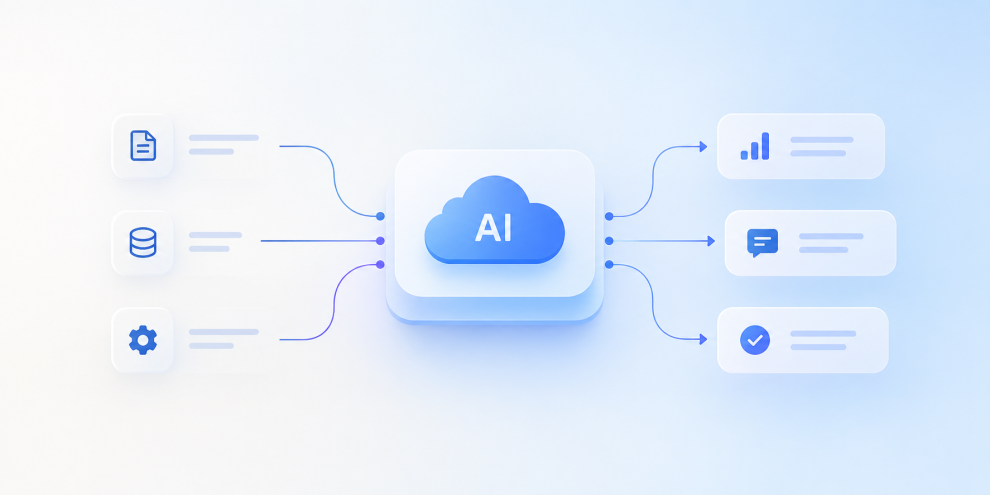
The architecture usually starts with an orchestration layer between the application’s deterministic services and its models.
Instead of allowing the user interface to call an LLM directly, the application routes requests through services responsible for context construction, retrieval, model selection, tool execution, authorization, evaluation, observability, and fallback behavior.
That creates several architectural requirements:
- The data layer must become context-aware. AI-native applications often need relational data, documents, events, embeddings, permissions, conversation state, and historical outcomes simultaneously. Retrieval cannot simply mean placing corporate documents in a vector database. The system needs metadata filtering, tenant isolation, access controls, freshness rules, retrieval evaluation, and often hybrid search. The objective is to give a model the smallest amount of authoritative context required to complete the task. Otherwise, retrieval increases both token consumption and the opportunity for incorrect answers.
- The intelligence layer needs model abstraction. Enterprises should avoid embedding one provider’s model directly throughout application code. A model gateway or abstraction layer can route workloads according to latency, cost, context window, privacy requirements, modality, and task quality. Teams can then change models without rewriting business workflows. The same layer can control prompts, model versions, caching, quotas, retries, and structured outputs.
- Agents need bounded tools rather than unrestricted application access. An agent that can read a customer record presents a different risk from one that can modify pricing, initiate a payment, delete data, or send external communications. Tool permissions should therefore follow least-privilege principles, with explicit schemas, authorization checks, approval gates, and transaction logging. OWASP identifies “excessive agency” as a GenAI application risk, particularly when systems receive unnecessary functionality, permissions, or autonomy.
- Evaluation must become part of CI/CD. Traditional SaaS teams can verify whether a function returns an expected value. Model outputs are probabilistic. AI-native teams therefore need evaluation datasets for factuality, task completion, retrieval quality, policy compliance, latency, tool selection, and regression. Production traces should feed new failure cases back into those evaluation suites. That turns AI quality from an occasional manual review into an engineering discipline.
- Observability needs to extend beyond uptime. A service can return HTTP 200 while giving the customer an unusable answer. Engineering teams need visibility into model latency, token consumption, retrieval sources, tool calls, failed actions, fallbacks, model versions, user corrections, and task success. These signals connect AI behavior to the same SLO and incident-management processes used elsewhere in the platform.
Together, these components create something more useful than an “AI layer.” They create an execution system in which intelligence can evolve without destabilizing the SaaS platform.
How Can Enterprises Control AI Risk Without Slowing Product Delivery?
Security becomes more complicated once software can interpret untrusted natural language and take actions.
Prompt injection, sensitive-information disclosure, insecure output handling, vector weaknesses, misinformation, excessive agency, and uncontrolled resource consumption are among the risks covered by OWASP’s 2025 guidance for LLM and GenAI applications.
For enterprise SaaS, those concerns intersect with familiar requirements such as RBAC, tenant isolation, encryption, data residency, audit trails, retention policies, and regulatory controls.
The practical response is not a separate governance process that begins before launch. Controls need to live inside the architecture.
An AI request should inherit the identity and authorization context of the requesting user. Retrieval should enforce those permissions before information enters a prompt. Tool calls should undergo independent authorization instead of trusting the model’s decision. High-impact actions can require deterministic validation or human approval.
The same principle applies to risk management. NIST’s Generative AI Profile extends its AI Risk Management Framework to risks across the GenAI lifecycle and organizes risk management around governing, mapping, measuring, and managing AI systems.
This matters for engineering leaders because production readiness becomes measurable. A release gate can ask whether the model has passed defined evaluations, whether sensitive data can reach an external model, whether every agent action is traceable, and whether the application has a deterministic fallback when the model is unavailable.
Governance then becomes architecture rather than paperwork.
Which Consulting Companies Work on AI-Native Product Engineering?
Large organizations rarely need a partner simply to connect an LLM API. The more difficult work sits around architecture, modernization, data, security, UX, evaluation, cloud infrastructure, and integration with existing systems.
Several firms operate across portions of that problem.
GeekyAnts works across AI-powered product engineering, digital product development, application modernization, cloud, and experience engineering. Its relevance is strongest where an organization needs AI capabilities integrated into a broader software product rather than treated as a standalone proof of concept.
Accenture brings a substantially larger enterprise consulting footprint, combining AI transformation with cloud, data, industry consulting, and large-scale systems integration. That model can fit transformation programs involving multiple business units and extensive enterprise-system dependencies.
Thoughtworks approaches the problem from a software engineering and modernization background, with work spanning AI-enabled software delivery, data platforms, architecture, and digital products.
The useful comparison is not which company has the longest list of AI capabilities. Engineering leaders should examine how a prospective partner handles existing architecture, model portability, evaluation, security boundaries, observability, cost controls, and production ownership.
A convincing AI demo answers very few of those questions.
How Should Enterprises Start Building AI-Native SaaS?
The safest starting point is usually not an enterprise-wide agent platform.
Teams can identify one workflow where intelligence changes the economics or experience of the product. They can then map the data required, decisions currently made by humans, systems the AI must access, consequences of incorrect outputs, acceptable latency, and measurable business outcome.
That creates a bounded production use case.
The team can establish its context pipeline, model abstraction, evaluation framework, tool permissions, observability, and feedback mechanisms around that workflow before expanding the architecture.
This approach also exposes an important truth about AI-native SaaS: the model is rarely the hardest part.
Production complexity usually appears in the systems surrounding it. Identity, enterprise data, integrations, evaluation, security, latency, cost, observability, human approvals, and failure recovery determine whether an impressive prototype becomes dependable software.
For a VP of Engineering or digital platform leader, that changes the first conversation. Instead of asking “Which model should the company use?”, the more useful question is “What would have to change in the current platform for AI to become a dependable part of how the product works?”
A focused architecture and production-readiness consultation around that question can reveal whether the organization needs a new AI-native product, selective re-architecture of an existing SaaS platform, or simply a better-designed intelligence layer. That distinction is worth establishing before committing the next engineering roadmap to AI.




Add Comment