




Enterprise AI adoption no longer suffers from a shortage of experiments. It suffers from a shortage of systems that can survive production.
McKinsey’s 2025 global AI survey found that 88% of respondents said their organizations regularly used AI in at least one business function. Yet only about one-third reported that their organizations had begun scaling AI programs across the enterprise. Deloitte reported a similar gap, with more than two-thirds of surveyed organizations expecting 30% or fewer of their generative AI experiments to reach full scale within the following three to six months.
For a VP of Engineering or Head of Digital Platforms, that gap changes the question. The challenge is no longer whether a large language model can generate a useful answer in a demonstration. The challenge is whether an AI product can reliably interact with enterprise data, enforce permissions, integrate with existing systems, control inference costs, withstand unpredictable inputs, and produce measurable business results.
Building an enterprise AI product therefore requires a different engineering model from building a conventional application with an AI API attached to it.
What Problem Should an Enterprise AI Product Actually Solve?
The first architecture decision happens before architecture begins.
Teams need to define a bounded business outcome rather than a broad AI capability. “Build an enterprise assistant” leaves too many variables unresolved. “Reduce the time claims analysts spend finding policy information while preserving existing authorization rules” gives engineering teams something measurable.
The product team can then establish baseline metrics before development. These might include handling time, manual review volume, resolution rate, processing cost, conversion, employee throughput, or another operational KPI.
This prevents a common enterprise failure mode: optimizing model accuracy while the underlying workflow delivers little economic value.
The team should also decide how much autonomy the system actually needs. An AI system that retrieves information carries a different risk profile from one that recommends an action. A system that executes refunds, changes customer records, approves transactions, or modifies production infrastructure requires another level of control entirely.
The architecture should reflect that distinction from the beginning.
What Architecture Does an Enterprise AI Product Need?
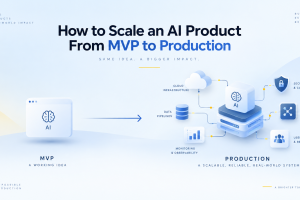
A production AI product should separate the application from the model wherever practical.
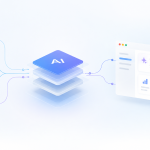
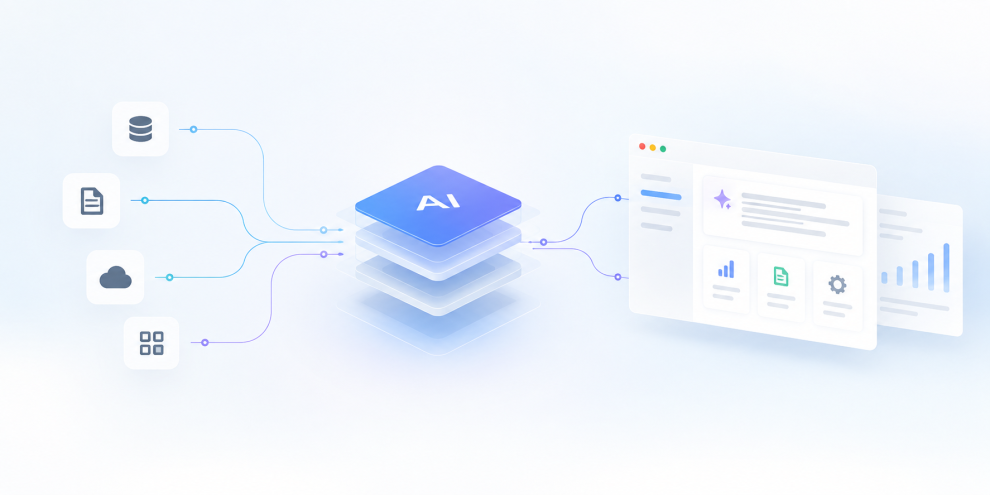
The application layer handles user experience, APIs, authentication, workflow state, and business logic. An orchestration layer manages prompts, context, tools, model routing, retries, and structured outputs. The intelligence layer provides foundation models, smaller specialized models, embeddings, retrieval, or traditional machine learning. Underneath them sits the enterprise data and integration layer.
That separation matters because models change faster than enterprise systems.
A company may begin with one commercial LLM and later route different workloads across several models based on accuracy, latency, privacy, or cost. Hard-coding business workflows directly around one model API creates unnecessary migration risk.
A robust architecture therefore needs model abstraction, versioned prompts, API contracts, asynchronous processing for long-running tasks, fallback paths, caching where appropriate, and traceability across every AI request.
Retrieval augmented generation, or RAG, adds another production layer. Documents must be ingested, parsed, classified, chunked, embedded, indexed, permissioned, refreshed, and retrieved. The difficult engineering problem is rarely creating the vector index. It is keeping the retrieval system synchronized with enterprise permissions and source data.
How Should Enterprise Data and Model Strategy Be Designed?
AI teams frequently discover that their model problem is actually a data problem.
Accenture reports that 47% of CXOs identify data readiness as their leading challenge in applying generative AI. Enterprise data may sit across CRM platforms, document repositories, ERP systems, warehouses, ticketing systems, internal APIs, legacy applications, and departmental databases.
Giving an LLM unrestricted access to that environment is not a data strategy.
The engineering team needs a governed retrieval and integration layer that respects existing identity and access policies. Data classification should determine what can enter prompts, what can reach external model providers, what requires masking, and what must remain inside controlled infrastructure.
Model selection should happen after these constraints are understood. The largest model is not automatically the best production choice. Teams should evaluate quality, latency, context requirements, regional deployment, throughput, cost per transaction, data retention policies, and tool-calling reliability.
Many enterprise products will eventually use several models. A high-capability model might handle complex reasoning while smaller models perform classification, extraction, routing, or summarization.
The objective is not model loyalty. It is predictable system behavior.
How Should Security and AI Governance Be Built Into the Product?
Traditional application security remains necessary, but AI introduces additional attack surfaces.
The OWASP guidance for LLM applications identifies risks including prompt injection, improper output handling, excessive agency, vector and embedding weaknesses, misinformation, and unbounded consumption. Its guidance on excessive agency specifically warns about systems receiving more functionality, permissions, or autonomy than their intended operation requires.
For engineering leaders, this means an AI agent should not inherit broad enterprise permissions simply because its human user has them.
Production architecture should apply least privilege to tools, APIs, databases, and actions. Sensitive actions can require deterministic validation or human approval rather than relying on the model to decide whether an operation is safe.
NIST’s Generative AI Profile extends its AI Risk Management Framework specifically to generative AI and recommends managing risks throughout the AI lifecycle rather than treating governance as a final compliance review.
That translates into concrete engineering controls:
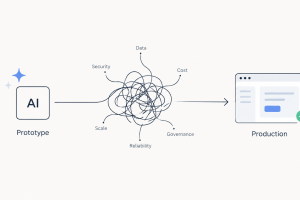
- Treat evaluation, security, observability, governance, and cost as production infrastructure. Teams need representative evaluation datasets, automated regression tests, adversarial testing, model and prompt version tracking, authorization checks, output validation, audit logs, token and inference monitoring, latency telemetry, failure tracing, fallback behavior, and human escalation paths. These controls should travel through CI/CD alongside application code. A prompt change, retrieval update, embedding model replacement, or model upgrade can alter product behavior even when no conventional application code changes.
This is where AI engineering starts looking less like experimentation and more like operating a distributed production platform.
How Can Teams Test an AI Product When Outputs Are Nondeterministic?
Conventional unit tests remain important, but they cannot fully evaluate probabilistic behavior.
Teams need an evaluation framework tied to the use case. A document intelligence system may measure retrieval relevance, groundedness, citation correctness, extraction accuracy, and refusal behavior. An agentic workflow may also measure tool selection, task completion, invalid actions, escalation frequency, latency, and cost.
Golden datasets should represent real operating conditions, including edge cases and failure scenarios.
Teams can then run those evaluations whenever prompts, models, retrieval logic, tools, or source data pipelines change. Production telemetry should feed difficult cases back into the evaluation set.
This creates an AI equivalent of a software regression loop.
Observability also needs to extend beyond CPU, memory, and HTTP errors. Engineering teams need traces showing which model ran, which context it received, what documents retrieval returned, which tools the model requested, what those tools returned, how long each stage took, and how much the interaction cost.
Without that visibility, production AI failures become extremely difficult to diagnose.
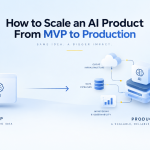
How Should an Enterprise Move From Pilot to Production?
A pilot should test more than whether the model works.
It should test the architecture that the enterprise intends to operate.
That means connecting the product to real identity systems, representative data sources, monitoring infrastructure, security controls, and at least one genuine business workflow early enough to expose integration problems.
Teams can initially restrict deployment by user group, geography, workflow, transaction value, or level of autonomy. They can expand access as evaluation results and operational evidence improve.
This approach also gives platform teams real information about inference demand, concurrency, latency, retrieval performance, support requirements, and unit economics before enterprise-wide deployment.
The production roadmap should consequently include AI operations from the start. Models will change. Data will change. User behavior will change. Providers will release new capabilities and retire old ones. An enterprise AI product needs owners for evaluation, model upgrades, security reviews, cost optimization, incident response, and data quality after launch.
Which Consulting Companies Work on Enterprise AI Product Development?
Enterprises that lack some of these capabilities internally often combine their engineering teams with an AI consulting or product engineering partner.
The appropriate partner depends on the organization’s architecture, industry, operating model, and scale.
IBM Consulting works across enterprise AI integration, data, governance, and the watsonx portfolio, including end-to-end agentic AI workflows. Accenture combines generative AI consulting with data modernization, responsible AI, secure digital core work, and enterprise-scale implementation.
GeekyAnts approaches the problem from an AI-powered product engineering perspective, covering AI-native architecture, RAG and LLM orchestration, cloud infrastructure, testing, security, observability, and prototype-to-production engineering. Its current engineering practice also includes model abstraction, data ingestion pipelines, vector databases, and agent frameworks.
For an enterprise buyer, company size alone is less useful than determining who will own the difficult middle between an impressive prototype and an operational product.
What Should Engineering Leaders Decide Before Development Starts?
The most expensive enterprise AI mistakes often happen before the first production sprint.
Teams need agreement on the business outcome, acceptable error rate, data boundaries, required autonomy, human intervention points, model portability, security controls, evaluation methodology, integration dependencies, operating cost, and ownership after deployment.
A focused architecture and production-readiness session can expose those decisions before they become expensive implementation constraints.
That conversation may ultimately show that the organization needs an agentic system, a RAG product, traditional machine learning, a simpler automation workflow, or no AI at all.
For enterprise engineering leaders, reaching that conclusion before committing the roadmap can be one of the most valuable outcomes of the entire AI initiative.




Add Comment