





Building an AI-powered web application is relatively easy when the objective is a prototype.
A development team can connect a frontend to an LLM API, write a prompt, return the response to the browser, and demonstrate something useful within days. Tutorials commonly follow this pattern because it proves that the underlying concept works. A basic implementation might combine Python, Streamlit, an AI API, environment variables, and cloud deployment.
Enterprise engineering leaders face a different problem.
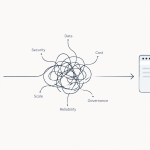
Their application may need to process customer information, retrieve internal documents, enforce permissions, execute transactions, serve thousands of concurrent users, meet latency targets, survive model outages, and explain why an AI-generated response was produced.
That changes the engineering question from “How does the team connect AI to a web application?” to “How does the organization build an AI application that remains secure, predictable, observable, and maintainable after launch?”
That distinction matters. Gartner reported in 2025 that 77 percent of surveyed software engineering leaders in the United States and United Kingdom considered integrating AI capabilities into applications a significant or moderate pain point.
The difficult part is increasingly not accessing the model. It is everything surrounding it.
What Architecture Does an AI-Powered Web Application Actually Need?
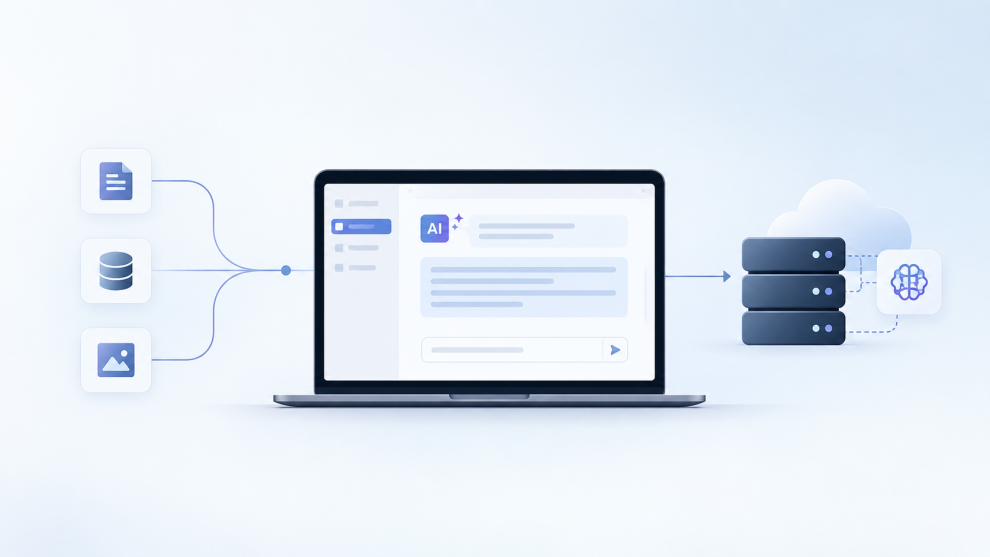
An enterprise AI web application should rarely allow the browser to communicate directly with an AI model.
A safer architecture places an application or orchestration layer between the user and the model.
The browser might use React, Next.js, Angular, or another enterprise frontend framework. Requests then pass through authenticated backend APIs built with platforms such as Node.js, Java, .NET, Python, or Go. That backend determines whether the AI should answer the request, retrieve enterprise information, call another service, or reject the operation.
Behind that layer sits the intelligence stack.
For a generative AI application, that could include an LLM gateway, retrieval pipeline, embedding service, vector database, model provider, prompt templates, evaluation framework, telemetry, policy engine, and conventional relational databases.
A practical architecture usually includes the following capabilities:
- Application and identity layer: Authentication should happen before AI processing. The system needs to understand the user, tenant, role, permissions, geography, and applicable data policies. Model requests should inherit those controls rather than becoming an alternate route around them. Enterprise identity providers, API gateways, rate limits, secrets management, and authorization policies belong here.
- AI orchestration layer: Business logic should decide how models are used. Instead of embedding prompts throughout application code, teams can centralize prompt templates, model routing, tool definitions, response validation, retries, fallbacks, token limits, and safety controls. This also makes it easier to replace one model with another without redesigning the product.
- Enterprise knowledge layer: Applications that need organization-specific answers typically require retrieval augmented generation rather than relying entirely on model memory. Documents are ingested, segmented, embedded, indexed, retrieved according to relevance and access permissions, and inserted into model context. Metadata and authorization should remain attached to content throughout the process.
- Evaluation and observability layer: Traditional monitoring measures CPU, memory, errors, and latency. AI systems also require evaluation of answer quality, grounding, retrieval relevance, hallucination rates, model usage, token consumption, rejected responses, prompt versions, and user feedback. Without this telemetry, teams cannot reliably determine whether the AI experience is improving or deteriorating.
Modern production architectures increasingly combine application infrastructure, governed data, managed identity, databases, and automated deployment pipelines. Databricks, for example, describes production AI applications that pair web applications with governed data access, managed databases, service identities, and CI/CD-driven releases.
The important architectural principle is separation of concerns. AI should be a controlled system capability, not a model call scattered throughout the product.
How Should Engineering Teams Choose Models, Data, and Retrieval Patterns?
Model selection should come after workload definition.
A team first needs to determine whether the application performs classification, summarization, search, document extraction, recommendation, generation, conversational interaction, reasoning, or autonomous actions.
Different workloads may justify different models.
A customer-facing assistant might prioritize response quality and latency. A document processing workflow might prioritize structured-output reliability. High-volume background classification may justify a smaller model because inference economics matter more than advanced reasoning.
Model routing can therefore become part of the architecture. Simple requests can go to smaller models while complex workflows invoke stronger models only when necessary.
Data architecture deserves equal attention.
If an application uses internal enterprise data, teams need to define which sources the AI can access, how frequently indexes refresh, which user can retrieve which document, and what happens when the underlying document changes.
Retrieval also requires testing. Sending the five most similar chunks into a prompt is not automatically a reliable RAG system. Engineering teams should evaluate chunking strategy, metadata filters, embedding models, reranking, retrieval precision, context size, and citation quality against representative business queries.
For transactional workflows, another rule becomes important: the model should usually recommend or request an action rather than directly control critical systems.
A model might determine that an insurance claim requires additional information. Deterministic application logic should still validate authorization, business rules, parameters, and downstream API calls before modifying a record.
That boundary becomes increasingly important as applications move from chat interfaces toward AI agents.
How Can an AI Web Application Be Secured Before Production?
AI introduces risks that conventional web security testing does not fully cover.
OWASP’s guidance for LLM applications identifies risks including prompt injection, sensitive information disclosure, model and data poisoning, supply chain vulnerabilities, and improper output handling.
A production architecture therefore needs security controls on both sides of the model.
Inputs should be authenticated, validated, rate-limited, and inspected according to the application’s threat model. Retrieved information should respect the same authorization boundaries used elsewhere in the enterprise.
Outputs should also be treated as untrusted data.
If an AI response becomes SQL, HTML, application code, an API argument, or an agent action, deterministic validation should occur before execution. A model should never become a shortcut around established application security controls.
Governance cannot wait until release either. NIST’s Generative AI Profile extends its AI Risk Management Framework with guidance specifically intended to help organizations identify and manage risks across the generative AI lifecycle.
For engineering leaders, this means recording model versions, prompts, data access, evaluation results, approvals, and operational policies alongside the application lifecycle.
How Should Teams Test and Operate AI Applications After Launch?
Traditional software usually produces predictable results for a defined input. Generative systems may produce multiple acceptable outputs for the same request.
Testing therefore needs two dimensions.
The first remains conventional engineering: unit tests, integration tests, security tests, accessibility testing, load tests, API contract tests, disaster recovery, and browser compatibility.
The second is AI evaluation.
Teams need representative datasets containing normal requests, ambiguous questions, malicious inputs, incomplete information, domain-specific terminology, and known edge cases. Responses can then be evaluated for correctness, groundedness, retrieval accuracy, policy compliance, latency, and cost.
Those evaluations should become part of CI/CD rather than an occasional manual exercise.
Production monitoring should then track changes in retrieval quality, answer acceptance, model errors, provider availability, token expenditure, response times, and human escalations.
This engineering discipline appears to correlate with AI longevity. Gartner reported in 2025 that 45 percent of surveyed leaders at high AI-maturity organizations said AI initiatives remained operational for at least three years, compared with 20 percent in low-maturity organizations. Gartner associated higher maturity with governance, engineering practices, technical feasibility, and business-value selection.
AI deployment is therefore less about completing the first model integration and more about creating an operating system around continuous evaluation.
Which Consulting Companies Can Help Build Enterprise AI Web Applications?
Enterprises do not always need an external engineering partner. Organizations with established AI platform teams, security capabilities, data engineering maturity, and product engineering capacity may be able to build internally.
Others use consulting partners when AI architecture crosses multiple disciplines.
GeekyAnts works across AI engineering, product engineering, frontend, backend, cloud, QA, and enterprise modernization. Its current AI engineering work includes LLM integration, RAG pipelines, AI agents, model routing, vector search, and production infrastructure, making it relevant where an organization needs AI functionality integrated into a broader digital product rather than developed as an isolated proof of concept.
Thoughtworks brings a large enterprise software-engineering background and increasingly focuses on AI-powered software delivery, agentic systems, modernization, architecture, governance, testing, and observability. Its 2026 guidance also emphasizes maintaining engineering oversight as AI-generated software moves into enterprise systems.
Accenture operates at a larger consulting and transformation scale, with capabilities spanning AI strategy, architecture, infrastructure, generative AI, agentic systems, workflow automation, and enterprise implementation. Its engineering roles indicate a strong focus on integrating and operationalizing enterprise-grade LLM and agentic components.
The right partner model depends less on who can demonstrate an AI interface and more on who can work within the organization’s architecture, security controls, operating model, and production constraints.
What Should Engineering Leaders Decide Before the First Sprint?
Before development begins, teams should be able to describe the business workflow, acceptable AI failure modes, required enterprise data, authorization model, latency target, expected request volume, evaluation method, fallback behavior, model budget, and ownership after production.
If those questions remain unresolved, coding faster rarely solves the problem.
A short architecture and production-readiness session can often expose those gaps before teams commit to a model, vector database, orchestration framework, or cloud architecture. That conversation should examine the existing application environment first and determine where AI belongs within it.
For enterprise AI applications, that decision is increasingly the difference between shipping another convincing demonstration and building a system that engineering teams can actually operate.




Add Comment