




Enterprise AI adoption has moved beyond experimentation. Stanford’s 2026 AI Index reports that organizational AI adoption reached 88 percent. Yet adoption does not equal operating maturity. A 2026 survey of 1,550 enterprise AI decision-makers found that 73 percent use AI regularly or across most business processes, while only 10 percent describe AI as core to how their business operates.
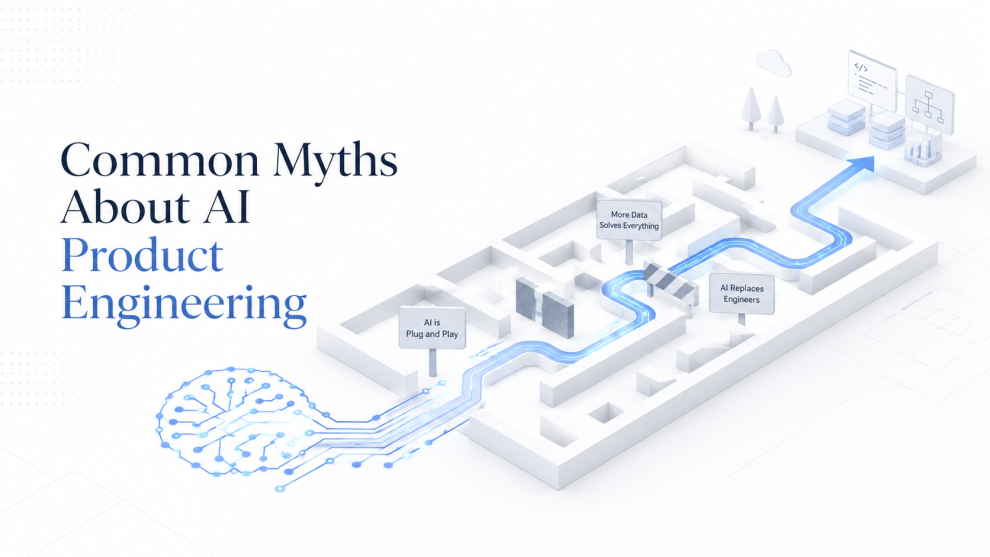
That gap creates a practical problem for engineering leaders. Boards expect faster releases, business units expect automation, and customers expect better digital experiences. Meanwhile, platform teams must control cost, security, reliability, and technical debt. Common myths about AI product engineering push those teams toward the wrong architecture, metrics, and delivery model.
AI product engineering does not mean adding a language model to an existing application. It means designing, releasing, and operating a probabilistic software system within enterprise constraints. That distinction separates an impressive demonstration from a dependable product.
Myth: The Best Model Produces the Best Product
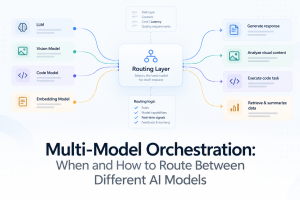
Benchmark performance offers useful input, but it does not define product quality. The strongest model on a public leaderboard may still miss the required latency, privacy, regional deployment, explainability, or cost target. A smaller model with retrieval, deterministic business rules, and task-specific routing may deliver a better production outcome.
Engineering teams need to define success at the workflow level. An internal service assistant may require grounded answers, permission-aware retrieval, source citations, and a safe refusal path. A claims or lending workflow may require structured output, complete auditability, and human approval above a risk threshold. These needs should drive model choice, not market visibility.
Another myth treats a working prototype as evidence that production work is almost complete. A prototype usually proves that a model can generate a useful response under controlled conditions. It rarely proves identity management, tenant isolation, data residency, prompt versioning, load behavior, failure recovery, abuse resistance, or operational ownership.
Production teams need evaluation datasets that reflect real users, edge cases, policy restrictions, and failure costs. They also need release gates, tracing, fallback models, rollback procedures, feedback loops, and incident playbooks. Traditional tests still matter, but AI products also require semantic evaluations because two different outputs can both look plausible while only one meets the business requirement.
Provider changes add another failure surface. Teams need model version controls, regression suites, configurable routing, and contract tests around structured outputs. A model upgrade should follow the same controlled release path as an API or database change, even when the provider labels it compatible.
Coding Speed Does Not Equal Product Delivery Speed
AI coding tools can increase developer output. A Microsoft Research field study across 4,867 developers at Microsoft, Accenture, and a Fortune 100 company found a 26.08 percent increase in completed tasks among developers with access to an AI coding assistant. Google’s 2025 DORA research also found 90 percent AI adoption among software development professionals and reported that more than 80 percent perceived productivity gains.
The myth appears when leaders convert those findings into a matching reduction in enterprise delivery time. Faster code creation can move the bottleneck into architecture review, security validation, integration testing, change approval, or release management. Bain notes that coding and testing account for only about 25 to 35 percent of the time between an initial idea and product launch. (Bain)
An engineering organization can therefore generate more pull requests without shipping more customer value. Review queues grow. Test environments become crowded. Shared services receive more change requests. Teams then measure AI success through generated code, accepted suggestions, or license utilization, even when lead time, defect escape rate, availability, and customer adoption remain flat.
Senior engineering judgment becomes more important in this environment, not less. AI can draft implementations, tests, migration scripts, and documentation. It cannot own the consequences of an architectural decision. Experienced engineers still need to define boundaries, review failure modes, protect domain invariants, and decide when a deterministic service should replace a model call.
Data, Agents, and Governance Create the Harder Work
Many AI roadmaps assume that more enterprise data will produce better answers. In practice, retrieval quality depends on data relevance, provenance, freshness, permissions, and structure. Connecting an LLM to every document repository can increase noise and expose information across access boundaries.
A production retrieval-augmented generation system needs ingestion rules, document parsing, metadata standards, chunking logic, hybrid search, reranking, access-control filtering, citation handling, and deletion workflows. Teams must test whether the system retrieves the right evidence before they judge the generated response. Poor retrieval often looks like a model problem, which leads teams to switch models without fixing the underlying data path.
Agentic AI creates a similar misconception. An agent that can call tools does not automatically qualify to control an end-to-end business process. Engineers must constrain tool permissions, state transitions, retry behavior, token and action budgets, approval thresholds, and recovery paths. Without idempotency controls, an agent may repeat a transaction. Without bounded autonomy, one faulty decision may trigger several valid but harmful downstream actions.
Governance does not need to sit outside delivery as a final approval stage. Teams can encode governance into the platform through model and prompt registries, data lineage, policy checks, audit logs, red-team tests, risk-based release gates, and runtime monitoring. This approach gives security, legal, product, and engineering teams shared evidence. It also reduces the late rework that makes governance appear slow.
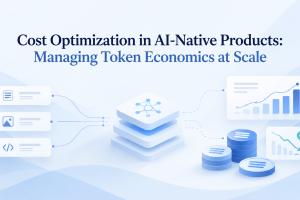
Cost requires the same engineering discipline. Model routing, semantic caching, prompt compression, batch inference, retrieval tuning, and response limits often matter more than negotiating a lower token price. The product team should track cost per completed business outcome, not cost per API call.
External Partners Do Not Replace Product Ownership
Some enterprises assume that an outsourcing partner can absorb the full uncertainty of AI delivery. A capable partner can add specialist skills, delivery capacity, and production patterns, but the enterprise still owns the business decision, data permissions, risk tolerance, acceptance criteria, and operating model.
Three firms illustrate the types of partners that enterprises may evaluate:
- GeekyAnts combines AI product engineering, digital product development, and modernization work. Its stated capabilities cover LLM integration, retrieval architectures, cloud infrastructure, CI/CD, testing, and observability. That mix can suit teams that need a hands-on engineering pod to move a use case from prototype to production while working within an existing product roadmap.
- Thoughtworks brings global technology consulting across design, software engineering, enterprise modernization, and AI. Its product development and enterprise AI offerings emphasize reusable foundations and production-grade systems, which can support organizations that need operating-model change alongside technical delivery.
- Publicis Sapient focuses on enterprise engineering, legacy modernization, AI platforms, and workflow integration. Its approach can fit large programs that connect AI adoption with broader system modernization and cross-functional transformation.
Leaders should assess any partner through the artifacts it can produce: a measurable use-case hypothesis, target architecture, evaluation strategy, security model, cost model, release plan, observability design, and ownership transition. A polished chatbot demonstration provides little evidence about those capabilities.
The right leadership question is not whether AI can generate an answer or write code. It is whether the organization can operate the resulting product at the required level of trust, cost, speed, and accountability.
A focused AI product engineering readiness session can test one priority use case against those conditions. The most useful outcome is not another roadmap presentation. It is a clear decision to proceed, reshape the scope, or stop before the organization commits more budget and platform capacity.




Add Comment