










AI adoption has moved past experimentation inside large enterprises, but enterprise value has not caught up at the same pace. McKinsey’s 2025 State of AI survey reported that 78 percent of respondents said their organizations used AI in at least one business function, and 71 percent regularly used generative AI in at least one function. Yet more than 80 percent said generative AI had not created tangible enterprise-level EBIT impact.
That gap explains why the next boardroom question sounds less like “Can AI work?” and more like “Can this AI product scale without creating cost, risk, or operational drag?”
For VPs of Engineering, Digital Platforms, Customer Experience, Cloud Infrastructure, and Transformation, scaling an AI product now demands more than model confidence. It requires proof that workflow, data, reliability, governance, and cost can survive enterprise traffic. A pilot can succeed with curated data, handpicked users, and manual oversight. A scaled AI product must handle inconsistent records, permission boundaries, latency spikes, audit requests, prompt attacks, and users who reject uncertainty in critical workflows.
The first validation is business fit, not model performance
Many AI products fail at scale because the team validates the demo instead of the decision path. A chatbot that summarizes support tickets may impress stakeholders, but the real question is whether it reduces resolution time, improves first-contact closure, or prevents escalations. A claims assistant may generate accurate summaries, but it still fails if adjusters must check every sentence against policy documents.
Leaders should validate whether the AI product owns a high-value workflow or only decorates an existing one. Product and engineering teams need to know which decision the system influences, who accepts the output, what happens when confidence drops, and how the workflow behaves when the model returns no useful answer. This should happen before platform teams build expensive shared infrastructure around the wrong use case.
Accenture’s 2025 research distinguishes broad AI adoption from strategic AI bets that focus on core value-chain workflows. The research found that 34 percent of companies had scaled at least one strategic AI bet, and those companies devoted 51 percent of technology budgets to cloud and AI, compared with 45 percent among companies that had not scaled any strategic bets.
This matters for enterprise leaders because AI scale should not start with infrastructure expansion alone. It should start with workflow clarity. If the AI product does not improve a measurable business process, scaling it will only spread ambiguity across more users, systems, and cost centers.
Data readiness now means traceability across every artifact
Enterprise AI products do not consume data in the same way analytics dashboards do. They extract text from documents, create chunks, generate embeddings, retrieve fragments, pass context into prompts, and sometimes write generated outputs back into systems of record. A clean source document can still produce a bad answer if the wrong chunk, stale version, or incomplete table reaches the model.
McKinsey’s 2026 analysis on AI data readiness reported that only 7 percent of companies had fully scaled AI across their organizations. It also highlighted that structured and unstructured data must connect into a governed, traceable, reusable foundation before teams can scale with consistency. In the same analysis, more than two-thirds of high-performing companies cited data as the main challenge to scaling generative AI.
This changes validation. Teams must inspect source versioning, metadata quality, entity resolution, permission inheritance, retention policies, and lineage across every derived artifact. They must test whether an answer can point back to the source, version, chunk, retrieval query, prompt template, model, and policy rule that produced it. Without this, the product may look accurate during user acceptance testing but become indefensible during audit, dispute, or compliance review.
For AI products that use retrieval-augmented generation, this layer becomes even more important. The model does not only answer based on its training. It depends on what the retrieval layer brings into the context window. If retrieval fails, the model may produce a confident but incomplete answer. If access control fails, the model may expose information to the wrong user. If source freshness fails, the product may recommend actions based on outdated policies, pricing, regulations, or customer records.
Five technical validations before the big push
- Validate the retrieval and data layer under production messiness. Engineering leaders should test the AI product against duplicate records, old policies, missing fields, regional variants, scanned PDFs, noisy transcripts, and conflicting source systems. Retrieval-augmented generation pipelines need retrieval precision, recall, citation integrity, freshness checks, and fallback behavior, not only a vector database. Teams should monitor how chunking affects answer quality, how embeddings update when sources change, and how access controls apply at retrieval time. A product that retrieves well from a clean document library may still fail when the same information appears in policy PDFs, CRM notes, knowledge-base articles, spreadsheets, emails, and legacy databases.
- Validate reliability with an evaluation harness, not human optimism. A scaled AI product needs regression testing for prompts, tools, models, and orchestration flows. Teams should build golden datasets, adversarial prompts, edge-case suites, hallucination checks, bias tests, and task-completion benchmarks. They should measure answer accuracy, groundedness, refusal quality, tool-call success, latency, and escalation frequency by workflow. Every model or prompt change needs comparison against a baseline before release. Without this discipline, product teams may improve one workflow while quietly breaking another.
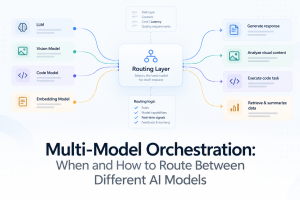
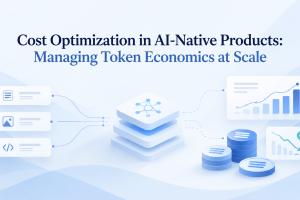
- Validate architecture and unit economics before usage expands. AI cost can rise faster than adoption when teams ignore token volume, context size, model selection, caching, retry loops, and long-running agent workflows. Platform teams should test multi-model routing, prompt compression, semantic caching, autoscaling, queue management, and cost-per-task visibility. A demo that uses the strongest model for every request may not survive procurement scrutiny once thousands of employees use it daily. Leaders need to know the cost of a resolved claim, completed support workflow, processed document, generated recommendation, or automated engineering task.
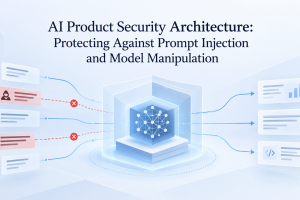
- Validate security, privacy, and governance at runtime. AI products make control decisions at retrieval, prompting, generation, memory use, and tool execution. Static access control does not cover every risk. Teams need PII detection, prompt injection defenses, output filtering, tenant isolation, audit logs, model-use policies, approval gates, and red-team testing. They should confirm that sensitive data cannot leak through embeddings, summaries, cached responses, or agent memory. In regulated sectors such as healthcare, insurance, banking, and financial services, runtime governance will decide whether the AI product can move from pilot to production.
- Validate the operating model and adoption loop. Large organizations often underestimate the human side of AI reliability. The product needs clear owner roles across product, platform, data, security, legal, and business operations. It also needs feedback loops that capture user corrections, false positives, missed answers, escalation reasons, and workflow abandonment. Product teams need adoption metrics tied to business outcomes, not only login counts or prompt volume. If employees use the tool but still complete the task manually, the product has not scaled. It has only added another interface.
The partner decision is part of scale validation
Many enterprises reach a point where internal teams can build the pilot but need help hardening the product. Among top consulting and outsourcing companies, Accenture often appears in conversations around enterprise AI strategy, responsible AI, governance, and large-scale transformation. EPAM often enters shortlists for digital engineering, AI-native engineering, and product-platform delivery. GeekyAnts appears in a more focused lane around AI-powered product engineering, LLM integration, retrieval-augmented generation pipelines, DevOps, CI/CD, cloud infrastructure, and production-grade product builds.
The useful filter is not brand size alone. Leaders should assess whether a partner can validate the product across architecture, data, security, user experience, cloud cost, and delivery governance. AI scaling fails when advisory work stays disconnected from engineering execution, or when engineering teams ship features without governance design. The better model combines product thinking, platform engineering, MLOps, data controls, and change management in one delivery rhythm.
For a VP managing multiple modernization programs, external support should reduce ambiguity. It should produce a readiness map, risk register, integration plan, evaluation approach, and scale roadmap that internal teams can challenge. A partner conversation should expose trade-offs before budget moves, not after the rollout starts.
This becomes especially important when the AI product touches customer experience, regulated workflows, employee productivity, or core revenue operations. In these cases, leaders need more than implementation speed. They need technical validation that explains where the product can scale safely, where it needs guardrails, and where the use case may not justify further investment.
Scale only after the product can handle ordinary enterprise pressure
The final validation is simple but difficult. The AI product must prove that it can behave reliably when data changes, users disagree, source systems fail, permissions conflict, costs rise, and auditors ask for evidence. Leaders do not need perfect AI before scaling. They need a product that knows when to act, when to ask, when to refuse, when to escalate, and how to prove why it produced an output.
Ready does not mean the model scored well in a pilot. Ready means the system has measurable business value, traceable data, automated evaluations, runtime controls, stable economics, and accountable owners. It means the product can improve without breaking trust.
The smartest next move is often a scale-readiness review before the enterprise commits another quarter of platform investment. In that session, engineering, product, data, security, and business leaders can examine the workflow, architecture, risk surface, and operating model together. The outcome should answer one question: what must be fixed before this AI product deserves enterprise scale?








Add Comment