





Enterprise AI strategy is entering a new phase in 2026.
For the past few years, most organizations focused on deploying generative AI assistants that could answer questions, generate content, summarize information, or accelerate isolated workflows. While those systems improved productivity, they also exposed a major limitation: most AI agents still lack operational continuity.
They complete a task, lose context, and effectively start over.
This limitation has become increasingly visible as enterprises attempt to scale AI across engineering, customer operations, compliance, internal support, and digital platforms. Businesses no longer want AI systems that only respond to prompts. They want systems capable of maintaining long-term operational context across projects, workflows, and organizational processes.
That is where persistent AI agents enter the conversation.
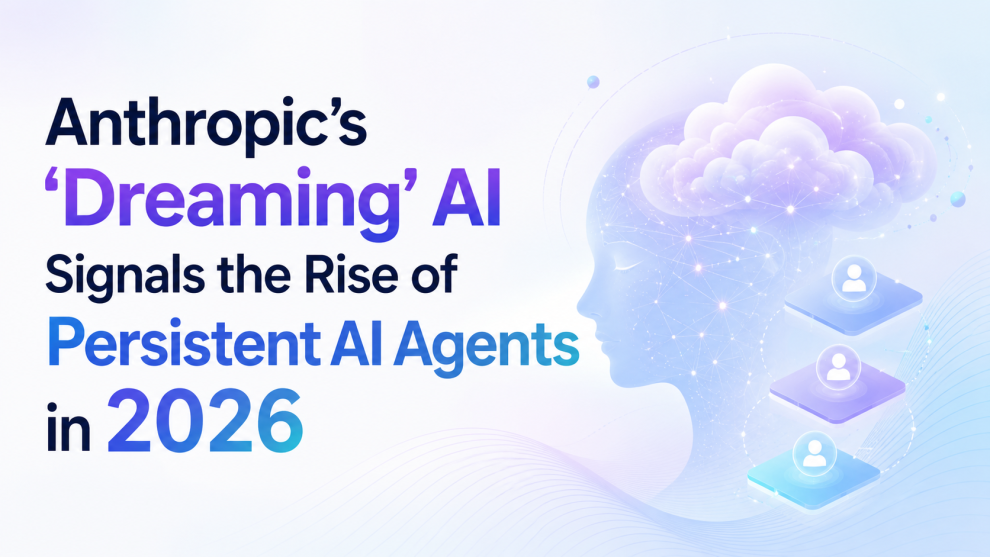
Anthropic’s new “dreaming” capability for Claude Managed Agents signals an important shift in how enterprise AI systems may evolve. The feature allows AI agents to review previous sessions, consolidate memory, identify patterns, and improve future task execution over time.
While the term “dreaming” attracted attention, the larger significance lies in persistent memory and long-horizon operational behavior.
The enterprise AI market is beginning to move beyond stateless interactions toward continuously adapting AI systems.
What Anthropic’s “Dreaming” Capability Actually Changes
Traditional AI assistants typically operate within limited session boundaries. Even advanced enterprise copilots often struggle to retain context between workflows unless additional memory infrastructure is manually implemented.
Anthropic’s “dreaming” capability attempts to address that weakness.
Instead of treating every interaction as isolated, the system periodically reviews previous operational data and identifies information worth retaining for future tasks. The AI system can refine workflows, recognize recurring patterns, and preserve useful organizational context over time.
Operationally, this changes how AI agents behave inside enterprise environments.
Rather than functioning like temporary assistants, persistent agents begin acting more like long-term operational systems that continuously evolve alongside organizational workflows.
This creates several important advantages:
- Improved workflow continuity
- Reduced repetitive prompting
- Better long-term task consistency
- More adaptive operational behavior
- Stronger organizational memory retention
For enterprises managing complex digital operations, these capabilities could significantly improve automation efficiency across distributed teams and long-running processes.
The Operational Limitations of Current Enterprise AI Agents
Most enterprise AI deployments today still operate inside fragmented interaction models.
A support assistant handles one conversation. A coding assistant supports one development task. A workflow agent processes one request. Once the interaction ends, most contextual continuity disappears.
This creates several operational challenges:
- Teams repeatedly retrain systems through prompts
- Context resets reduce workflow consistency
- Long-running projects lose operational continuity
- Human oversight requirements remain high
- AI outputs drift between sessions
These limitations become increasingly problematic as organizations expand AI adoption across departments.
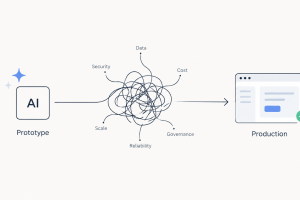
Many enterprises discovered that moving AI pilots into stable production systems requires more than powerful models. Operational persistence, memory retention, and long-horizon reasoning have emerged as major infrastructure challenges.
Persistent AI agents directly target those bottlenecks.
Instead of restarting continuously, persistent systems accumulate organizational understanding over time. An AI agent capable of remembering previous engineering incidents, customer interactions, workflow preferences, or compliance decisions becomes more valuable as it gains operational context.
That fundamentally changes enterprise automation economics.
Why Persistent Memory Changes Enterprise Automation Economics
Traditional automation systems depend heavily on predefined workflows and deterministic rules.
Generative AI introduced flexibility and adaptive reasoning, but most systems still remain operationally forgetful. Persistent AI agents may combine adaptive intelligence with long-term operational continuity.
That combination is strategically important for enterprises.
Organizations operate through accumulated context. Customer history, engineering decisions, compliance records, operational procedures, and institutional knowledge all depend on continuity over time.
Persistent agents allow AI systems to participate in that continuity.
This may create measurable benefits across enterprise environments:
Engineering Operations
AI agents could retain infrastructure history, deployment patterns, recurring incidents, and operational preferences across software delivery workflows.
Customer Experience Systems
Persistent memory may improve support continuity by allowing agents to retain historical interaction context and evolving customer preferences.
Internal Knowledge Management
Organizations may reduce workflow fragmentation by enabling AI systems to preserve institutional knowledge between teams and operational cycles.
Enterprise Automation
Long-running business processes could become more adaptive as AI systems continuously refine workflows instead of restarting with limited context.
As enterprises pursue larger-scale AI adoption, persistent memory may become one of the defining competitive differentiators in enterprise automation platforms.
Infrastructure, Governance, and Compliance Challenges Ahead
The rise of persistent AI agents also introduces significant operational complexity.
Most enterprise AI discussions still focus on model performance, inference costs, and prompt engineering. Persistent systems require a much broader architectural conversation centered around governance, infrastructure reliability, and operational control.
Memory management becomes infrastructure.
Organizations will likely need new operational frameworks for:
- Agent memory versioning
- Context retention policies
- Memory rollback controls
- Auditability of evolving behavior
- Cross-agent synchronization
- Security controls for retained data
These are not theoretical concerns.
Persistent AI systems introduce risks that short-session agents largely avoided. If agents retain organizational context over time, enterprises must ensure that memory systems remain secure, governable, and compliant with regulatory requirements.
Potential risks include:
- Memory corruption
- Context poisoning
- Behavioral drift
- Unauthorized data retention
- Inconsistent decision-making across workflows
This is why AI governance infrastructure is becoming increasingly important in enterprise architecture discussions.
Organizations deploying persistent agents will likely require stronger observability systems, policy-driven controls, and lifecycle management frameworks to ensure operational stability.
How Enterprise Architecture Strategies Will Evolve Around AI Agents
Persistent AI agents may significantly reshape enterprise architecture priorities over the next several years.
AI systems are gradually evolving from isolated productivity tools into operational infrastructure layers embedded within digital platforms and enterprise workflows.
That transition changes how organizations approach architecture design.
Platform engineering teams may eventually manage AI memory systems similarly to distributed infrastructure components such as databases, observability platforms, or Kubernetes environments.
This introduces new architectural priorities:
- Persistent memory infrastructure
- AI observability systems
- Agent lifecycle management
- Governance-driven AI operations
- Distributed memory synchronization
- Operational reliability engineering
Reliability will likely become more important than raw intelligence.
Enterprise systems require predictable operational behavior over long time horizons. AI agents supporting financial analysis, infrastructure operations, compliance workflows, or legal processes cannot gradually drift operationally without creating serious business risk.
As a result, organizations will increasingly prioritize stable, governable AI systems over purely experimental capabilities.
Why Consulting and Platform Engineering Expertise Are Becoming Critical
Persistent AI systems require more than model deployment expertise.
Enterprises now face broader operational questions involving infrastructure governance, system integration, AI observability, memory architecture, security policies, and workflow orchestration.
This is one reason platform engineering and AI consulting expertise are becoming increasingly important in 2026.
Organizations are moving beyond isolated AI experiments toward large-scale operational adoption. That shift requires strategic planning across cloud infrastructure, governance frameworks, distributed systems architecture, and enterprise transformation programs.
Consulting and engineering partners are increasingly helping enterprises:
- Design scalable AI infrastructure
- Build governed AI operational frameworks
- Integrate persistent agents into enterprise systems
- Develop observability and monitoring pipelines
- Reduce operational risk during AI adoption
- Align AI initiatives with long-term digital transformation goals
The enterprise challenge is no longer simply deploying AI assistants. It is building environments where AI systems can persist, adapt, and remain governable at scale.
Closing Perspective
Anthropic’s “dreaming” capability may still appear experimental today, but it signals a broader transition already unfolding across enterprise AI architecture.
The industry is moving toward persistent AI agents capable of maintaining operational continuity across workflows, projects, and organizational systems.
That shift could reshape enterprise automation over the next decade.
Organizations that successfully operationalize persistent AI systems may improve workflow continuity, strengthen knowledge retention, and build more adaptive digital operations. At the same time, they will inherit new governance, infrastructure, and compliance responsibilities that require careful architectural planning.
For enterprise leaders, the conversation is no longer about whether AI can assist isolated tasks.
The more important question is whether organizations are prepared to manage AI systems that continuously evolve operationally over time.
As persistent AI agents become more integrated into enterprise infrastructure, businesses will increasingly require scalable platform engineering strategies, AI governance frameworks, and long-term operational expertise to ensure these systems remain reliable, secure, and effective as enterprise workloads continue evolving.
To learn more about enterprise cloud modernization, platform engineering, and cloud native transformation strategies, visit our homepage !





Add Comment