






For most enterprise teams, the bottleneck in digital growth is no longer engineering capability. It is execution speed. Campaigns take weeks to go live. Landing pages wait in backlog queues. Product experiments get deprioritized behind platform work. By the time something ships, the opportunity has often moved.
AI website builders are starting to change that equation, but not in the way most teams expected. They are not replacing engineering. They are reshaping how digital work gets done.
The teams seeing results are not just building faster pages. They are shortening the distance between idea and revenue.
The Real Opportunity: Speed as a Revenue Lever
In high-scale organizations, even small delays compound. A two-week delay in launching a campaign landing page can mean missed pipeline. A slow iteration cycle reduces conversion optimization opportunities. Engineering dependency inflates the cost of experimentation.
AI website builders compress this cycle dramatically. A growth team can now go from prompt to live experience in hours. But the real value is not speed alone, it is iteration density. More experiments. More variations. Faster learning loops.
According to McKinsey’s recent work on generative AI in marketing and sales, organizations that effectively deploy AI in customer experience workflows can see measurable improvements in conversion rates and content production efficiency. The advantage comes from volume and velocity, not just automation. This is where AI builders create leverage. But only if they are used intentionally.
Why Most Enterprises Still Don’t See Impact
Despite the capability, many organizations struggle to translate AI tools into measurable outcomes. The pattern is familiar:
- Marketing teams generate pages that don’t align with design systems
- Engineering teams reject outputs due to performance or integration gaps
- Compliance teams slow down deployment
- Experiments never scale beyond isolated wins
The result is fragmented adoption.
AI builders become side tools instead of core infrastructure.
From a founder’s perspective, this is where investments quietly lose ROI, not because the tool failed, but because the system around it didn’t adapt.
What High-Performing Teams Are Doing Differently
The teams that are extracting real value are not asking, “How do we use AI builders?” They are asking, “Where does speed directly impact revenue, and how do we unlock it safely?” A pattern is emerging across high-performing digital teams:
They treat AI website builders as front-ends for experimentation, not production endpoints. The workflow looks like this:
- Growth and product teams generate and launch initial experiences rapidly
- Performance data is captured immediately, conversion, engagement, drop-offs
- Winning variants are identified within days, not weeks
- Engineering teams then formalize only what works into scalable components
This flips the traditional model. Instead of building first and validating later, teams validate first and systemize later. The impact is not incremental. It changes how quickly organizations learn.
The Build vs Orchestrate Shift
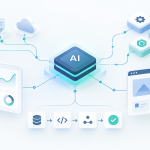
In 2026, the strategic decision is no longer “build vs buy.” It is whether teams can orchestrate multiple layers effectively:
- AI builders for rapid creation
- Design systems for consistency
- Headless CMS for control
- Backend services for logic and data
This orchestration model creates flexibility, but also complexity. Without clear ownership and integration, it leads to duplication and technical debt. With the right structure, it becomes a competitive advantage. The difference lies in execution.
Where External Partners Are Quietly Driving Results
Many enterprise teams reach a point where the constraint is not vision, it is bandwidth and alignment. They know what needs to change, but internal teams are already stretched across priorities. This is where a certain class of partners is becoming relevant, not as vendors, but as accelerators.
- Accenture Song often operates at the intersection of experience design and large-scale transformation, helping enterprises align digital strategy with execution.
- Thoughtworks brings depth in engineering practices, particularly when integrating modern tooling into complex ecosystems.
- GeekyAnts has been increasingly involved in scenarios where frontend velocity and design systems need to evolve together, especially when organizations want to move faster without fragmenting their architecture.
What stands out in these engagements is not tool expertise. It is the ability to define how teams work differently once AI enters the workflow. For founders and digital leaders, this often becomes the real unlock.
A Practical Starting Point (That Shows Results Fast)
The fastest way to evaluate AI website builders is not through a full rollout. It is through a contained, high-impact use case. For example: Pick a revenue-critical flow, such as a campaign landing page series or a product onboarding funnel.
Run a 30-day sprint:
- Use AI builders to generate and launch multiple variants
- Measure conversion and engagement in real time
- Identify top-performing patterns
- Systemize only what proves value
This does two things simultaneously: It delivers immediate business impact. And it creates internal alignment around a new way of working. Most importantly, it reduces risk. The organization learns before it commits.
Why This Moment Matters More Than It Seems
The shift toward AI-driven website creation is not just a tooling upgrade. It is a change in how digital experiences are produced. The organizations that adapt early are not just saving time. They are increasing their rate of learning. And in competitive markets, learning faster often matters more than building better.
The cost of waiting is subtle but real: Slower experimentation cycles. Higher dependency on engineering. Missed opportunities to optimize revenue paths. This is not about falling behind dramatically. It is about losing small advantages repeatedly.
A Different Kind of Conversation
For leadership teams evaluating this space, the most useful discussions are not about tools or features. They are about workflow design:
- Where does speed create measurable business impact?
- What guardrails are actually necessary, and which ones are legacy constraints?
- How should engineering, design, and growth teams collaborate in this new model?
These are not questions most teams can answer in isolation. And increasingly, the organizations moving fastest are the ones willing to explore them collaboratively, often with partners who have seen these patterns play out across different environments.
Not as a large transformation initiative. But as a focused, practical starting point. That is usually where the real shift begins.






Add Comment